Representative David John Lewis
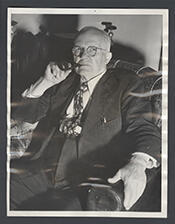
Here you will find contact information for Representative David John Lewis, including email address, phone number, and mailing address.
| Name | David John Lewis |
| Position | Representative |
| State | Maryland |
| District | 6 |
| Party | Democratic |
| Status | Former Representative |
| Term Start | April 4, 1911 |
| Term End | January 3, 1939 |
| Terms Served | 7 |
| Born | May 1, 1869 |
| Gender | Male |
| Bioguide ID | L000277 |
About Representative David John Lewis
David John Lewis (May 1, 1869 – August 12, 1952) was an American politician and lawyer from Maryland who served in the Maryland State Senate and as a Representative from Maryland in the United States Congress from 1911 to 1939. A member of the Democratic Party, he contributed to the legislative process during seven terms in the House of Representatives, participating in the democratic process and representing the interests of his constituents during a significant period in American history.
Lewis was born on May 1, 1869, and grew up in Maryland at a time when the state was still adjusting to the social and economic changes that followed the Civil War. His early life in a largely rural and industrializing region helped shape his later interest in labor issues, social welfare, and economic policy. Coming from modest circumstances, he developed an early appreciation for education and public service, which would guide his professional and political career.
After completing his early schooling, Lewis studied law and was admitted to the bar, beginning the practice of law in Cumberland, Maryland. His legal work brought him into close contact with working people and local businesses, reinforcing his interest in public policy and reform. His growing reputation as an able lawyer and advocate for his community led naturally into elective office at the state level, where he first gained legislative experience and visibility.
Lewis entered public life as a member of the Maryland State Senate, where he served prior to his election to Congress. In the State Senate, he participated in debates over state governance, economic regulation, and social policy, building a record that helped propel him to national office. His work in Annapolis established him as a committed Democrat and a legislator attentive to the needs of his district, particularly in matters affecting labor and industry.
Lewis was first elected to the United States House of Representatives as a Democrat from Maryland, beginning his service in Congress in 1911. Over the course of seven terms in the House, he represented Maryland during an era that encompassed the Progressive Era, World War I, and the early years of the New Deal. As a member of the House of Representatives, he played an active role in the legislative process, working on measures related to tariffs, labor, and social welfare, and consistently advocating for the interests of his constituents.
From April 1917 to March 1925, Lewis served as a member of the United States Tariff Commission, a body created to provide expert analysis and recommendations on tariff policy at a time when trade and protectionism were central issues in national politics. During this period, he also sought higher office, becoming an unsuccessful candidate for the Democratic nomination for the United States Senate in 1922. After his service on the Tariff Commission concluded, he resumed the practice of law in Cumberland, maintaining his engagement with public affairs and the Democratic Party.
Lewis returned to Congress when he was elected to the Seventy-second and to the three succeeding Congresses, representing Maryland’s sixth congressional district from March 4, 1931, to January 3, 1939. His later congressional service coincided with the Great Depression and the New Deal, and he was notably sympathetic to President Franklin D. Roosevelt’s reform agenda. During this time, he was associated with major social legislation, including the development of federal social insurance programs that culminated in the Social Security Act of 1935, a landmark measure in which he played an important legislative role. In 1938, he chose not to be a candidate for renomination to the House, instead making a third bid for the United States Senate by challenging incumbent Senator Millard Tydings in the Democratic primary. Although he had the backing of President Roosevelt and was more supportive of the New Deal than Tydings, his campaign was again unsuccessful.
Following his departure from Congress, Lewis continued his public service at the federal level. From 1939 to 1943, he served as a member of the National Mediation Board, an agency responsible for helping resolve labor disputes in the transportation industry and other critical sectors. In this role, he drew on his long-standing interest in labor relations and economic policy, contributing to the federal government’s efforts to maintain industrial peace during a period that included the early years of World War II.
In his later years, Lewis remained a respected figure in Maryland and within Democratic circles, known for his long record of service in both state and national government and for his advocacy of social and economic reforms. He died in Cumberland, Maryland, on August 12, 1952. David John Lewis was interred in Hillcrest Cemetery, leaving a legacy as a Maryland legislator, congressman, and federal official who helped shape national policy during some of the most transformative decades of the early twentieth century.