Representative David Alexander Nunn
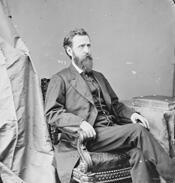
Here you will find contact information for Representative David Alexander Nunn, including email address, phone number, and mailing address.
| Name | David Alexander Nunn |
| Position | Representative |
| State | Tennessee |
| District | 8 |
| Party | Republican |
| Status | Former Representative |
| Term Start | March 4, 1867 |
| Term End | March 3, 1875 |
| Terms Served | 2 |
| Born | July 26, 1833 |
| Gender | Male |
| Bioguide ID | N000170 |
About Representative David Alexander Nunn
David Alexander Nunn (July 26, 1833 – September 11, 1918) was an American politician and lawyer who served as a Representative from Tennessee in the United States Congress from 1867 to 1875. A member of the Republican Party, he represented Tennessee’s 8th congressional district and contributed to the legislative process during two terms in office, participating in the democratic process and representing the interests of his constituents during a significant period in American history.
Nunn was born near Brownsville, in Haywood County, Tennessee, on July 26, 1833, the son of David and Alice Koonce Nunn. He attended local private schools and then pursued higher education at West Tennessee College in Jackson, an institution later associated with what is now Union University. Demonstrating an early interest in the law, he continued his studies at Cumberland University in Lebanon, Tennessee, from which he graduated in 1853. That same year he was admitted to the bar and commenced the practice of law in Brownsville, establishing himself professionally in his home region.
In 1853 Nunn married Mary E. Thompson. The couple had five children: Willie T., David S., Alice Isabella, Charlie, and Cordie L. His family life was rooted in Brownsville, where he combined his legal practice with growing political involvement. After the death of his first wife Mary in 1873, Nunn remarried in 1875, taking Tennessee Whitehead as his second wife. These personal milestones occurred alongside his emerging role in state and national politics.
Nunn’s political career began before the Civil War, reflecting the shifting allegiances of the era. In 1860 he served as a presidential elector on the Constitutional Union ticket, supporting an effort to preserve the Union and avoid sectional conflict. During the Civil War period, his political alignment evolved, and in 1864 he served as a presidential elector on the Republican ticket, signaling his support for the Union cause and the policies of the Republican Party during the conflict and its aftermath.
Elected as a Republican to the Fortieth Congress, Nunn entered the U.S. House of Representatives at the outset of Reconstruction. He served from March 4, 1867, to March 4, 1869, representing Tennessee’s 8th congressional district. During this first term, he participated in the legislative work of a Congress that grappled with the reintegration of the former Confederate states and the redefinition of civil and political rights in the postwar South. In 1868 he ran for re-election as an Independent Republican to the Forty-first Congress but was unsuccessful, temporarily interrupting his congressional service.
Following his initial term in Congress, Nunn was appointed Minister Resident to Ecuador by President Ulysses S. Grant on April 21, 1869. His appointment placed him in the diplomatic service of the United States, but his tenure was brief; he resigned the post on November 2, 1869, and returned to Tennessee. Remaining active in politics, he was again elected to Congress as a Republican, this time to the Forty-third Congress, and served from March 4, 1873, to March 3, 1875. His second term again coincided with the later years of Reconstruction, and he continued to represent the 8th district’s interests in national affairs. He was an unsuccessful candidate for re-election to the Forty-fourth Congress in 1874, concluding his service in the House of Representatives.
After leaving Congress, Nunn remained a prominent figure in Tennessee public life. He served as secretary of state of Tennessee from 1881 to 1885, a key administrative office in which he oversaw various state records and official functions. His federal service resumed when President William McKinley appointed him collector of internal revenue at Nashville, Tennessee, on July 20, 1897. In that capacity he administered federal tax laws in the region until his resignation on November 7, 1902, after which he returned to private life and withdrew from active public office.
David Alexander Nunn spent his later years in Brownsville, the community where he had been born, educated, and first established his legal and political career. He died there on September 11, 1918, at the age of 85 years and 47 days. Nunn was interred at Oakwood Cemetery in Brownsville, Tennessee, closing a long life that spanned the antebellum era, the Civil War, Reconstruction, and the early twentieth century, and that included significant service at both the state and national levels of government.