Senator David Trotter Patterson
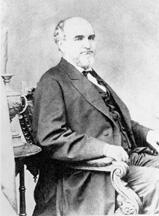
Here you will find contact information for Senator David Trotter Patterson, including email address, phone number, and mailing address.
| Name | David Trotter Patterson |
| Position | Senator |
| State | Tennessee |
| Party | Democratic |
| Status | Former Representative |
| Term Start | January 1, 1866 |
| Term End | March 3, 1869 |
| Terms Served | 1 |
| Born | February 28, 1818 |
| Gender | Male |
| Bioguide ID | P000110 |
About Senator David Trotter Patterson
David Trotter Patterson (February 28, 1818 – November 3, 1891) was a United States Senator from Tennessee at the beginning of the Reconstruction period. A member of the Democratic Party and a staunch Union supporter, as were most of his fellow East Tennesseans, he served one term in the United States Senate from 1865 to 1869, contributing to the legislative process during a significant period in American history. His Senate service coincided with the readmission of Tennessee to the Union and the impeachment trial of his father-in-law, President Andrew Johnson.
Patterson was born at Cedar Creek, near Greeneville, Greene County, Tennessee, on February 28, 1818. He attended the common schools of the area and later studied for two years at Greeneville College, an institution that served many young men of East Tennessee seeking higher education in the early nineteenth century. After leaving college, he read law with a local attorney, following the customary practice of legal apprenticeship of the time to prepare for admission to the bar.
In 1841 Patterson was admitted to the bar and commenced the practice of law in Greeneville. In addition to his legal work, he engaged in manufacturing and acquired substantial amounts of land in East Tennessee, where he grew commodity crops. Like many landowners of his era and region, he owned slaves prior to the Civil War. His growing prominence in the community and legal profession led to his appointment as judge of the first circuit court of Tennessee, a position he held from 1854 to 1863. His judicial service spanned the turbulent years leading up to and including the early period of the Civil War, during which East Tennessee was a center of Unionist sentiment within a seceding state.
On December 13, 1855, Patterson married Martha Johnson, the daughter of Andrew Johnson and Eliza McCardle Johnson. This marriage linked him closely to one of Tennessee’s most prominent political families. The couple had two children: a son, Andrew (1857–1932), and a daughter, Mary (1859–1891). Through his marriage, Patterson became the son-in-law of Andrew Johnson, who served as military governor of Tennessee during the Civil War and later as Vice President and then President of the United States following the assassination of Abraham Lincoln in April 1865.
A committed Unionist from East Tennessee, Patterson emerged as a political figure during the Reconstruction era. When Tennessee became the first former Confederate state to be readmitted to the Union on July 24, 1866, the Tennessee General Assembly elected him to the United States Senate. He presented his credentials to the Senate on July 26, 1866, but they were challenged, and he was not permitted to take the oath of office until July 28. As a Senator from Tennessee in the United States Congress from 1865 to 1869, Patterson participated in the democratic process and represented the interests of his constituents during the critical early years of Reconstruction, when questions of readmission, civil rights, and the redefinition of federal-state relations dominated national politics.
Patterson’s Senate career was deeply affected by the presidency of his father-in-law, Andrew Johnson, who had succeeded to the presidency in 1865. In February 1868 the United States House of Representatives impeached President Johnson, setting the stage for a Senate trial that took place from March to May 1868. Under the Constitution, the Senate was required to sit as a court of impeachment, placing Patterson in a position of acute personal and political conflict. He believed that Johnson was not guilty of the charges brought against him and that the articles of impeachment were contrived for partisan purposes. The Senate ultimately fell one vote short of the two-thirds majority required for conviction, and Johnson remained in office. In the decades following the impeachment, many historians reached a consensus broadly consistent with Patterson’s view that the charges were largely political in nature, though some scholars have continued to disagree.
When his Senate term expired on March 3, 1869, Patterson retired from public life. He chose not to seek further elective office and returned to East Tennessee, where he devoted himself to managing his extensive agricultural and landholding interests. In his later years he remained a figure of local prominence, associated both with the Unionist legacy of East Tennessee and with the extended Johnson family.
David Trotter Patterson died on November 3, 1891, in the small community of Afton, near Greeneville, Tennessee. He was interred with members of the Johnson family in what is now the Andrew Johnson National Cemetery in Greeneville, a site that commemorates the life and career of his father-in-law and serves as the final resting place for several members of the Johnson and Patterson families.