Representative David Lane Powers
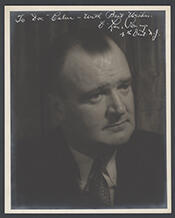
Here you will find contact information for Representative David Lane Powers, including email address, phone number, and mailing address.
| Name | David Lane Powers |
| Position | Representative |
| State | New Jersey |
| District | 4 |
| Party | Republican |
| Status | Former Representative |
| Term Start | March 9, 1933 |
| Term End | January 3, 1947 |
| Terms Served | 7 |
| Born | July 29, 1896 |
| Gender | Male |
| Bioguide ID | P000488 |
About Representative David Lane Powers
David Lane Powers (July 29, 1896 – March 28, 1968) was an American World War I veteran and Republican Party politician who represented New Jersey’s 4th congressional district in the United States House of Representatives for seven terms during a significant period in American history. He served as a Representative from New Jersey in the United States Congress from 1933 to 1947, contributing to the legislative process and participating in the democratic governance of the nation as a member of the House of Representatives.
Powers was born in Philadelphia, Pennsylvania, on July 29, 1896. He attended the public schools of Philadelphia and pursued military education at Pennsylvania Military College in Chester, Pennsylvania, from which he was graduated in 1915. His early training at this institution, which combined academic instruction with military discipline, prepared him for subsequent service in the armed forces during World War I and laid the foundation for his later public career.
With the entry of the United States into World War I, Powers was commissioned a second lieutenant on August 15, 1917. He was later promoted to first lieutenant and served as battalion adjutant in the 807th Pioneer Infantry. In this capacity, he undertook administrative and organizational responsibilities within his unit, contributing to the support and logistical operations essential to the American Expeditionary Forces during the conflict. His wartime service established him as a World War I veteran and provided him with leadership experience that would inform his later political life.
Following the war, Powers moved to Trenton, New Jersey, in 1919 and engaged in the building business. His work in the private sector connected him to the economic and civic life of Trenton and central New Jersey at a time of postwar growth and development. Entering public service at the state level, he served as a member of the New Jersey General Assembly from 1928 to 1930. In the Assembly, he began to build his reputation as a Republican legislator and to develop familiarity with the legislative process that would carry over into his subsequent federal service.
Powers was elected as a Republican to the Seventy-third Congress and to the six succeeding Congresses, representing New Jersey’s 4th congressional district. He served in the United States House of Representatives from March 4, 1933, until his resignation on August 30, 1945. His tenure in Congress thus spanned the Great Depression, the New Deal era, and most of World War II, a period of profound economic, social, and international change. As a member of the Republican Party, he contributed to the legislative process over seven terms in office, participating in debates and votes on domestic recovery, social welfare, wartime mobilization, and postwar planning, and representing the interests of his New Jersey constituents in the national legislature.
On August 30, 1945, Powers resigned from Congress to accept appointment as a member of the New Jersey Public Utilities Commission. In this role, which he held from 1945 until his retirement in 1967, he was involved in the regulation and oversight of public utilities within the state, addressing issues related to rates, service, and infrastructure in sectors such as electricity, gas, transportation, and communications. His more than two decades on the commission extended his public service beyond elective office and allowed him to influence the development and governance of essential public services in New Jersey during the postwar period of suburbanization and economic expansion.
David Lane Powers died in Feasterville, Pennsylvania, on March 28, 1968. He was interred in Riverview Cemetery in Trenton, New Jersey, reflecting his long association with that city and the state he represented in public office.