Representative David G. Reichert
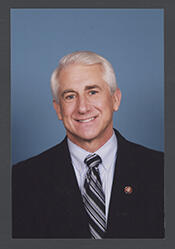
Here you will find contact information for Representative David G. Reichert, including email address, phone number, and mailing address.
| Name | David G. Reichert |
| Position | Representative |
| State | Washington |
| District | 8 |
| Party | Republican |
| Status | Former Representative |
| Term Start | January 4, 2005 |
| Term End | January 3, 2019 |
| Terms Served | 7 |
| Born | August 29, 1950 |
| Gender | Male |
| Bioguide ID | R000578 |
About Representative David G. Reichert
David George Reichert (RY-kərt; born August 29, 1950) is an American retired police officer and politician who served as the U.S. representative for Washington’s 8th congressional district from January 3, 2005, to January 3, 2019. A moderate member of the Republican Party, he previously served as sheriff of King County, Washington, from 1997 to 2005 and earlier spent more than three decades in law enforcement. Over seven terms in Congress, Reichert represented a politically competitive suburban district east of Seattle and contributed to the legislative process during a significant period in American history.
Reichert was born in Detroit Lakes, Minnesota, the son of Marlys Ann (née Troeger) and George F. Reichert. He is the eldest of seven children and a grandson of the town marshal, a family background that exposed him early to public service and law enforcement. In 1951 his family moved to Washington State, initially settling in Renton before relocating to Kent. He attended Kent-Meridian High School in Kent, graduating in 1968. That year he enrolled at Concordia Lutheran College in Portland, Oregon, on a partial football scholarship, and in 1970 he earned an Associate of Arts degree in social work, a field that complemented his later work in public safety and community protection.
In 1971 Reichert joined the Air Force Reserve’s 939th Military Airlift Group. He served on active duty for six months and remained in the Air Force Reserve until 1976. Around the same time, he began his career in law enforcement. Reichert joined the King County Sheriff’s Office (KCSO) in 1972, embarking on what would become a prominent and often high-risk tenure in policing. Early in his law enforcement career, in 1971 during his second year in the field, he responded to a domestic violence call where a knife‑wielding man was attempting to kill his wife. During the confrontation, the assailant attacked Reichert and slit his throat with a butcher knife, requiring surgery and forty‑five stitches. Reichert later recalled that he was able to save the wife during the struggle. For his actions in that incident, he received one of his two Medals of Valor, reflecting his reputation for personal courage in the line of duty.
Reichert gained national attention for his work on the Green River Task Force, formed to investigate a series of murders committed by the so‑called “Green River killer” in King County. As a member of this task force, he worked for years on the complex and high‑profile serial murder investigation. In 1984 he and fellow King County homicide detective Robert Keppel met with incarcerated serial killer Ted Bundy to develop a psychological profile of the Green River killer. In 2001 DNA evidence identified Gary Leon Ridgway as the Green River killer, leading to Ridgway’s arrest and eventual conviction. Reichert later recounted his two‑decade involvement in the case in his 2004 memoir, “Chasing the Devil: My Twenty‑Year Quest to Capture the Green River Killer.” Over the course of his law enforcement career he rose through the ranks of the KCSO and became a recognized leader in Washington’s law enforcement community.
In 1997 King County Executive Ron Sims appointed Reichert sheriff of King County, Washington, placing him in charge of one of the largest local law enforcement agencies in the Pacific Northwest. He was subsequently elected in his own right and, in 2001, ran unopposed for a second four‑year term as sheriff. During his tenure he served as president of the Washington State Sheriffs Association and as an executive board member of the Washington Association of Sheriffs and Police Chiefs. His performance as sheriff earned him significant professional recognition, including the National Sheriffs’ Association’s Sheriff of the Year award in 2004, two valor awards, and the Washington State Attorney General’s award for courageous action. These honors underscored his prominence in law enforcement just as he was preparing to transition to national elective office.
In 2004 Reichert ran for Congress in Washington’s 8th congressional district, a swing district that includes parts of King and Pierce counties. During the Republican primary he declined to participate in a debate after two other candidates aired critical advertisements against him, but he ultimately secured the nomination. In the November 2004 general election he defeated Democratic opponent Dave Ross, a KIRO radio talk show host, by a margin of 52 percent to 47 percent, succeeding retiring Republican Representative Jennifer Dunn. His victory was notable because, in the same election, Democratic presidential nominee Senator John Kerry carried the 8th district over President George W. Bush by 51 percent to 48 percent, making Reichert one of only 17 House Republicans elected in districts that simultaneously voted for the Democratic presidential candidate. His campaign received support from national Republican organizations, including a $20,000 contribution from ARMPAC, the political action committee of then–House Majority Leader Tom DeLay.
Reichert was reelected to the House six times. In 2006 he faced Democratic challenger Darcy Burner and won with 51 percent of the vote. In a 2008 rematch against Burner, he again prevailed, this time with 53 percent of the vote to her 47 percent. In subsequent election cycles he continued to defend his seat in a competitive environment: he was challenged by Democrat Suzan DelBene in 2010, by Democrat Karen Porterfield in 2012—when he won with almost 60 percent of the vote—by Democrat Jason Ritchie in 2014, when he secured approximately 63 percent of the vote, and by Democrat Tony Ventrella in 2016, when he won with about 60 percent of the vote. Throughout his congressional tenure, Reichert was generally regarded as a moderate Republican, reflecting the centrist leanings of his district and often positioning himself as a pragmatic legislator willing to work across the aisle.
During his service in Congress, Reichert served on the influential House Committee on Ways and Means, which has jurisdiction over taxation, trade, and many aspects of federal economic policy. Within that committee he sat on the Subcommittee on Trade and chaired the Subcommittee on Select Revenue Measures, giving him a role in shaping tax legislation and trade policy. He also participated in a variety of caucuses that reflected both regional and policy interests, including the House Baltic Caucus, the Congressional Arts Caucus, the Congressional NextGen 9‑1‑1 Caucus, the Climate Solutions Caucus, and the U.S.–Japan Caucus. These assignments and affiliations underscored his engagement with international relations, public safety communications, environmental issues, and cultural affairs, as well as his interest in strengthening ties with key U.S. allies.
In September 2017 Reichert announced that he would retire from Congress at the end of his seventh term and not seek reelection in 2018. He left office on January 3, 2019, concluding fourteen years in the House of Representatives. After departing Congress, he remained active in public affairs and Republican politics in Washington State. In 2024 he ran for governor of Washington as the Republican nominee but was unsuccessful, losing to Democrat Bob Ferguson. Reichert’s career, spanning military reserve service, decades in local law enforcement, leadership as sheriff, and seven terms in Congress, has made him a prominent figure in the recent political and law enforcement history of Washington State.