Senator David Turpie
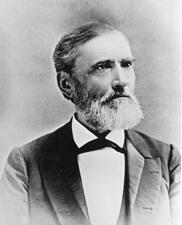
Here you will find contact information for Senator David Turpie, including email address, phone number, and mailing address.
| Name | David Turpie |
| Position | Senator |
| State | Indiana |
| Party | Democratic |
| Status | Former Representative |
| Term Start | December 7, 1863 |
| Term End | March 3, 1899 |
| Terms Served | 3 |
| Born | July 8, 1828 |
| Gender | Male |
| Bioguide ID | T000432 |
About Senator David Turpie
David Battle Turpie (July 8, 1828 – April 21, 1909) was an American politician and lawyer who served as a United States Senator from Indiana during three separate terms of service, most notably from 1887 until 1899. A lifelong member of the Democratic Party, he played a prominent role in the Senate’s deliberations in the late nineteenth century and served as Chairman of the Senate Democratic Caucus from 1898 to 1899 during the last year of his tenure in the chamber. Over the course of his career, Turpie contributed to the legislative process during a significant period in American history, representing the interests of his Indiana constituents and participating actively in the democratic process.
Turpie was born in Hamilton County, Ohio, on July 8, 1828, the son of John Turpie and Mary Biddle Turpie. His mother, Mary, was a native of Scotland, and he spent his early years in Ohio. He pursued higher education at Kenyon College in Gambier, Ohio, from which he graduated in 1848. After college he studied law, gaining admission to the bar, and moved to Logansport, Indiana, where he established a law practice. In Logansport he quickly became active in the Democratic Party, to which he would remain devoted for the rest of his life, and began to build the legal and political reputation that would carry him into public office.
Turpie entered public life at a relatively young age. In 1852, at the age of twenty-four, he was elected to the Indiana state legislature, serving one term before returning to his legal practice. His judicial career began soon thereafter: in 1854 he became a judge of the court of common pleas, and in 1856 he advanced to the position of state circuit court judge. He returned again to the Indiana legislature in 1858, serving another one-year term. By the early 1860s he was a well-known Democratic figure in the state. In 1862 he was the Democratic candidate for the U.S. House of Representatives from the district then represented by Schuyler Colfax, losing the race by a narrow margin but solidifying his status as a leading party figure in Indiana.
Turpie’s first service in the United States Senate came during the Civil War. Shortly after his 1862 House campaign, he was elected by the Indiana legislature to the U.S. Senate to fill the unexpired term of Senator Jesse D. Bright, who had been expelled for alleged disloyalty. Turpie’s initial tenure in the Senate was brief—he served for just under two months, until the arrival of the regularly elected senator, Thomas A. Hendricks, who took the seat. Although short, this early Senate service marked the beginning of Turpie’s long association with the national legislature, which would later extend, in total, from 1863 to 1899 when his nonconsecutive terms are considered.
After this first period in national office, Turpie resumed his legal and political activities in Indiana. In 1872 he moved to Indianapolis, the state capital, where he continued to practice law and remained influential in Democratic politics. He was again elected to the Indiana state legislature and rose to a position of leadership as speaker of the Indiana House of Representatives from 1874 to 1875. His legal expertise and party loyalty led to his appointment as United States District Attorney for Indiana, a post he held from 1886 to 1887, further enhancing his standing as one of the state’s leading Democratic lawyers and public servants.
In 1887 Turpie returned to the United States Senate from Indiana, this time elected to a full term by the state legislature. In that contest he defeated Republican Benjamin Harrison, who would soon afterward be elected President of the United States. Turpie’s return to the Senate after an interval of 24 years and 1 day marked one of the longest gaps in service in the history of the chamber, ranking as the third longest such hiatus. He was reelected in 1893, and in this extended period of service he sat in the Senate from 1887 to 1899. During these twelve years he emerged as an influential Democratic voice. He served as chairman of the Committee on the Census from 1893 to 1895, and from 1898 to 1899 he was chairman of the Senate Democratic Caucus (often referred to as the Democratic Conference), reflecting the confidence his colleagues placed in his judgment and leadership. On major issues of the day, he was known, among other positions, for supporting a plebiscite on the question of annexation for the people of Hawaii, favoring a popular vote rather than forced annexation by the United States. His long Senate career, spanning three terms in office and occurring during a transformative era in American politics and expansion, made him a significant figure in Indiana’s congressional history. He was ultimately defeated for reelection by Republican Albert J. Beveridge in 1899, bringing his Senate service to a close.
Turpie was widely regarded as a scholarly orator and a careful guardian of senatorial decorum. Journalist and historian Claude G. Bowers later described him as a speaker of “classic English” and a scrupulous upholder of the traditions of the Senate. Bowers also recounted an anecdote illustrating Turpie’s dry wit and capacity for gentle satire: when Henry Cabot Lodge entered the Senate with what some colleagues perceived as a somewhat pretentious manner, Turpie, known as a master of satire, was informally assigned the task of “hazing” the new senator, a task he was said to have carried out with characteristic subtlety and elegance. Such recollections contributed to his reputation as both a serious legislator and a figure of quiet, understated humor.
After his defeat in 1899, Turpie retired from public life and returned to private pursuits in Indianapolis. He remained out of elective office for the rest of his life, living in the city where he had long practiced law and participated in Democratic politics. David Battle Turpie died in Indianapolis, Indiana, on April 21, 1909. His papers and related materials, including the David Turpie collection held in the Rare Books and Manuscripts division of the Indiana State Library, preserve the record of a career that linked state and national politics over more than half a century.