Representative Dean A. Gallo
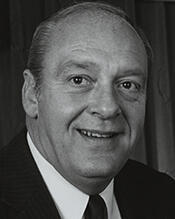
Here you will find contact information for Representative Dean A. Gallo, including email address, phone number, and mailing address.
| Name | Dean A. Gallo |
| Position | Representative |
| State | New Jersey |
| District | 11 |
| Party | Republican |
| Status | Former Representative |
| Term Start | January 3, 1985 |
| Term End | January 3, 1995 |
| Terms Served | 5 |
| Born | November 23, 1935 |
| Gender | Male |
| Bioguide ID | G000025 |
About Representative Dean A. Gallo
Dean Anderson Gallo (November 23, 1935 – November 6, 1994) was an American politician and businessman who served as a member of the United States House of Representatives, representing New Jersey’s 11th congressional district from 1985 until his death from prostate cancer in Denville Township, New Jersey, in 1994. A member of the Republican Party, he contributed to the legislative process during five terms in office and participated actively in the democratic process on behalf of his constituents during a significant period in American history.
Gallo was born in Hackensack, New Jersey, the son of Dean and Selma Gallo. He grew up in Boonton, New Jersey, and attended public schools in Parsippany–Troy Hills. He graduated from Boonton High School in 1954. His early life in Morris County communities would later shape his political base and inform his understanding of the suburban and small-town concerns that became central to his public career.
After high school, Gallo embarked on a career in real estate, becoming a realtor and real estate developer. He was an owner of Gallo & DeCroce, a real estate firm he founded with Alex DeCroce, who would also go on to a prominent career in New Jersey politics. Through this business, Gallo became well known in Morris County, developing relationships in both the business community and local civic life that laid the groundwork for his entry into elective office.
Gallo’s political career began at the local level in Parsippany–Troy Hills. He was elected to the Parsippany–Troy Hills Township Council in 1967 and quickly rose to a leadership role, serving as council president from 1968 to 1971. In 1971 he was elected to the Morris County Board of Freeholders to fill an unexpired term and then won a full three-year term in 1972. He served as freeholder director from 1973 to 1975, overseeing county government during a period of growth and suburban development. In 1974, when long-serving Representative Peter Frelinghuysen Sr. retired from New Jersey’s 5th congressional district, Gallo considered seeking the Republican nomination for the open seat, which then included all of Somerset County and parts of Essex, Mercer, and Morris counties, including his hometown of Parsippany. He ultimately chose not to run and instead endorsed Assembly Minority Leader Thomas Kean, who narrowly lost the Republican primary to Millicent Fenwick.
In 1975, Gallo sought state legislative office as a candidate for the New Jersey General Assembly from the 24th Legislative District, which then included part of Morris County and the city of Summit in Union County. He won the Republican primary by more than a two-to-one margin against four opponents—W. Thomas Tintle, Gerard R. Hughes, Jack Newberger, and Raymond F. Bonnell. In the general election, he defeated two-term Democratic Assemblyman John J. Sinsimer by 6,605 votes, 26,277 to 19,672. Gallo faced Sinsimer again in 1977 and expanded his margin of victory to 15,505 votes, winning 33,306 to 17,801. He was re-elected by similarly comfortable margins in 1979, 1981, and 1983. Within the Assembly, Gallo advanced into the Republican leadership, being elected Assembly Minority Leader in 1981 and re-elected to a second term in that position in 1983, which enhanced his profile as a statewide political figure.
Gallo’s transition to national office came in the wake of a major redistricting following the 1980 United States census. In 1984, New Jersey’s congressional map was thrown out by a federal court on the grounds that population variations among districts were too large. A panel of federal judges imposed a new map that significantly altered the 11th Congressional District, then represented by eleven-term Democrat Joseph Minish. The redrawn district removed many Democratic-leaning municipalities in Essex, Hudson, southern Bergen, and Passaic counties and extended the district westward to include all of heavily Republican Morris County, as well as several Republican areas in Sussex and Warren counties, while retaining the more Republican sections of Essex County. The new configuration placed Gallo’s home in Parsippany within the 11th District and transformed it into one of the most Republican-leaning districts in the Northeast. Gallo immediately entered the race. Although Minish considered running in another district, he ultimately chose to seek re-election in the reconfigured 11th and faced difficult odds. In the 1984 general election, aided in part by President Ronald Reagan’s landslide re-election campaign, Gallo defeated Minish by 27,624 votes, receiving 133,662 votes (56 percent) to Minish’s 106,038 votes (44 percent). His campaign was managed by Assemblyman Bob Franks, who would later serve in Congress himself.
Dean Anderson Gallo served in the United States House of Representatives from January 3, 1985, until his death on November 6, 1994, representing New Jersey’s 11th congressional district for five consecutive terms. As a member of the House, he represented one of the most reliably Republican districts in the region and was consistently re-elected with relative ease in 1986, 1988, 1990, and 1992. During his tenure, he served on the influential House Appropriations Committee, which oversees federal spending, and he joined the House Republican leadership as a Deputy Minority Whip, helping to coordinate party strategy and votes. His decade in Congress coincided with the final years of the Reagan administration, the presidency of George H. W. Bush, and the early years of the Clinton administration, a period marked by debates over federal spending, defense, and domestic policy in which he participated as part of the Republican caucus.
In 1992, Gallo was treated for prostate cancer, and the disease returned in 1994. Despite his illness, he sought re-nomination that year and faced a primary challenge from Dr. Joseph Pennacchio, a more conservative Republican who spent over $200,000 of his own money attacking Gallo. In a four-candidate race, Gallo prevailed decisively, winning 26,492 votes (65.28 percent) to Pennacchio’s 10,917 votes (26.90 percent). As his health declined, however, Gallo withdrew as a candidate for re-election on August 29, 1994. He died of prostate cancer on November 6, 1994, at age 58, in Denville Township, New Jersey. Assemblyman Rodney Frelinghuysen was selected to replace Gallo on the ballot and was elected to succeed him in Congress two days after Gallo’s death. In recognition of his battle with cancer and his public service, the Dean and Betty Gallo Prostate Cancer Center at the Cancer Institute of New Jersey was named in his honor.