Senator Dean Heller
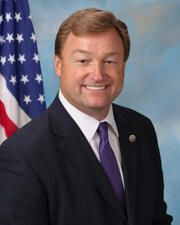
Here you will find contact information for Senator Dean Heller, including email address, phone number, and mailing address.
| Name | Dean Heller |
| Position | Senator |
| State | Nevada |
| Party | Republican |
| Status | Former Representative |
| Term Start | January 4, 2007 |
| Term End | January 3, 2019 |
| Terms Served | 7 |
| Born | May 10, 1960 |
| Gender | Male |
| Bioguide ID | H001041 |
About Senator Dean Heller
Dean Arthur Heller (born May 10, 1960) is an American businessman and politician who served in the United States Congress from 2007 to 2019, including as a United States senator representing Nevada from May 9, 2011, to January 3, 2019. A member of the Republican Party, he previously served as the 15th secretary of state of Nevada from 1995 to 2007 and as U.S. representative for Nevada’s 2nd congressional district from 2007 to 2011. Over five terms in Congress, Heller contributed to the legislative process during a significant period in American history, participating in the democratic process and representing the interests of his Nevada constituents. As of 2025, he is the last Republican to have won a U.S. Senate race in Nevada.
Heller was born in Castro Valley, California, to Janet (née MacNelly) and Charles Alfred “Jack” Heller, a mechanic and stock car driver. When he was nine months old, his family moved to Carson City, Nevada, where he was raised alongside five siblings. Growing up in the state capital, he developed early ties to Nevada’s political and civic life. He attended local schools and graduated from Carson High School in 1978. Heller was accepted into the University of Southern California, where he studied business and finance. In 1985 he earned a Bachelor of Business Administration degree, specializing in finance and securities analysis, from the USC Marshall School of Business. While at USC, he joined the Sigma Nu social fraternity and the Trojan Knights, reflecting an active engagement in campus life.
After college, Heller entered the private sector, working in finance and banking. He became a senior commercial banking consultant for Bank of America, a position he held from 1990 to 1995. His professional experience in banking and securities analysis informed his later work on economic and fiscal issues in public office. Heller’s early career combined private-sector financial expertise with growing involvement in Nevada politics, setting the stage for his subsequent legislative and statewide service.
Heller’s formal political career began in the Nevada Assembly, where he served two terms from 1990 to 1994, representing Carson City. In the Assembly, he gained experience in state-level policymaking during a period of population growth and economic diversification in Nevada. In 1994 he successfully ran for secretary of state of Nevada and took office in 1995. He was reelected in 1998 and 2002, serving as secretary of state until 2007. In that role, Heller oversaw elections and business filings and became known for election administration reforms. Under his leadership, Nevada became the first state in the nation to implement an auditable paper trail for electronic voting machines, a measure intended to enhance the integrity and verifiability of election results.
In 2005, after ten-term Republican Representative Jim Gibbons decided to run for governor, Heller announced his candidacy for Nevada’s 2nd congressional district. He won a competitive Republican primary on August 15, 2006, with 36 percent of the vote, narrowly defeating State Assemblywoman Sharron Angle by 421 votes; Angle received 35 percent, and former state Assemblywoman Dawn Gibbons, the incumbent’s wife, received 25 percent. In the November 2006 general election, Heller defeated Democratic nominee and University of Nevada Regent Jill Derby by a margin of 49 percent to 46 percent. Derby carried Washoe County, home to Reno and the largest county in the district, but Heller amassed sufficient margins in the rest of the largely rural district to prevail, aided in part by Jim Gibbons’s strong performance at the top of the ticket in his successful gubernatorial race. It was only the third close race in the district since its creation in 1983.
Heller was reelected to the House in 2008 and 2010. In the 2008 Republican primary, he defeated James W. Smack by a margin of 86 percent to 14 percent, and in a rematch of the 2006 general election, he again defeated Jill Derby, this time by 52 percent to 41 percent, winning every county in the district except Clark County. In 2010 he faced another primary challenge, defeating Patrick J. Colletti 84 percent to 16 percent, and then won a third term in the general election, defeating Democrat Nancy Price 63 percent to 36 percent. During his tenure in the House of Representatives from 2007 to 2011, Heller served as vice chairman of the Congressional Western Caucus, playing a leading role in advocating for issues affecting western states, including public lands, natural resources, and rural economic development. He opposed the Troubled Asset Relief Program (TARP) during the financial crisis, reflecting his skepticism of large-scale federal bailouts. Heller also served on the House Committee on Ways and Means, including the Subcommittee on Income Security and Family Support and the Subcommittee on Select Revenue Measures, where he worked on tax and social policy issues.
In March 2011, following the announcement that U.S. Senator John Ensign would resign amid an ethics investigation, Heller declared that he would run for the United States Senate in 2012 to succeed him. Nevada Governor Brian Sandoval appointed Heller to the U.S. Senate to fill the vacancy created by Ensign’s resignation, and Heller took office on May 9, 2011. In the 2012 general election, he sought a full term and faced Democratic U.S. Representative Shelley Berkley of Nevada’s 1st congressional district. In a closely contested race, Heller defeated Berkley with 45.9 percent of the vote to her 44.7 percent. During his Senate service, he continued to focus on fiscal policy, public lands, veterans’ issues, and regulatory matters important to Nevada’s gaming, tourism, and mining industries. On May 23, 2013, he introduced S. 1049, the Senate companion to the Good Samaritan Search and Recovery Act of 2013 (H.R. 2166), sponsored in the House by Nevada Representative Joe Heck. The legislation sought to require the federal government to issue permits within 48 hours to volunteer search and rescue groups to allow them to search federal lands for missing persons. Heller argued that “the last thing families who have lost loved ones need is the federal government to stand in the way of recovering their remains.” Later that year, in October 2013, he was one of 18 senators who voted against the bill to reopen the federal government following the United States government shutdown of 2013, stating that the agreement did not make structural fiscal changes or place the nation on sound long-term economic footing. In 2014 he campaigned to be elected chairman of the National Republican Senatorial Committee for the 114th Congress but was defeated by Senator Roger Wicker of Mississippi on November 13, 2014.
Heller’s 2018 reelection campaign unfolded against a shifting political landscape in Nevada and nationally. In August 2017, Las Vegas businessman Danny Tarkanian, a strong supporter of President Donald Trump, announced a Republican primary challenge, criticizing Heller for not fully supporting Trump’s “America First” agenda and calling for the repeal of the Affordable Care Act and stricter immigration enforcement. By September 2017, national media described Heller as one of the most endangered senators facing reelection in the 2018 midterm cycle, noting substantial opposition from conservatives within his own party and a general electorate in Nevada that was trending more Democratic, as well as his complicated relationship with President Trump. On February 1, 2018, Trump told Republican National Committee members that he would travel to Nevada to campaign for Heller in a competitive primary. In March 2018, Trump persuaded Tarkanian to drop his primary challenge; Tarkanian instead ran for the U.S. House in Nevada’s 3rd congressional district, with Trump’s support, as incumbent Democrat Jacky Rosen left that seat to run against Heller for the Senate. In the November 2018 general election, Heller was defeated by Rosen, who received 50 percent of the vote to Heller’s 45 percent, with third-party candidates receiving the remaining 5 percent. Although Heller carried 15 of Nevada’s 17 county-level jurisdictions, Rosen won the state by carrying the two largest counties, Clark (home to Las Vegas) and Washoe (home to Reno), and Heller was unable to overcome a deficit of approximately 92,000 votes in Clark County.
After leaving the Senate in January 2019, Heller remained active in Republican politics in Nevada. In 2022 he sought a return to statewide office as a candidate for governor of Nevada. Running in a crowded Republican primary, he was ultimately unsuccessful in securing the party’s nomination. Nonetheless, his career—spanning service in the Nevada Assembly, more than a decade as Nevada’s secretary of state, and twelve years in the U.S. House of Representatives and U.S. Senate—has made him a prominent figure in the modern political history of Nevada and the Republican Party in the state.