Representative Deborah L. Halvorson
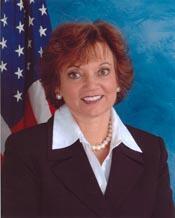
Here you will find contact information for Representative Deborah L. Halvorson, including email address, phone number, and mailing address.
| Name | Deborah L. Halvorson |
| Position | Representative |
| State | Illinois |
| District | 11 |
| Party | Democratic |
| Status | Former Representative |
| Term Start | January 6, 2009 |
| Term End | January 3, 2011 |
| Terms Served | 1 |
| Born | March 1, 1958 |
| Gender | Female |
| Bioguide ID | H001044 |
About Representative Deborah L. Halvorson
Deborah L. Halvorson (born March 1, 1958) is an American politician and member of the Democratic Party who represented Illinois’s 11th congressional district in the U.S. House of Representatives from January 3, 2009, to January 3, 2011. Her single term in Congress followed a lengthy career in state and local government, including service in the Illinois Senate from 1997 through 2009, where she rose to become the first female Majority Leader of that body. Over the course of her public life, she has been particularly associated with issues of economic development, transportation, agriculture, veterans’ affairs, and public health.
Halvorson grew up in Steger, Illinois, a south suburban community of Chicago, and graduated from Bloom High School. Before entering politics, she spent 13 years working as a cosmetics saleswoman for Mary Kay, an experience that introduced her to sales, small business concerns, and grassroots organizing. She pursued higher education while working and raising a family, earning degrees from Robert Morris College and Prairie State College, and later completing both a Bachelor of Arts and a master’s degree in communication at Governors State University. She subsequently became a sales representative, served as Crete Township Clerk, and worked as an educator at Governors State University, building a profile in local government and community affairs. Halvorson and her husband, Jim Bush, reside in Crete, Illinois, and have four children and four grandchildren.
Halvorson’s formal political career began in state government when she ran for the Illinois State Senate in the November 1996 general election. She defeated incumbent Republican State Senator Aldo DeAngelis by a margin of 56 percent to 44 percent in the 40th Senate District, a largely south suburban and exurban area. She was reelected to a second term in 1998, defeating Republican State Representative Flora Ciarlo with 66 percent of the vote to Ciarlo’s 34 percent. In 2002, Halvorson secured a third term without opposition, and in 2006 she won a fourth term with 70 percent of the vote, reflecting her strong electoral position in the district.
During her tenure in the Illinois Senate from 1997 through 2009, Halvorson advanced steadily through the Democratic leadership ranks. In 2005 she became the first female Majority Leader of the Illinois State Senate, a milestone in the state’s political history. She served on a wide range of committees and task forces, including the Senate Committee of the Whole, the Senate Committee on Agriculture & Conservation, and the Senate Committee on Transportation. She chaired both the Senate Subcommittee on Airports and the Senate Subcommittee on Tollways, and also served on the Subcommittee on Railroad Safety and the Senate Taskforce on Alcoholic Beverages. After being diagnosed as at high risk for cervical cancer due to HPV, she gained particular attention—both support and controversy—for creating a program intended to broaden access to HPV testing and vaccination. She also became involved in a public dispute with U.S. Representative Jesse Jackson Jr. over the proposed Peotone airport, a project located outside Jackson’s district; Jackson responded by attempting to tie Halvorson politically to businessman and fundraiser Tony Rezko. As she prepared to leave the state legislature following her election to Congress, an ongoing process narrowed the field of candidates to succeed her in the Senate, and she was ultimately replaced by Toi Hutchinson. Just before Halvorson was set to officially resign her seat, Governor Rod Blagojevich was arrested on federal corruption charges; Halvorson publicly called for his resignation, stating that although she was frustrated and disappointed, she was not surprised by the developments.
Halvorson’s move to national office came after Republican U.S. Representative Jerry Weller announced in September 2007 that he would not seek another term in Illinois’s 11th congressional district, citing a desire to spend more time with his family. On October 2, 2007, Halvorson declared her candidacy for the open seat. She quickly attracted national Democratic support, including an endorsement from EMILY’s List in November 2007. The Republican field shifted when the initial GOP nominee, New Lenox Mayor Tim Baldermann, withdrew from the race in February 2008, citing other obligations; he was replaced by businessman Marty Ozinga. In the November 2008 general election, Halvorson won decisively with 58 percent of the vote to Ozinga’s 34 percent, securing her first term in the U.S. House of Representatives. (Ozinga’s son, Tim Ozinga, would later be elected to the Illinois House of Representatives in 2020.)
As a member of the 111th Congress, Halvorson represented Illinois’s 11th district during a period marked by the aftermath of the 2008 financial crisis and major legislative initiatives on economic recovery and health care. She was appointed to the House Democratic Steering and Policy Committee, a key internal body that helps shape the party’s legislative agenda and committee assignments. Her committee work reflected her longstanding interests: she served on the Committee on Agriculture, including the Subcommittee on Conservation, Credit, Energy, and Research and the Subcommittee on General Farm Commodities and Risk Management; the Committee on Small Business, including the Subcommittee on Finance and Tax and the Subcommittee on Contracting and Technology; and the Committee on Veterans’ Affairs, including the Subcommittee on Disability Assistance and Memorial Affairs. Halvorson identified economic development and transportation as among her “true loves” in public policy and emphasized constituent services as one of her main focuses in office. In key roll-call votes, she supported the 2009 Economic Stimulus Act, cap-and-trade legislation on emissions, and the federal health care bill that became the Affordable Care Act.
In the 2010 midterm elections, Halvorson sought a second term but faced a challenging political environment for Democrats nationwide. She was defeated by Republican nominee Adam Kinzinger, who won 58 percent of the vote to her 42 percent. Despite her landslide victory two years earlier, this represented the fifth-largest margin of defeat for a Democratic House incumbent in the 2010 cycle. Her loss ended her service in Congress after one term, from 2009 to 2011, during which she had participated in the legislative process at a time of significant national economic and political change and represented the interests of her constituents in the 11th district.
Following her departure from Congress, Halvorson remained active in electoral politics. In September 2011 she filed candidacy papers with the Federal Election Commission to run in the newly redistricted Illinois 2nd congressional district, challenging incumbent Democrat Jesse Jackson Jr. She argued that Jackson was disconnected from the district, stating that he lived in Washington, D.C., did not regularly return home on weekends, and sent his children to school in the capital. Halvorson contended that Jackson and his allies “should be fearing me becoming a congresswoman” because she represented the people of the then-current 11th district and that he was “nervous that I’m going to become a congresswoman because then his control is over.” The newly drawn 2nd district was approximately 54 percent African American. In the March 2012 Democratic primary, Jackson defeated Halvorson by a margin of 71 percent to 29 percent.
After Jackson resigned from Congress on November 21, 2012, Halvorson again sought a return to the U.S. House. She announced her candidacy on November 26, 2012, for the 2013 special election to fill the vacancy in Illinois’s 2nd congressional district. In the February 26, 2013 Democratic primary, however, she lost to former state representative Robin Kelly. Although she did not return to elective office, Halvorson’s career has encompassed local, state, and federal service, and her tenure has been noted for her leadership role in the Illinois Senate, her advocacy on public health and transportation issues, and her participation in some of the major legislative debates of the early twenty-first century as a member of the U.S. House of Representatives.