Representative Deborah Pryce
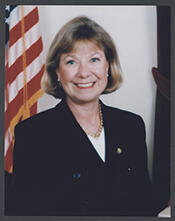
Here you will find contact information for Representative Deborah Pryce, including email address, phone number, and mailing address.
| Name | Deborah Pryce |
| Position | Representative |
| State | Ohio |
| District | 15 |
| Party | Republican |
| Status | Former Representative |
| Term Start | January 5, 1993 |
| Term End | January 3, 2009 |
| Terms Served | 8 |
| Born | July 29, 1951 |
| Gender | Female |
| Bioguide ID | P000555 |
About Representative Deborah Pryce
Deborah Denine Pryce (born July 29, 1951) is an American lawyer, jurist, and Republican politician from Ohio who represented Ohio’s 15th congressional district in the United States House of Representatives from January 3, 1993, to January 3, 2009. Her district included the western half of Columbus and the surrounding suburbs, and she served eight consecutive terms in Congress during a period of significant political and historical change in the United States.
Pryce was born in Warren, Ohio, and later attended The Ohio State University in Columbus. She graduated from Ohio State in 1973, where she was a member of the Alpha Xi Delta sorority. Pursuing a legal career, she enrolled at Capital University Law School, also in Columbus, and received her law degree in 1976. Her legal education laid the foundation for a professional path that combined law, municipal administration, and ultimately elective office at both the judicial and federal legislative levels.
Immediately after completing law school, Pryce began her career in public service as an administrative law judge for the Ohio State Department of Insurance, serving from 1976 to 1978. She then joined the city government of Columbus, Ohio, where from 1978 to 1985 she held a series of positions of increasing responsibility. She first worked as an assistant city prosecutor, then as a senior assistant city attorney, and later as an assistant city manager. In these roles she gained experience in municipal law, city administration, and public policy implementation in a large and growing urban center.
In 1985, Pryce was elected to the Franklin County Municipal Court, where she served as a judge until 1992. Over the course of her judicial tenure she rose to become presiding judge of the court. Her service on the bench enhanced her profile in central Ohio and provided her with extensive experience in the administration of justice, which would later inform her work as a legislator. By the early 1990s, she transitioned from the judiciary to electoral politics at the federal level.
Pryce was first elected to the U.S. House of Representatives in November 1992, winning a three-way race in which an independent conservative, pro-life candidate, Linda Reidelbach, received almost 20 percent of the vote while Pryce secured slightly more than 45 percent. A member of the Republican Party, she contributed to the legislative process during eight terms in office and participated actively in the democratic process on behalf of her constituents in the 15th district. Between 1994 and 2002, she was reelected with at least two-thirds of the vote in each election. In the 2004 Republican primary she defeated Charles R. Morrison II by 84 percent to 16 percent, and in the general election that year she won 62 percent of the vote against Democrat Mark P. Brown, whom she had also defeated in the 2002 general election.
Within the House Republican Conference, Pryce rose to a prominent leadership role. Until the election of 2006, she served as Chair of the House Republican Conference, the fourth-highest Republican leadership position in the House of Representatives, a post previously held by figures such as J. C. Watts, Dick Cheney, and Jack Kemp. She also served as a deputy Republican whip, helping to marshal party support for key legislative initiatives. Over the course of her congressional career, she served on the House Committee on Financial Services and became the ranking minority member of its Capital Markets, Insurance, and Government-Sponsored Enterprises Subcommittee. She returned to the Financial Services Committee after spending ten years on the influential House Rules Committee, which oversees the terms of debate and consideration for most legislation on the House floor.
Ideologically, Pryce was generally regarded as a fiscally and socially conservative Republican, yet she was also associated with several center-right and moderate Republican organizations. She was a member of the Republican Main Street Partnership, Republicans For Environmental Protection, the Republican Majority For Choice, Republicans for Choice, and The WISH List, a pro-choice women’s political group. Reflecting her stance on reproductive rights, she opposed a complete ban on abortion and stated that “the Government should not interfere in decisions a woman makes about her pregnancy.” Her voting record on environmental issues drew criticism from some advocacy groups; the League of Conservation Voters (LCV) placed her on its “Dirty Dozen” list of what it considered environmentally irresponsible federal officeholders, giving her a score of 13 out of 100 for 2006 and 16 out of 100 for her career. LCV also criticized her for accepting more than $90,000 in campaign contributions from oil and gas interests and for voting in line with energy industry priorities, though she also supported measures such as elevating the Environmental Protection Agency to cabinet status, expediting certain forest-thinning projects, and de-authorizing some “critical habitat” designations under the Endangered Species Act.
Pryce’s later congressional terms were marked by the national debates over the Iraq War and shifting partisan dynamics in the House. She voted in favor of authorizing the use of force in Iraq and, when questioned about the war during a 2006 CNN interview, ended the interview by walking away. In a subsequent statement to CNN she said, “What’s happening in Iraq is not a direct reflection on me,” and added that while she was not always satisfied with developments in Iraq, she believed “nothing [would be] worse for our troops or our prospects for success than having 435 members of Congress second-guessing our commanders.” During the 2006 campaign she reiterated on CNN radio that “What’s happening in Iraq is not a direct reflection on me.” After narrowly winning reelection that year, she stepped down from her leadership post and, according to contemporaneous reporting, increasingly voted with the new Democratic majority on several major bills and rule changes in early 2007, even opposing her party on at least one procedural vote. However, on Iraq policy in 2007 she remained aligned with Republican leadership, supporting Ohio Republican John Boehner’s H.R. 1062, a measure requiring the president to submit status reports to Congress every 30 days on the progress of the troop surge and Iraqi government cooperation, and establishing a bipartisan panel to study proposals for U.S. policy and strategy in Iraq.
Pryce’s 2006 reelection campaign against Democratic Franklin County Commissioner Mary Jo Kilroy drew national attention as one of the most competitive House races in the country. The 15th district, historically the more Republican of the two districts dividing Columbus, had become more politically balanced following the 2000 redistricting, and the race was widely rated a toss-up amid a strong anti-Republican climate in Ohio. Pryce emphasized her success in securing federal funding for local projects, including millions of dollars for environmental, infrastructure, and health research initiatives in the Columbus area, which were cited in national press coverage as examples of the use of earmarks in competitive districts. Two debates between Pryce and Kilroy were held on September 18 and October 12, 2006, at which they addressed the Iraq War, the war on terror, taxes, Social Security, the federal deficit, and President George W. Bush’s policies. The second debate, held at The Ohio State University’s Fawcett Center before an audience of about 400 people and reporters from as far away as Ireland, was notably contentious, with each candidate sharply criticizing the other’s record and ideology. Pryce received endorsements from organizations including Business and Professional Women, the Franklin County Republican Party, the Union County Republican Party Executive Committee, the National Federation of Independent Business, the U.S. Chamber of Commerce, and the Fraternal Order of Police; the Human Rights Campaign issued a dual endorsement of both Pryce and Kilroy. On Election Night, Pryce led by 1,055 votes, with strong margins in rural Madison and Union Counties offsetting her deficit in Franklin County. Because the margin was within one-half of one percent, an automatic recount was triggered under Ohio law. The recount confirmed her victory, with 110,739 votes for Pryce to 109,677 for Kilroy, and she was certified the winner.
On August 16, 2007, Pryce announced that she would not seek a ninth term in Congress, citing a desire to spend more time with her daughter and aging parents. Her final term concluded on January 3, 2009, ending sixteen years of service in the House of Representatives. She was succeeded by Mary Jo Kilroy, her 2006 opponent, who won the open-seat race in 2008. After leaving Congress, Pryce remained active in public affairs and legal and policy circles. In 2013, she was a signatory to an amicus curiae brief submitted to the Supreme Court of the United States in support of same-sex marriage in Hollingsworth v. Perry, reflecting her continued engagement with national issues and her willingness to take positions that sometimes diverged from those of many in her party.