Senator Delazon Smith
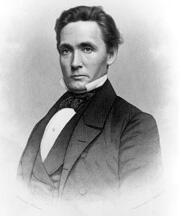
Here you will find contact information for Senator Delazon Smith, including email address, phone number, and mailing address.
| Name | Delazon Smith |
| Position | Senator |
| State | Oregon |
| Party | Democratic |
| Status | Former Representative |
| Term Start | December 5, 1859 |
| Term End | December 31, 1859 |
| Terms Served | 1 |
| Born | October 5, 1816 |
| Gender | Male |
| Bioguide ID | S000526 |
About Senator Delazon Smith
Delazon Smith (October 5, 1816 – November 19, 1860) was a Democratic Party politician, lawyer, editor, and legislator whose brief tenure as a United States Senator from Oregon in 1859 ranked among the shortest in Senate history. He was born in New Berlin, New York, on October 5, 1816. Little is recorded about his early childhood, but his later reputation for an “adventurous” and “eccentric” career, as noted in his obituary in the Chicago Tribune, suggests a personality inclined toward controversy and public life from a relatively young age.
Smith pursued higher education at Oberlin College in Ohio, an institution then known for its religious and reformist character. His time there ended abruptly in 1837 when he was expelled from the college and excommunicated from “the church.” His expulsion was closely tied to his strong opposition to abolitionism and to Oberlin’s admission of Black students, as well as his hostility toward the interracial friendships and alleged romantic relationships he claimed to observe among students. After leaving Oberlin, he turned to the study of law and was soon admitted to the bar, marking the beginning of his professional career.
Smith quickly moved into journalism and political advocacy through the press. In 1838 he established the New York Watchman newspaper in Rochester, New York, which he edited for two years. He later edited the True Jeffersonian and the Western Herald in Rochester in 1840, using these platforms to advance Democratic views. In 1841 he founded another newspaper, the Western Empire, in Dayton, Ohio. Like many Democrats of his era, Smith opposed the abolition of American slavery, and his editorial work reflected his party’s positions and his own resistance to the anti-slavery and egalitarian currents then gaining strength in the North.
His formal political and diplomatic career began in the early 1840s. In 1842 Smith was appointed a special United States commissioner to Quito, Ecuador, a post he held until 1845. After returning from South America, he moved to the Iowa Territory in 1846 and became a minister, adding religious leadership to his already varied résumé. In 1850 he ran as an Independent candidate in the Iowa 1st congressional district special election, receiving 3.43% of the vote. Though unsuccessful, this campaign marked his first bid for federal office and underscored his continuing ambition for national political influence.
In 1852 Smith relocated to the Oregon Territory, where he resumed his work as a newspaper editor, taking charge of the Oregon Democrat. His prominence in territorial politics grew rapidly. In 1854 he was elected to the Oregon Territorial House of Representatives, representing Linn County. During the 1855–1856 session he served as Speaker of the House, and he remained a representative through the following session, which was his last term in that body. In 1857 he was a delegate to Oregon’s constitutional convention, which drafted the state’s first constitution in preparation for admission to the Union. Through these roles, Smith helped shape the legal and political framework of the emerging state.
Upon Oregon’s admission to the Union as the 33rd state, Smith reached the pinnacle of his political career. A member of the Democratic Party, he was elected by the state legislature as one of Oregon’s first United States Senators and served in the U.S. Senate from February 14 to March 3, 1859. His service in Congress thus ran only from 1859 to 1859 and lasted for less than one month, placing his term among the shortest on record in the Senate. During this brief period, Delazon Smith participated in the legislative process and represented the interests of his Oregon constituents at a time of mounting sectional tension in the United States. He was an unsuccessful candidate for re-election, and his Senate career ended almost as soon as it began.
Less than two years after leaving the Senate, Smith’s eventful life came to an early close. He died in Portland, Oregon, on November 19, 1860, at the age of 44. His body was interred in the Masonic Cemetery in Albany, Oregon. Though his time in the U.S. Senate was fleeting, his broader career—as a controversial student at Oberlin, a lawyer, editor, diplomat, minister, territorial legislator, and constitutional convention delegate—left a distinctive imprint on the political development of the Oregon Territory and the early history of the state. His life and career, often described by contemporaries as eccentric and adventurous, were emblematic of the turbulent and rapidly changing political landscape of mid-19th-century America.