Representative Delbert L. Latta
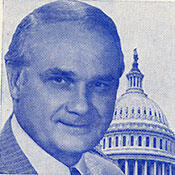
Here you will find contact information for Representative Delbert L. Latta, including email address, phone number, and mailing address.
| Name | Delbert L. Latta |
| Position | Representative |
| State | Ohio |
| District | 5 |
| Party | Republican |
| Status | Former Representative |
| Term Start | January 7, 1959 |
| Term End | January 3, 1989 |
| Terms Served | 15 |
| Born | March 5, 1920 |
| Gender | Male |
| Bioguide ID | L000116 |
About Representative Delbert L. Latta
Delbert Leroy Latta (March 5, 1920 – May 12, 2016) was an American lawyer and Republican politician who served 15 consecutive terms as a United States Representative from Ohio’s 5th congressional district from January 3, 1959, to January 3, 1989. Over three decades in the House of Representatives, he became one of Ohio’s longest-serving politicians and played a prominent role in budgetary and economic legislation. He was also the father of Robert E. “Bob” Latta, who has held his father’s former congressional seat since 2007.
Latta was born in Weston, Wood County, Ohio, the son of Bessie Viola (Thompson) and Lester Latta. He attended public schools in North Baltimore, Ohio, and graduated from McComb High School in 1938. After high school he pursued higher education at Findlay College from 1939 to 1940, and then enrolled at Ohio Northern University. At Ohio Northern, he completed his legal education, earning an LL.B. in 1943 and later an A.B. degree in 1945, combining formal legal training with a broader liberal arts education that would underpin his later public service.
Before beginning his legal and political career, Latta served in the armed forces. He was a member of the Ohio National Guard and the United States Army, serving with the 37th Division from 1938 to 1941, a period that spanned the years immediately preceding America’s entry into World War II. In 1942 and 1943, he served in the United States Marine Corps Reserve. His military experience, both in the National Guard and in federal service, informed his later legislative interests, particularly in matters of national defense and veterans’ affairs.
Latta was admitted to the bar in 1944 and began practicing law in Ohio. In addition to his legal practice, he taught at Ohio Northern University, contributing to the training of future lawyers while building his own reputation in the profession. His entry into elective office came at the state level: he served in the Ohio Senate from 1953 to 1958, winning three terms. During his tenure in the state legislature he developed a reputation as a conservative Republican and an attentive representative of his northwest Ohio constituency, laying the groundwork for his subsequent congressional career.
In 1958, Latta was elected as a Republican to the 86th Congress and was subsequently reelected to the 14 succeeding Congresses, serving continuously from January 3, 1959, to January 3, 1989, as the representative of Ohio’s 5th district. His service in Congress occurred during a significant period in American history, spanning the Cold War, the civil rights era, the Vietnam War, the Watergate scandal, and the Reagan years. As a member of the House of Representatives, Delbert Leroy Latta participated in the democratic process, contributed to the legislative work of the chamber, and represented the interests of his constituents in northwest Ohio for three decades.
Throughout his congressional career, Latta held key committee assignments that amplified his influence on national policy. He served on the House Committee on Agriculture, reflecting the rural and agricultural character of much of his district, and on the powerful House Rules Committee, which controls the flow of legislation to the floor. During the Watergate scandal, he was appointed to the House Judiciary Committee for the impeachment inquiry into President Richard M. Nixon. On the committee he was one of ten Representatives who initially supported Nixon, voting “no” on all three articles of impeachment. However, after the release of the so‑called “smoking gun” tape in August 1974, which revealed Nixon’s direct involvement in the cover-up, Latta publicly reversed his position, stating that hearing the president’s role in the cover-up showed that “we certainly weren’t given the truth” by the White House. He then indicated he would vote for impeachment when the articles came before the full House, joining all of the Republicans who had opposed impeachment in committee in changing their stance.
Latta’s most enduring legislative influence came through his long service on the House Budget Committee, where he served as the ranking Republican member from 1975 until his retirement in 1989. In that capacity he was a central figure in shaping Republican fiscal policy during a period of intense debate over federal spending and taxation. In 1981, he co-sponsored the Gramm–Latta Omnibus Reconciliation Bill, which implemented key elements of President Ronald Reagan’s economic program. The legislation increased military spending, reduced certain discretionary and mandatory domestic expenditures, and provided the legislative framework for the Economic Recovery Tax Act of 1981, commonly known as the Kemp–Roth tax cut. This package became a cornerstone of what came to be known as “Reaganomics,” and Latta’s role in its passage marked one of the high points of his congressional career. He also participated in national party affairs as a delegate to the 1968 Republican National Convention.
After choosing not to seek reelection in 1988, Latta retired from Congress at the conclusion of his fifteenth term in January 1989. His long tenure made him a senior figure in the Ohio Republican Party and a respected voice on budgetary and agricultural issues. In recognition of his service, Congress in 2003 designated the Bowling Green, Ohio, Post Office as the Delbert L. Latta Post Office Building under Public Law 108-50, a symbolic honor in the heart of the region he had represented for so many years.
Latta married Rose Mary Kiene in rural Pandora, Ohio. The couple had two children, Rose Ellen and Robert (Bob) Latta, as well as five grandchildren and four great-grandchildren. Bob Latta followed his father into public service and, beginning in 2007, has represented Ohio’s 5th congressional district in the U.S. House of Representatives, occupying the same seat his father had held for three decades. Delbert Leroy Latta died on May 12, 2016, at a nursing home in Bowling Green, Ohio, closing a life that spanned nearly a century and was marked by extensive military, legal, and legislative service to his state and nation.