Representative Dennis E. Eckart
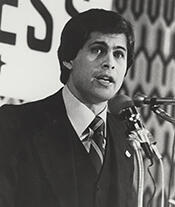
Here you will find contact information for Representative Dennis E. Eckart, including email address, phone number, and mailing address.
| Name | Dennis E. Eckart |
| Position | Representative |
| State | Ohio |
| District | 11 |
| Party | Democratic |
| Status | Former Representative |
| Term Start | January 5, 1981 |
| Term End | January 3, 1993 |
| Terms Served | 6 |
| Born | April 6, 1950 |
| Gender | Male |
| Bioguide ID | E000031 |
About Representative Dennis E. Eckart
Dennis Edward Eckart (born April 6, 1950) is an American lawyer and Democratic politician who served six terms as a Representative from Ohio in the United States Congress from 1981 to 1993. A member of the Democratic Party, he represented Ohio’s 22nd congressional district from January 3, 1981, to January 3, 1983, and Ohio’s 11th congressional district from January 3, 1983, to January 3, 1993. During his twelve years in the House of Representatives, Eckart contributed to the legislative process on a wide range of issues, particularly in the areas of environmental protection, energy policy, small business, and economic regulation, while representing the interests of his constituents during a significant period in late twentieth-century American political history.
Eckart was born into a Roman Catholic family in Cleveland, Ohio, and was raised there with his two brothers, Gary and Edward. He attended St. Joseph High School (now Villa Angela–St. Joseph High School) in Cleveland, where he received his early education. He went on to Xavier University in Cincinnati, Ohio, earning a Bachelor of Arts degree in 1971. Committed to a career in law and public service, he then enrolled at the Cleveland State University College of Law, where he obtained a Bachelor of Laws degree in 1974. That same year he was admitted to the Ohio bar, marking the formal beginning of his legal career.
Following his admission to the bar, Eckart began practicing law in Cleveland and served as an assistant prosecutor in the Lake County, Ohio, prosecuting attorney’s office. His early legal work exposed him to issues of local governance, public safety, and community needs, and helped lay the foundation for his subsequent political career. In 1974, he successfully ran for a seat in the Ohio House of Representatives, beginning service in January 1975. He served three consecutive terms in the Ohio House from 1975 until 1980, gaining experience in state-level legislation and building a reputation as an energetic young lawmaker. From 1978 until 1982, he also served as a vice president of the Slovene National Benefit Society, reflecting his engagement with ethnic and fraternal organizations in the Cleveland area.
In 1980, Eckart sought election to the United States House of Representatives to succeed retiring thirteen-term Congressman Charles Vanik. Running in Ohio’s 11th congressional district, he won the Democratic primary with 40 percent of the vote, defeating State Senator Tim McCormack and State Representative Anthony O. Calabrese Jr. He then prevailed in the general election over Republican Joseph Nahra with 55 percent of the vote and took office on January 3, 1981. Following the reapportionment and redistricting that followed the 1980 census, Eckart’s district was renumbered and redrawn, and he subsequently represented Ohio’s 22nd congressional district. In that configuration, he defeated State Representative Marcus Roberto in the Democratic primary and Republican Glen W. Warner in the general election. After the 1990 census, with an overall decline in Ohio’s population and a resulting redistricting, his district was divided among the 13th, 14th, 17th, and 19th districts. Rather than seek reelection in one of the new districts, Eckart chose not to run again and left Congress at the conclusion of his sixth term in January 1993. He was succeeded by Congressman Eric Fingerhut.
During his twelve years in the House of Representatives, Eckart served on the House Committee on Energy and Commerce, the House Committee on Education and the Workforce, and the House Committee on Small Business. Within the Small Business Committee, he chaired the Subcommittee on Antitrust, Deregulation and Ecology, a position that placed him at the intersection of competition policy, regulatory reform, and environmental concerns. He was particularly active on environmental and energy issues. Eckart supported improving standards for environmental protection and sponsored the Safe Drinking Water Act Amendments of 1983, legislation aimed at strengthening enforcement mechanisms and enhancing protections for underground sources of drinking water. He also sponsored the Great Lakes Emergency Shoreline Protection Act, which proposed a federal guaranteed-loan program to help protect Great Lakes shorelines from erosion, reflecting his concern for the environmental and economic health of the Great Lakes region.
Eckart’s legislative portfolio extended to nuclear energy and federal fiscal policy. He sponsored the Price–Anderson Amendments Act of 1987, which amended the Atomic Energy Act of 1954 to provide for effectively unlimited liability in the event of an accident at a nuclear power plant, thereby reshaping the liability framework for nuclear facilities and strengthening protections for the public. He also sponsored House Joint Resolution 617, a proposed constitutional amendment to require a balanced federal budget, although that measure did not succeed. On major science and technology projects, Eckart was a prominent opponent of the Superconducting Super Collider, and in 1992 he sponsored an amendment in the House to defund the project, arguing against its cost and priority in the federal budget. His political profile during this period included a notable role in national campaign politics: he gained public attention for portraying Vice President Dan Quayle in debate preparation sessions with Senator Lloyd Bentsen prior to the 1988 vice-presidential debate. Americans for Democratic Action later rated his overall congressional voting record with a liberal quotient of 80 percent, reflecting a generally progressive stance on many issues.
After leaving Congress in 1993, Eckart remained active in legal, professional, and public policy circles. He worked with the American Bar Association’s Congressional Process Committee, contributing his experience in legislative procedure and congressional operations, and served on the board of the American Institute of Certified Public Accountants, where he helped bridge legal, regulatory, and financial perspectives. He also served as chair of the United States Delegation to the Conference on Security and Cooperation in Europe, participating in international discussions on security, human rights, and cooperation in the post–Cold War era. In the private sector, he joined the law firm BakerHostetler as a partner, representing a variety of clients before Congress, the Executive Branch, federal and state agencies, and state legislatures. He continued this work until 2006, when he established North Shore Associates, a consulting firm through which he has advised many of his previous clients and engaged in real estate development and related projects.
Eckart also took on leadership roles in civic and policy-oriented organizations. From 2000 to 2003, he served as president and chief executive officer of the Greater Cleveland Growth Association, working to promote economic development, business growth, and regional competitiveness in northeast Ohio. In 2002, he was elected chairman of the National Center for Responsible Gaming, an organization dedicated to scientific research on pathological and youth gambling, underscoring his interest in public health and regulatory issues surrounding gaming. In 2007, Ohio Governor Ted Strickland appointed him to the board of trustees of Kent State University, where he contributed to the governance and strategic direction of a major public university. Over the years, Eckart has occasionally been mentioned in media and political circles as a potential candidate for statewide office in Ohio, including for the United States Senate, but such speculation has not led to a renewed bid for elective office.
In his personal life, Eckart is a practicing Roman Catholic. He and his wife, Sandy, have one adult son, Eddy, and reside in Concord, Ohio. In addition to his consulting and legal work, he has appeared in various public forums, including legal news and public affairs programming, to provide commentary and insight on Congress and the legislative process, drawing on his extensive experience in both state and federal government.