Representative Dennis McCarthy
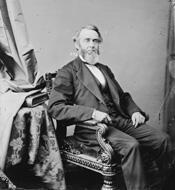
Here you will find contact information for Representative Dennis McCarthy, including email address, phone number, and mailing address.
| Name | Dennis McCarthy |
| Position | Representative |
| State | New York |
| District | 23 |
| Party | Republican |
| Status | Former Representative |
| Term Start | March 4, 1867 |
| Term End | March 3, 1871 |
| Terms Served | 2 |
| Born | March 19, 1814 |
| Gender | Male |
| Bioguide ID | M000310 |
About Representative Dennis McCarthy
Dennis McCarthy was a United States Representative from New York who served in the House of Representatives from 1867 to 1871 and later became acting lieutenant governor of New York. A member of the Republican Party, he contributed to the legislative process during two terms in Congress, representing the interests of his constituents during a pivotal era in American history. He is historically distinguished from several other notable individuals of the same or similar name, including Dennis McCarthy (scientist), an American scientist; Dennis McCarthy (composer) (born 1945), an American composer; Dennis McCarthy (radio presenter) (1933–1996), a British radio presenter; Denis Florence MacCarthy (1817–1882), an Irish poet; Dennis M. McCarthy (1945–2023), a U.S. Marine Corps general; Dennis McCarthy, a shooting victim of Colin Ferguson; and Dennis McCarthy (1719–1796), an Irish merchant settled in Bordeaux and owner of the Château MacCarthy in the Médoc wine region. Dennis McCarthy the New York politician was born in 1814 and died in 1886, and his public career was closely tied to the political and economic development of New York in the mid- to late nineteenth century.
McCarthy’s early life unfolded in the context of a rapidly changing United States, as the country expanded westward and industrialization began to reshape local economies. Born in 1814, he came of age during the Era of Good Feelings and the rise of new political alignments that would eventually give way to the Republican Party in the 1850s. Although detailed records of his childhood and family background are limited in the surviving public accounts, his later prominence in business and politics suggests that he acquired a practical education suited to commerce and public affairs, likely through local schooling and early work experience in New York. These formative years prepared him for a career that would bridge both entrepreneurial activity and public service.
By the time he entered national politics, McCarthy had established himself sufficiently in New York to earn the confidence of voters in his district. His election as a Republican to the United States House of Representatives placed him in the Fortieth and Forty-first Congresses, covering the period from 1867 to 1871. This was a significant period in American history, marked by Reconstruction following the Civil War, the reintegration of the seceded states, and intense national debates over civil rights, federal authority, and economic recovery. As a member of the House of Representatives, Dennis McCarthy participated in the democratic process and represented the interests of his constituents, contributing to the legislative work of Congress during these consequential years. His two terms in office coincided with major Reconstruction legislation and the ongoing effort to define the postwar role of the federal government.
Within Congress, McCarthy’s service reflected the priorities of a Republican from New York, a state that was central to the nation’s commerce and politics. While detailed committee assignments and specific bills associated with him are not enumerated in the surviving summary accounts, his participation in the legislative process would have included voting on measures related to Reconstruction policy, economic development, and the governance of a rapidly industrializing nation. Serving from 1867 to 1871, he was part of the congressional cohort that navigated the transition from wartime emergency to peacetime governance, addressing issues such as the readmission of Southern states, the protection of newly freed African Americans, and the stabilization of the national economy.
After his tenure in the House of Representatives, Dennis McCarthy continued his public career in New York state government, where he rose to the position of acting lieutenant governor of New York. In that capacity, he was involved in the executive leadership of the state, working alongside the governor and the state legislature during a period when New York was consolidating its role as a leading industrial and financial center. His service as acting lieutenant governor reflected the confidence placed in him by his party and colleagues and extended his influence beyond the federal sphere into state-level governance, where issues such as infrastructure, commerce, and urban growth were increasingly prominent.
In his later years, McCarthy remained identified with the generation of Republican leaders who had guided the nation through and beyond the Civil War era. Living until 1886, he witnessed the continued evolution of the United States during the Gilded Age, as questions of economic inequality, political reform, and industrial expansion came to the fore. His death in 1886 closed a life that had spanned from the early nineteenth century through the transformative decades of war, Reconstruction, and rapid national growth. Remembered primarily as a United States congressman from New York and as acting lieutenant governor of New York, Dennis McCarthy’s career illustrates the role of state and federal legislators in steering the country through one of its most consequential historical periods.