Representative Dewey Jackson Short
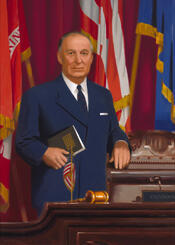
Here you will find contact information for Representative Dewey Jackson Short, including email address, phone number, and mailing address.
| Name | Dewey Jackson Short |
| Position | Representative |
| State | Missouri |
| District | 7 |
| Party | Republican |
| Status | Former Representative |
| Term Start | April 15, 1929 |
| Term End | January 3, 1957 |
| Terms Served | 12 |
| Born | April 7, 1898 |
| Gender | Male |
| Bioguide ID | S000377 |
About Representative Dewey Jackson Short
Dewey Jackson Short (April 7, 1898 – November 19, 1979) was an American politician from Missouri who served as a Republican member of the United States House of Representatives for 12 terms between 1929 and 1957. A prominent conservative voice in mid‑twentieth‑century American politics, he was best known as a staunch opponent of President Franklin D. Roosevelt’s New Deal and as one of the most noted orators of his era.
Short was born in Galena, Stone County, Missouri, on April 7, 1898, to Jackson Grant Short and Permelia C. Long. He grew up in the Ozarks and graduated from Galena High School in 1914. He then attended Marionville College in Marionville, Missouri, before pursuing further higher education. Raised in a religious environment, he began his preaching career at the age of nineteen, when he received his license to preach from the Methodist Church, an early indication of the rhetorical skills that would later define his public life.
Short sought extensive education both in the United States and abroad. He graduated from Baker University in Baldwin City, Kansas, in 1919 and later from Boston University. While attending Baker University in 1918, during World War I, he entered a United States Army officer training camp at Fort Sheridan, Illinois, as a representative of the university. Although he was not old enough to be drafted and his status as a reverend would have exempted him under the Selective Service Act of 1917, he felt compelled to serve alongside his two older brothers who were already in the Army. After the war, he pursued advanced studies at several institutions, including Harvard Law School, where he studied alongside his brother Theodore, as well as Heidelberg University, the University of Berlin, Drew University, and Oxford University. In recognition of his later public service, he received an honorary Doctor of Laws degree from Drury University in Springfield, Missouri.
After leaving Harvard Law School, Short embarked on an academic and ministerial career. He became a lecturer and later professor of ethics, psychology, and political philosophy at Southwestern College in Winfield, Kansas, where he taught during the academic years 1923–1924 and 1926–1928. At the same time, he continued his religious vocation and in 1927 served as pastor of Grace Methodist Episcopal Church in Springfield, Missouri. These dual roles as educator and clergyman helped shape his philosophical outlook and honed the oratorical style that would later make him a commanding presence in congressional debate. On April 20, 1937, he married Helen Gladys Hughes of Washington, D.C.; the couple had no children.
Short entered national politics as a Republican and was first elected to the Seventy‑first Congress, serving from March 4, 1929, to March 3, 1931, as a Representative from Missouri. His initial term coincided with the onset of the Great Depression following the Wall Street crash of 1929. He was an unsuccessful candidate for reelection in 1930 to the Seventy‑second Congress and, after leaving office, he resumed his former professional pursuits in teaching and public speaking. He remained active in Republican politics, serving as a delegate to the Republican National Convention in 1932 and seeking, unsuccessfully, the Republican nomination for the United States Senate that same year.
Returning to the House of Representatives in the elections of 1934, Short was elected to the Seventy‑fourth Congress and then to the ten succeeding Congresses, serving continuously from January 3, 1935, to January 3, 1957. During these 11 consecutive terms, combined with his earlier service, he completed 12 terms in the House. His congressional career spanned the New Deal, World War II, the early Cold War, and the beginning of the civil rights era. A member of the Republican Party, he became one of the most vigorous and colorful critics of Roosevelt’s New Deal policies. On January 23, 1935, he delivered one of his most famous speeches on the House floor, denouncing what he saw as the surrender of legislative authority to unelected “brain trusters and ‘new dealers’” and describing the House as having “degenerated into a supine, subservient, soporific, superfluous, supercilious, pusillanimous body of nitwits.” His biting wit was also reflected in remarks such as, “Mr. Jefferson founded the Democratic Party and President Roosevelt has dumfounded it,” and, “I know that without change there would be no progress, but I am not going to mistake mere change for progress.” Another oft‑quoted line of his was, “I look at the Supreme Court and know why Jesus wept,” and he once quipped about work and industry, “I have always been old-fashioned enough to believe it is much better to ‘git up and get’ than it is to ‘sit down and set.’ The only animal I know which can sit and still produce dividends is the old hen.”
Within the House, Short rose to positions of influence, particularly on defense matters. He served as chairman of the Committee on Armed Services in the Eighty‑third Congress, during the administration of President Dwight D. Eisenhower, at a time when the United States was consolidating its military posture in the early Cold War. In 1945, he served as a congressional delegate to inspect Nazi concentration camps in Germany, an experience that placed him among the American legislators who directly witnessed the aftermath of the Holocaust. At the 1940 Republican National Convention in Philadelphia, Pennsylvania, he received 108 delegate votes for the party’s vice‑presidential nomination, finishing as runner‑up to the eventual nominee, Senator Charles L. McNary, who received 848 votes. Short’s prominence as a national figure was further recognized on April 30, 1955, when he was presented with an Honorary Ozark Hillbilly Medallion by the Springfield, Missouri, Chamber of Commerce during a broadcast of ABC‑TV’s country music program Ozark Jubilee. Despite his conservative record, he did not sign the 1956 Southern Manifesto, a document authored by a group of southern legislators to oppose the Supreme Court’s decision in Brown v. Board of Education (1954), which declared segregated public schools unconstitutional.
Short’s long tenure in Congress came to an end when he was an unsuccessful candidate for reelection in 1956 to the Eighty‑fifth Congress. He was defeated by Democrat Charles H. Brown, who received 90,986 votes to Short’s 89,926. After leaving the House, he continued his service in the federal government when he was appointed Assistant Secretary of the Army, a position he held from March 15, 1957, to January 20, 1961, spanning the remainder of the Eisenhower administration. In this role he was involved in overseeing Army administration and policy during a critical phase of Cold War military planning. Later, he served as president emeritus of the National Rivers and Harbors Congress, reflecting his continued interest in infrastructure and waterways development.
In his later years, Short remained a respected elder statesman within Republican and Missouri political circles, widely remembered for his eloquence and colorful rhetoric. Former President Richard Nixon, in his 1990 memoir In the Arena, cited Dewey Short as perhaps the finest orator he had ever seen, a tribute that underscored Short’s reputation as the “Orator of the Ozarks,” a title also used in a 1985 biographical study by Robert S. Wiley. Dewey Jackson Short died in Washington, D.C., on November 19, 1979. His body was returned to his native Missouri, where he was interred in Galena Cemetery in Galena, bringing to a close the life of a prominent Missouri Republican who had played a significant role in Congress during some of the most transformative decades of the twentieth century.