Representative Donald Hammer Magnuson
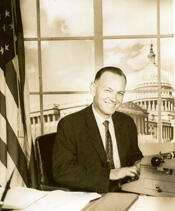
Here you will find contact information for Representative Donald Hammer Magnuson, including email address, phone number, and mailing address.
| Name | Donald Hammer Magnuson |
| Position | Representative |
| State | Washington |
| District | 7 |
| Party | Democratic |
| Status | Former Representative |
| Term Start | January 3, 1953 |
| Term End | January 3, 1963 |
| Terms Served | 5 |
| Born | March 7, 1911 |
| Gender | Male |
| Bioguide ID | M000052 |
About Representative Donald Hammer Magnuson
Donald Hammer Magnuson (March 7, 1911 – October 5, 1979) was an American journalist and five-term Democratic congressman from the state of Washington, noted for his investigative reporting for the Daily Olympian and the Seattle Times and for his service in the United States House of Representatives from 1953 to 1963. Over the course of five consecutive terms, he contributed to the legislative process during a significant period in American history, representing the interests of his Washington constituents. Although he shared a surname and home state with Washington’s long-serving U.S. Senator Warren G. Magnuson, the two were not related.
Magnuson was born on a farm near Freeman, in Spokane County, Washington, the son of Ellis William Magnuson and Ida (Hammer) Magnuson. He attended local public schools before enrolling at Spokane University, where he studied from 1926 to 1928. He then transferred to the University of Washington in Seattle and earned a bachelor’s degree in 1931. Following his graduation during the difficult economic conditions of the early 1930s, Magnuson worked as a harvester and later as a riveter in an aircraft factory, experiences that exposed him to the lives of working people and informed his later interests in labor, public works, and social issues.
By 1934 Magnuson had embarked on a career in journalism, becoming a newspaper reporter for the Daily Olympian and the Seattle Times, a position he held until 1952. He gained prominence as an investigative journalist, notably in 1942 when he wrote a series of reports about loafing in the Seattle-Tacoma Shipyards during World War II, drawing attention to inefficiencies in wartime production. Magnuson was instrumental in obtaining the pardon of Clarence Boggie, who had been wrongly convicted of murder; his coverage of the case earned him a Heywood Broun Award and a nomination for a Pulitzer Prize in Local Reporting in 1949 by the managing editor of the Seattle Times. The Boggie investigation was dramatized nationally in a February 1949 episode of the radio program “The Big Story.” In another widely noted case, Magnuson’s reporting generated such public response that the death sentence of 17-year-old Joe Maish was commuted to life imprisonment just 66 minutes before the scheduled execution.
Magnuson continued to explore complex social problems through his journalism. In 1950 he wrote an extensive series on alcoholism, interviewing some 6,000 men who had been treated over a 15-year period. He described and analyzed the “conditioned-reflect treatment,” an aversion therapy based on Ivan Pavlov’s work on conditioned reflexes, in which patients were given alcohol while nausea was induced with an additive to create a lasting repugnance to drinking. This work reflected Magnuson’s interest in scientific approaches to public health and social welfare and helped establish his reputation as a reporter who combined human-interest storytelling with careful attention to medical and psychological research.
In 1952 Magnuson was elected as a Democrat to the Eighty-third Congress and took office on January 3, 1953, beginning a decade of service in the U.S. House of Representatives. He was re-elected four times, serving continuously until January 3, 1963. During his tenure he served on several key committees. In 1955 he was named to the Committee on Merchant Marine and Fisheries, and he later served on the Appropriations Committee subcommittee overseeing the Department of State, the Department of Justice and the federal judiciary, and the Department of the Interior. He also served on the Public Works Committee, which had oversight over the United States Army Corps of Engineers, the Bureau of Reclamation, and the Atomic Energy Commission. Through these assignments, Magnuson participated in debates over foreign affairs, justice, natural resources, infrastructure, and atomic energy during the Cold War era.
Magnuson’s congressional career included dramatic personal episodes that drew national attention. On March 1, 1954, he was on the House floor when Puerto Rican nationalists Lolita Lebrón, Rafael Cancel Miranda, Andres Figueroa Cordero, and Irving Flores Rodríguez unfurled a Puerto Rican flag and opened fire from the visitors’ gallery on the 240 Representatives who were debating an immigration bill. Magnuson was shot through the sleeve of his coat but escaped serious injury. True to his journalistic instincts, he quickly telephoned the Seattle Times during the chaos to provide an eyewitness account, an incident later recounted by Speaker of the House Thomas P. “Tip” O’Neill in his memoirs. In 1958 Magnuson again narrowly avoided serious harm when he was among 60 passengers who survived a Northwest Airlines plane crash into a cornfield near Minneapolis; the aircraft burst into flames, and he was photographed in Northwestern Hospital with a hospital identification tag pinned to his blood-spotted shirt. His opponent in that year’s congressional race complained about the sympathetic publicity Magnuson received as a result. Magnuson credited Private First Class Raymond C. Maruschak, one of at least 11 U.S. Army service members on board, with helping to save many lives, and he recommended Maruschak for the Soldier’s Medal after the soldier and a comrade tore a hole in the fuselage large enough for passengers to escape.
In addition to his committee work, Magnuson pursued a range of legislative initiatives and public positions. On January 30, 1959, he introduced a bill to establish a federal shield law to protect reporters from being compelled to reveal confidential sources, reflecting his professional background and concern for press freedom. On February 2, 1959, he introduced a bill to grant a second income tax exemption to college students who were employed while pursuing their education. On February 7, 1959, he was named to the board of oversight of the U.S. Air Force Academy at Colorado Springs, serving in that capacity for four consecutive years. As a member of the Appropriations Committee, on May 22, 1959, he voted in subcommittee for an addition of $724,000 to the public works bill to initiate the Greater Wenatchee reclamation project in central Washington. On August 4, 1959, commenting on the impending visit of Soviet Premier Nikita Khrushchev to the United States, Magnuson stated, “What Khrushchev sees here may help guard against a fatal miscalculation on his part,” underscoring his belief in the value of direct exposure to American society during the Cold War. On January 21, 1960, the Bellingham Labor News reported that as a member of the Public Works Committee, he sponsored a resolution authorizing the U.S. Army Corps of Engineers to review flood control studies in western Washington, and on the same day he was appointed a charter member of the Democratic Study Group, a caucus of reform-minded House Democrats. In 1960, as a member of the Appropriations Committee, he voted against an additional $73 million for the development of nuclear-powered airplanes, a stance reported by The Labor Journal.
Following an extremely close victory in his 1960 re-election campaign, Magnuson was defeated in his bid for a sixth term in 1962 and left Congress at the conclusion of his term in January 1963. He then continued his public service in the executive branch. From 1963 to 1969 he was employed by the Department of the Interior, where his legislative experience with natural resources and public works issues proved relevant. From 1969 to 1973 he worked for the Department of Labor, extending his long-standing interest in labor conditions, employment, and social policy into administrative roles. After retiring from federal service in 1973, Magnuson resided in Seattle, Washington.
Magnuson lived quietly in retirement in Seattle until his death there on October 5, 1979. He was interred in Evergreen Washelli Memorial Park in north Seattle. His congressional and political legacy is documented in his papers, housed at the University of Washington Libraries, which include approximately 18 cubic feet of legislative materials and eight film strip reels relating to his various political campaigns. These archives, together with his published journalism, preserve the record of a career that bridged investigative reporting and national legislative service during a transformative era in twentieth-century American history.