Representative Don Ritter
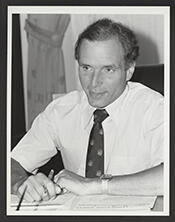
Here you will find contact information for Representative Don Ritter, including email address, phone number, and mailing address.
| Name | Don Ritter |
| Position | Representative |
| State | Pennsylvania |
| District | 15 |
| Party | Republican |
| Status | Former Representative |
| Term Start | January 15, 1979 |
| Term End | January 3, 1993 |
| Terms Served | 7 |
| Born | October 21, 1940 |
| Gender | Male |
| Bioguide ID | R000277 |
About Representative Don Ritter
Donald Lawrence Ritter (born October 21, 1940) is a former Republican member of the U.S. House of Representatives from Pennsylvania who served seven consecutive terms in Congress from 1979 to 1993. From 1979 to 1993, he represented Pennsylvania’s 15th congressional district, which then included the Lehigh Valley region of eastern Pennsylvania, encompassing the cities of Allentown, Bethlehem, and Easton. Over fourteen years in the House of Representatives, Ritter participated actively in the legislative process, became a senior member of key committees, and was widely known among his colleagues as a “scientist-congressman” for his advanced scientific training and his efforts to apply scientific principles to public policy.
Ritter was born in Washington Heights in New York City, the son of Frank and Ruth Ritter. His father, Frank Ritter, was born in Hungary and lived in Manhattan and later in The Bronx, reflecting the immigrant and working-class background that shaped Ritter’s early life. He attended New York City public schools, including P.S. 70 Elementary School, Joseph H. Wade Junior High School, P.S. 117, and the Bronx High School of Science, one of the city’s most selective specialized high schools. This early exposure to rigorous scientific education and the diverse environment of New York City helped lay the foundation for his later academic and professional pursuits in engineering and metallurgy.
After graduating from the Bronx High School of Science, Ritter enrolled at Lehigh University in Bethlehem, Pennsylvania, where he earned a Bachelor of Science degree in metallurgical engineering in 1961. He then pursued graduate studies at the Massachusetts Institute of Technology (MIT) in Cambridge, Massachusetts, receiving a Master of Science degree in 1963 and a Doctor of Science (Sc.D.) in physical metallurgy in 1966. While completing his doctoral work at MIT from 1961 to 1966, he served as a research assistant, deepening his expertise in materials science and engineering. During this period he also developed a strong interest in Russian language, literature, culture, and history, studying Russian as a hobby and being introduced to the language by Alexander Isaacovich Lipson, a professor at Harvard and MIT. Ritter eventually became fluent in Russian, a skill that would later inform his work on Soviet and Eastern European issues in Congress.
Ritter’s early professional career combined scientific research, international exchange, and academic service. From 1967 to 1968, he was a National Academy of Sciences scientific exchange fellow at the Baikov Institute of Metallurgy and Materials Science at the Academy of Sciences of the Soviet Union in Moscow, then the Soviet Union’s highest scientific institution. During his time there, the Academy was led by Mstislav Keldysh, an engineer prominent in the Soviet space program and a member of both the Central Committee of the Communist Party of the Soviet Union and the Supreme Soviet. In 1968, Ritter returned to the United States and became an assistant professor at California Polytechnic State University (Cal Poly), while also working as a contract consultant for General Dynamics in Pomona, California. In 1969, he returned to Lehigh University as a member of the metallurgy faculty and as assistant to the university’s vice president. In 1976, he was appointed manager of Lehigh’s research program development, a position he held until 1979 while also serving as an engineering consultant to private industry. These roles gave him experience at the intersection of higher education, applied research, and industrial innovation.
Ritter entered electoral politics in the late 1970s. In 1979, he announced his candidacy for Congress in Pennsylvania’s 15th congressional district. He prevailed in a five-way Republican primary and then went on to upset 16-year incumbent Democrat Fred B. Rooney in the general election, winning a seat in the 96th United States Congress. He subsequently won reelection six more times, serving a total of seven terms from 1979 to 1993. His district, centered in the Lehigh Valley, had a hybrid economy that combined heavy manufacturing—particularly steel and related industries—with a substantial university and college presence. Although ancestrally Democratic, the district also had a strong socially conservative streak and a significant population of Hungarian, Polish, Slovak, and Ukrainian Americans, many of whom supported Ritter’s staunch anti-communism. He enjoyed consistently high rankings from conservative interest groups and correspondingly low rankings from liberal organizations. After his initial victory, he was reelected without serious difficulty, even in challenging years for Republicans nationally; he won 57 percent of the vote in 1982 and 56 percent in 1986.
In Congress, Ritter rose to become a senior member of two influential committees: the Committee on Energy and Commerce and the Committee on Science and Technology. On both panels, and through his legislative initiatives and voting record, he worked to bring a more rigorous scientific and technical perspective to debates over environmental and energy regulation. Because he was one of the few members of Congress with a Ph.D.- or Sc.D.-level scientific background, he was frequently referred to as the “scientist-congressman.” He supported free markets and small government policies, but he also cast several trade-related votes in favor of the steel and apparel industries in his district, which were beginning to lose global market share to foreign competitors, particularly in Asia, who benefited from government subsidies, limited regulatory constraints, low wages, and other practices. At the same time, he supported the North American Free Trade Agreement (NAFTA), which was debated and passed by the House in 1993, reflecting his broader commitment to trade liberalization despite the pressures on traditional industries in his district.
A central theme of Ritter’s congressional work was his advocacy for the use of risk assessment in environmental and energy policy. He argued that hazards should be evaluated and prioritized using systematic, science-based methods to focus resources on the most serious threats to public health and the environment. His risk assessment initiatives culminated in legislation that was later incorporated into the Republican “Contract with America” in 1994 and enacted into law in 1995. He also championed the application of total quality management (TQM) principles to public policy development and governmental management. In Congress, he worked to build bridges between lawmakers and leading global TQM thinkers, including W. Edwards Deming, Joseph M. Juran, Armand V. Feigenbaum, and others. In his Lehigh Valley district, he launched “Quality Valley USA,” an initiative that promoted the use of total quality management practices and sought to raise public awareness of the economic advantages such practices could offer to citizens, businesses, and workers.
Ritter also devoted significant attention to environmental and regional development issues in eastern Pennsylvania. He promoted the Lehigh River as a linear environmental center for the Lehigh Valley, emphasizing its importance to leisure, recreation, and creative economic development for his constituents. Working with neighboring Pennsylvania Congressman Peter H. Kostmayer, he co-authored legislation that created the Delaware and Lehigh National Heritage Corridor. This designation helped preserve and develop the historic transportation and industrial corridor along the Delaware and Lehigh rivers, which has since become a primary environmental and recreational focus in the region. These efforts reflected his broader interest in integrating environmental stewardship with economic revitalization and community development.
On foreign policy and human rights, Ritter was a prominent critic of Soviet expansionism and an active supporter of peoples living under Soviet domination. He opposed what he viewed as the Soviet Union’s expansionist activities in Afghanistan, Cuba, Central America, Eastern Europe, and elsewhere. He served on the Commission on Security and Cooperation in Europe (the U.S. Helsinki Commission) and was the founding chairman of the Ad Hoc Committee on the Baltic States and Ukraine, whose co-chairmen were Representative Dennis Hertel and Senator Donald Riegle, both Democrats from Michigan. In 1983, he addressed a memorial rally at the Washington Monument in support of millions of Ukrainians who perished in the Holodomor, the man-made famine of the early 1930s orchestrated under Josef Stalin. Ritter was a leading voice in Congress opposing the Soviet invasion of Afghanistan in 1979. He authored the “Material Assistance to Afghanistan” legislation, known as Ritter–Tsongas, in 1982, and created the Congressional Task Force on Afghanistan (Ritter–Humphrey) to promote material assistance of all kinds to the Afghan resistance. He convened meetings on Afghanistan with representatives of the U.S. Department of State, Defense Intelligence Agency, Central Intelligence Agency, and Federal Bureau of Investigation to enhance U.S. support for Afghan resistance forces. Using his ranking position on the Commission on Security and Cooperation in Europe, he worked to expand the commission’s focus beyond Eastern Europe and the Soviet Union to include the Soviet invasion, occupation, and destruction of Afghanistan, which he argued violated the Soviet Union’s commitments under the Helsinki Accords.
Ritter’s political fortunes shifted in the early 1990s. In the 1992 election, amid a three-way presidential race in which Independent candidate Ross Perot drew significant support and President George H. W. Bush secured only 36 percent of the vote in his unsuccessful reelection bid, Ritter faced a difficult reelection campaign. That year he narrowly lost what would have been his seventh reelection to Democratic State Representative Paul McHale. His defeat ended fourteen years of service in the House of Representatives, during which he had represented the interests of his Lehigh Valley constituents while advancing a legislative agenda grounded in scientific analysis, conservative economic principles, and strong anti-communist foreign policy positions.
Following his departure from Congress, Ritter remained active in public policy, environmental affairs, and international engagement, particularly with respect to Afghanistan. From 1993 to 2002, he served as founder, chairman, and president of the National Environmental Policy Institute (NEPI), an organization that sought greater involvement of states and localities in environmental policy development, which had largely been controlled at the federal level. NEPI worked to develop and mobilize grassroots support for moving environmental policy in a more fact- and science-based direction, as opposed to what Ritter viewed as a politicized, Washington-centered approach. The institute organized working groups of 40 to 50 participants on various environmental policy issues, including proposals to “reinvent” the Environmental Protection Agency in line with then–Vice President Al Gore’s Reinventing Government initiative. NEPI emphasized expanded participation by the scientific community and bipartisan representation from states and localities, which had traditionally been underrepresented in the formulation of federal environmental policy. The organization and its collaborators produced numerous publications, and its annual conferences in Washington, D.C., drew 250 to 300 participants, including governors, mayors, state legislators, congressional committee chairpersons, Cabinet members, EPA administrators, White House officials, leaders of environmental advocacy groups, and prominent legal and scientific experts. NEPI also convened specialized working groups on highly technical issues such as bioavailability and contaminated sediments.
In parallel with his environmental policy work, Ritter continued his long-standing engagement with Afghanistan. While heading NEPI, he founded the Afghanistan Foundation in Washington, D.C., which he chaired. The foundation was one of the few organizations in the late 1990s consistently drawing attention to emerging warning signs in Afghanistan that would ultimately culminate in the September 11, 2001, terrorist attacks. Ritter also focused on fostering a market economy in Afghanistan as both a businessman and investor. He co-founded the Afghan-American Chamber of Commerce (AACC) and the USAID-supported Afghan International Chamber of Commerce (AICC), which later evolved into the Afghanistan Chamber of Commerce and Industries. In these roles, he worked with Afghan business and political figures, including Mahmud Karzai and members of the Karzai family: Hamid Karzai (later president of Afghanistan), Ahmed Wali Karzai (assassinated in 2011), and Qayum Karzai, with whom he co-authored several opinion editorials in The Washington Times. Through these activities, Ritter extended his congressional legacy of engagement with Afghanistan into the post–Cold War era, combining his interests in foreign policy, economic development, and democratic governance.