Representative Douglas R. Stringfellow
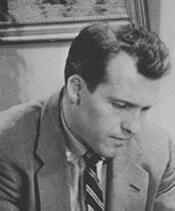
Here you will find contact information for Representative Douglas R. Stringfellow, including email address, phone number, and mailing address.
| Name | Douglas R. Stringfellow |
| Position | Representative |
| State | Utah |
| District | 1 |
| Party | Republican |
| Status | Former Representative |
| Term Start | January 3, 1953 |
| Term End | January 3, 1955 |
| Terms Served | 1 |
| Born | September 24, 1922 |
| Gender | Male |
| Bioguide ID | S001006 |
About Representative Douglas R. Stringfellow
Douglas R. Stringfellow (September 24, 1922 – October 19, 1966) was an American soldier, radio announcer, public speaker, and Republican politician from Utah who served one term as a Representative from Utah in the United States Congress from 1953 to 1955. Elected to the 83rd United States Congress, he represented his constituents during a significant period in American history, but his career was later overshadowed by revelations that he had fabricated key aspects of his World War II military record, making him widely known as a military impostor.
Stringfellow was born in Draper, Utah, to Henry Elden Stringfellow (1889/1890–1954). He received a public education and graduated from high school in 1941. He then pursued higher education intermittently during the war years, attending Weber College in Ogden, Utah, in the 1941–1942 academic year, Ohio State University in 1943, and the University of Cincinnati from 1943 to 1944. A lifelong member of The Church of Jesus Christ of Latter-day Saints, he was active in Mormon circles throughout his life. In early 1945 he met Shirley Mae Lemmon, then a dancer with the United Service Organizations; they were married on June 11, 1946, in the Salt Lake Temple in Salt Lake City, Utah. The couple had four children and, in May 1966, moved to San Clemente, California.
On November 4, 1942, Stringfellow enlisted in the United States Army at Ogden, Utah, serving as an infantryman during World War II. His first overseas deployment was to southern France in December 1944, where he was assigned to demining operations. Within two weeks of arriving, he was accidentally wounded when shrapnel from an S-mine struck his spine, leaving him paraplegic. For his injuries he received the Purple Heart. Evacuated from France, he was transferred back to Utah in January 1945 and subsequently separated from the Army as a private first class on November 8, 1945, at Brigham City, Utah. After his discharge, he returned to civilian life and worked as a radio announcer in Ogden, Utah.
In the years following his separation from the military, Stringfellow began a second career as a public speaker, addressing Mormon gatherings and civic groups in the Salt Lake City metropolitan area and eventually audiences across the country. During this period he began to embellish and then wholly falsify his wartime experiences. He claimed that he had been assigned to the Office of Strategic Services and sent on a top-secret mission behind enemy lines to capture German nuclear physicist Otto Hahn with a team of 29 other soldiers, all of whom he said were killed. He further asserted that he had been captured, tortured at the Bergen-Belsen concentration camp, and that his paraplegia resulted either from this torture or from a land mine encountered after his escape to France. These fabrications, repeated in speeches and media appearances, brought him national attention. He appeared on popular radio and television programs such as Suspense and This Is Your Life, received numerous awards from civic and veterans’ organizations, and was named by the Junior Chamber of Commerce as one of the top ten outstanding young men in the United States. The Evergreen Freedom Foundation later ranked his public speaking behind only former presidents Herbert Hoover and Dwight D. Eisenhower, and multiple film studios bid for the rights to adapt his purported life story, with producer Hall Bartlett securing those rights in the week of October 10, 1954.
Capitalizing on his growing fame and his fabricated reputation as a war hero, Stringfellow entered politics as a Republican. In 1952 he announced his candidacy for the U.S. House of Representatives from Utah. Running heavily on his embellished military narrative, he easily won election, defeating Democrat Ernest R. McKay. He took his seat in the 83rd United States Congress, serving from 1953 to 1955. During his single term in office, he participated in the legislative process as a member of the House of Representatives and represented the interests of his Utah constituents during a period marked by Cold War tensions and domestic debates over defense and resource development.
In Congress, Stringfellow became involved in issues of particular concern to his state, especially those related to nuclear testing and water development. He liaised with the United States Atomic Energy Commission after reports that the Upshot–Knothole Harry nuclear weapons test had sickened residents and miners in and around St. George, Utah. Responding to fears among his southern Utah constituents about the impact of fallout on their health and livestock, he later requested that the AEC postpone or relocate the planned Operation Teapot tests. He also supported the construction of the Echo Park Dam in the Upper Colorado River Basin, a controversial reclamation project, and, while generally favoring agricultural price controls, he backed efforts by Secretary of Agriculture Ezra Taft Benson to reduce such supports, aligning himself with the Eisenhower administration’s farm policy.
By the time of the next election cycle in 1954, Stringfellow appeared to be a strong favorite for reelection against former Representative Walter K. Granger. However, persistent rumors about his military record prompted reporters to investigate his oft-repeated OSS story. Their inquiries were initially frustrated by the Department of Defense, which was reluctant to release information out of a stated “fear of offending a congressman.” Two weeks before the November election, Harold G. Stagg of the Army Times published an article titled “The Strange Case of Congressman Doug Stringfellow,” presenting documentary evidence that his claims of secret missions, capture, and torture did not withstand scrutiny; Stagg later reported that White House staff had known of the discrepancies for six months. Stringfellow denounced the article as political persecution, threatened a libel suit, and publicly urged President Dwight D. Eisenhower to release what he alleged were secret Central Intelligence Agency files that would vindicate him.
Confronted privately by Utah’s U.S. Senators, Wallace F. Bennett and Arthur V. Watkins, Stringfellow admitted that his wartime heroics were fabrications. Shortly thereafter, he appeared on KSL-TV in Salt Lake City, accompanied by his wife and Senator Watkins, and made a public confession. He acknowledged that he had never been an OSS agent, had never participated in any secret behind-the-lines mission, and had never captured Otto Hahn or any other German physicist. He explained that, as he was thrust into the limelight, he had “thrived on the adulation and new-found popularity” and gradually embellished his story until it bore little resemblance to reality. The chairman of the Utah Republican Party reported that the reaction to Stringfellow’s disclosure at state party headquarters was “tremendous,” and that many callers and telegrams indicated they would still vote for him. Stringfellow did not resign his seat and completed his term, but he withdrew from the 1954 race. The Republican Party replaced him on the ballot with Henry Aldous Dixon, who went on to win the election.
After leaving Congress in 1955, Stringfellow returned to public life as a speaker, though now under the cloud of his exposed deception. He continued to lecture and later turned to the visual arts, working as a landscape painter in California, Mexico, and Utah. The Washington Post later reported that he did not return the awards he had received during the years when he was promoting his false OSS story, stating that he believed they had been given for his then-current abilities and activities rather than for the specific details of his wartime narrative. He also undertook to write his life story, producing a 385-page autobiography for which he received a $20,000 advance from Random House. Ultimately, he declined to publish the book and returned the advance. In the manuscript, he wrote that he only fully realized the extent of his fabrications when others began to question them, and he later said he had chosen to confess to deliberate lying rather than attribute his conduct to self-delusion, fearing that the latter would lead people to consider him insane. Scholars have since debated the psychological dimensions of his case: University of Warwick psychology professor Kimberly Wade has suggested that her research supports the possibility that Stringfellow developed false memories, while Harvard Medical School psychiatry professor Roger K. Pitman has argued that such cases are rare but possible and might have been related to post-traumatic stress disorder.
In his final years, Stringfellow divided his time between the United States and Mexico. While living in San Miguel de Allende, Mexico, he suffered three heart attacks between October 26 and November 9, 1965. Physicians attributed these episodes to a blood clot in his lungs, caused by poor circulation in his paralyzed legs, a lingering consequence of his wartime injury. On October 19, 1966, at the age of 44, Douglas R. Stringfellow died of another heart attack in Long Beach, California. He was interred at Memorial Gardens of the Wasatch in Ogden, Utah.