Representative Dudley Chase Haskell
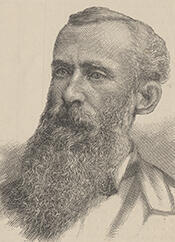
Here you will find contact information for Representative Dudley Chase Haskell, including email address, phone number, and mailing address.
| Name | Dudley Chase Haskell |
| Position | Representative |
| State | Kansas |
| District | 2 |
| Party | Republican |
| Status | Former Representative |
| Term Start | October 15, 1877 |
| Term End | March 3, 1885 |
| Terms Served | 4 |
| Born | March 23, 1842 |
| Gender | Male |
| Bioguide ID | H000316 |
About Representative Dudley Chase Haskell
Dudley Chase Haskell (March 23, 1842 – December 16, 1883) was an American merchant, Civil War veteran, and Republican Party politician who represented Kansas in the United States House of Representatives from 1877 until his death in 1883. He was born in Springfield, Vermont, the son of Franklin and Almira (Chase) Haskell, and was part of a family that included his brother, architect John G. Haskell. In 1855 he moved with his parents to Lawrence, Kansas, then a center of the Free-State movement in the Kansas Territory. He returned to Vermont to attend schools in Springfield in 1857 and 1858, before heading west again as a young man.
In 1859 Haskell joined the Pike’s Peak Gold Rush, moving to the Pikes Peak region of Colorado, where he lived until 1861. With the outbreak of the Civil War, he returned to Missouri and entered Union service. From 1861 to 1862 he served as an assistant to the quartermaster of the Union Army in Missouri, Arkansas, Kansas, and the Indian Territory, gaining administrative and logistical experience that would later inform his public career. After leaving the army, he turned back to education, enrolling at Williston Seminary in Easthampton, Massachusetts, in 1863. He subsequently entered Yale College, from which he graduated in 1865 at the age of 23.
Following his graduation from Yale, Haskell returned to Lawrence, Kansas, where he engaged in the shoe business from 1865 to 1867 and established himself as a merchant. He became active in the Republican Party and entered state politics, winning election to the Kansas House of Representatives. He served in that body in 1872, 1875, and 1876, and in 1876 he was chosen Speaker of the Kansas House of Representatives. His leadership in the state legislature helped elevate his profile within Kansas Republican circles and positioned him for national office.
In 1876 Haskell was elected as a Republican from Kansas’s 2nd congressional district to the United States House of Representatives. He entered Congress on March 4, 1877, and served four consecutive terms, remaining in office until his death on December 16, 1883. His congressional service occurred during a significant period in American history, in the years following Reconstruction, when questions of western expansion, Native American policy, and economic development were central to national debate. As a member of the House of Representatives, he participated in the legislative process and represented the interests of his Kansas constituents, contributing to the work of Congress over his years in office.
Haskell became particularly prominent in federal Indian policy. From 1881 to 1883 he served as chairman of the House Committee on Indian Affairs. He believed in education for Native American children and used his position to support legislation authorizing the construction of three off-reservation Indian boarding schools, to be located in Nebraska, Kansas, and Indian Territory. He successfully secured the location of the Kansas school in his hometown of Lawrence. The school opened in 1884 with 22 elementary-level students and grew rapidly in size and scope. In 1887, four years after his death, it was named Haskell Institute in his honor. Over time, the institution evolved into Haskell Indian Nations University, a federally operated university for Native American students whose most famous alumnus is the athlete Jim Thorpe.
Haskell died in office in Washington, D.C., on December 16, 1883, while still serving in the House of Representatives. His body was returned to Lawrence, Kansas, where he was interred in Oak Hill Cemetery. He had married and had a family; among his descendants was his grandson Otis Halbert Holmes, who grew up in eastern Washington and later served eight terms as a Republican U.S. Representative from Washington State. Haskell’s legacy in Kansas is reflected not only in the educational institution that bears his name but also in the naming of Haskell County in southwestern Kansas, commemorating his role in the state’s political and civic life.