Senator Dwight Palmer Griswold
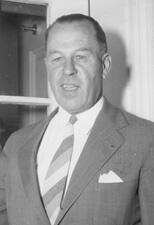
Here you will find contact information for Senator Dwight Palmer Griswold, including email address, phone number, and mailing address.
| Name | Dwight Palmer Griswold |
| Position | Senator |
| State | Nebraska |
| Party | Republican |
| Status | Former Representative |
| Term Start | January 1, 1952 |
| Term End | January 3, 1955 |
| Terms Served | 1 |
| Born | November 27, 1893 |
| Gender | Male |
| Bioguide ID | G000481 |
About Senator Dwight Palmer Griswold
Dwight Palmer Griswold (November 27, 1893 – April 12, 1954) was an American publisher and Republican politician from Nebraska who served as the twenty-fifth governor of Nebraska from 1941 to 1947 and as a United States Senator from Nebraska in the early 1950s. A member of the Republican Party, he contributed to the legislative process during one term in office in the United States Congress, representing the interests of his constituents during a significant period in American history.
Griswold was born in Harrison, Sioux County, Nebraska, and grew up in northwestern Nebraska, attending the public schools in Gordon, Nebraska. He pursued further education at the Kearney Military Academy and at Nebraska Wesleyan University before enrolling at the University of Nebraska in Lincoln. He received a Bachelor of Arts degree from the University of Nebraska in 1914, grounding himself in liberal arts education that preceded his military and political careers.
Following his graduation, Griswold entered military service during a period of rising international and border tensions. He served as an infantry sergeant on the U.S.–Mexico border from 1916 to 1917, part of the mobilization associated with the Mexican Expedition and related security operations. During World War I he continued his military service, becoming a captain in the field artillery. This combination of enlisted and commissioned experience gave him familiarity with both the rank-and-file and command aspects of military life, which later informed his work in postwar international administration.
After returning to civilian life, Griswold entered journalism and state politics. From 1922 to 1940 he was editor and publisher of the Gordon Journal in Gordon, Nebraska, a local newspaper that anchored his public profile in the region and provided a platform for engagement in civic affairs. He was elected to the Nebraska House of Representatives in 1920, marking his first formal entry into elective office. He later served in the Nebraska Senate from 1925 to 1929, participating in state legislative deliberations during the interwar period. Griswold sought higher office repeatedly in the 1930s, running unsuccessfully for governor in 1932, 1934, and 1936, campaigns that nonetheless solidified his standing within the state Republican Party.
Griswold achieved statewide office in 1940 when he was elected governor of Nebraska. He took office as the state’s twenty-fifth governor in January 1941 and was reelected in 1942 and 1944, serving continuously until 1947. His gubernatorial tenure coincided with World War II, a period in which state governments were heavily involved in wartime mobilization, resource management, and veterans’ issues. In 1946 he sought to extend his political career to the federal level by challenging incumbent Senator Hugh A. Butler in the Nebraska Republican primary, but he was decisively defeated, temporarily halting his immediate ambitions for a seat in the United States Senate.
After leaving the governorship, Griswold turned to international service in the early Cold War environment. In 1947 he served in the Military Government of Germany, participating in the American occupation and reconstruction efforts following World War II. That same year he was appointed chief of the American mission for aid to Greece, a position he held from 1947 to 1948. In this capacity he oversaw the U.S. assistance program to Greece during the Greek Civil War, an early and prominent implementation of the Truman Doctrine aimed at containing communist influence in the Mediterranean region.
Griswold’s service in Congress came later, during a critical phase of postwar American politics. He was elected in 1952 to the United States Senate from Nebraska to complete an unexpired term scheduled to end on January 3, 1955, thereby filling Nebraska’s Class 2 Senate seat during the Eighty-third Congress. His tenure in the Senate, which began in 1952, placed him in Washington during the administration of President Dwight D. Eisenhower and at the height of early Cold War legislative debates. As a member of the Senate, Dwight Palmer Griswold participated in the democratic process, contributed to the legislative work of the chamber, and represented the interests of Nebraskans at the federal level. His service made him the third of six Senators to hold Nebraska’s Class 2 seat during the fifteenth Senate term for that seat, covering the period from January 3, 1949, to January 3, 1955.
Griswold’s Senate career was cut short by ill health. He died of a heart attack on April 12, 1954, at the Bethesda Naval Hospital in Bethesda, Maryland, while still in office and before the expiration of the term to which he had been elected. He was interred at Fairview Cemetery in Scottsbluff, Nebraska, reflecting his enduring ties to the state he had served in both state and national office. In recognition of his long public career—as legislator, governor, international administrator, and U.S. Senator—Dwight Palmer Griswold was posthumously inducted into the Nebraska Hall of Fame in 1993.