Senator Dwight May Sabin
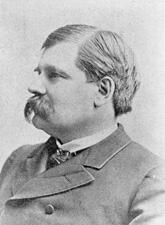
Here you will find contact information for Senator Dwight May Sabin, including email address, phone number, and mailing address.
| Name | Dwight May Sabin |
| Position | Senator |
| State | Minnesota |
| Party | Republican |
| Status | Former Representative |
| Term Start | December 3, 1883 |
| Term End | March 3, 1889 |
| Terms Served | 1 |
| Born | April 25, 1843 |
| Gender | Male |
| Bioguide ID | S000003 |
About Senator Dwight May Sabin
Dwight May Sabin (April 25, 1843 – December 22, 1902) was an American businessman and Republican politician who served as a United States Senator from Minnesota from March 4, 1883, to March 3, 1889, and as a member of both houses of the Minnesota Legislature. He was closely associated with major manufacturing and railroad-related enterprises in Minnesota, notably Seymour, Sabin & Co. and the Northwestern Car Company, whose rapid growth depended heavily on lucrative prison labor contracts he negotiated with the State of Minnesota in the 1870s. His election to the United States Senate in 1883 followed a protracted and highly contentious deadlock in the Minnesota Legislature, during which incumbent Senator William Windom failed of re-election in what contemporary observers described as “the worst campaign in the known history of the state.” He later became the namesake of the city of Sabin, Minnesota.
Sabin was born in 1843 in Marseilles, LaSalle County, Illinois, the elder of two sons of Horace Carver Sabin and Maria Elizabeth Webster, originally of Fredonia, New York. His father, a native of Windham County, Connecticut, had moved west to establish property near Marseilles, which was platted in 1853 as a canal town in anticipation of the completion of the Illinois and Michigan Canal. Horace Sabin’s enterprise in Illinois was initially successful, but recurring illness led the family to return to Connecticut by 1857. They settled in the Sabin ancestral home in Windham County, part of the original Connecticut New Roxbury Grant, which had descended through the family from some of the area’s earliest white settlers, circa 1686. Dwight Sabin spent his youth between these developing Midwestern and long-established New England environments, experiences that later informed both his business interests in lumber and his political identification with a rapidly industrializing West.
Following the death of his grandfather in 1862, Sabin enrolled at Phillips Academy in Andover, Massachusetts, where he studied civil engineering and mathematics. He remained there for about a year before leaving school to enlist in the Union Army during the American Civil War. Period accounts from 1883 claimed that he arrived at Gettysburg in July 1863 “on the second day of the decisive and dreadful battle of the rebellion,” at the time when the only Minnesota regiment in the Army of the Potomac was engaged on Cemetery Hill, though historians have noted that this Minnesota reference may have been emphasized as a political nod to his later Senate constituency. While in the Federal Army, Sabin served as an aide to the chief medical officer of General Alfred Pleasonton’s cavalry command. After several months of field service, he developed a pulmonary illness attributed to exposure in the field and was transferred from camp duty to a clerkship in the office of the Third Auditor of the Treasury (Auditor of the War Department) in Washington, D.C. When his father died in 1864, Sabin, then about twenty years old, was discharged from service and returned to Connecticut to assist his mother in managing the family estate.
In the years immediately following the war, Sabin divided family responsibilities with his mother and brother. He took charge of the family property in Windham County, Connecticut, where he spent roughly three years cutting his woodlands into lumber and disposing of it, while his mother, accompanied by his brother Jay, returned to Illinois to manage the farm there. During this period he married Ellen Amelia (E. Amelia) Hutchens (b. May 1, 1844), the adoptive daughter of a physician from Danielson, Connecticut; their marriage took place sometime between his return from wartime service in Washington and his later move to Minnesota. In 1867, on the advice of his physician, Sabin was urged to relocate for the sake of his health. After spending time with his family in Illinois, he moved farther west to Minnesota, settling in Stillwater, where he became involved in lumber and related manufacturing interests. This move marked the beginning of the business career that would underpin his later political prominence.
Sabin’s major business ventures began in 1868, when he entered into partnership with George M. Seymour to form Seymour, Sabin & Co. in Stillwater. The firm secured a contract with the State of Minnesota to employ inmate labor at the recently established Stillwater Prison, building on a labor-contract system that had begun in 1859. Under earlier arrangements, manufacturers had leased prison workshops and paid the state a per diem rate for each prisoner employed. By the time Sabin joined Seymour, concerns about the exploitative nature of the system were already being voiced; in 1868 the prison warden formally protested that inmates should be allowed to work for the benefit of the state rather than for private firms. Whether these protests were prompted by, or coincided with, the formation of Seymour, Sabin & Co. is unclear, but the new company quickly consolidated and expanded its operations. By 1871 the firm’s sales had surpassed $135,000. Initially manufacturing doors, window sashes, cooperage, and other wood products that naturally extended from Sabin’s lumber interests, the company expanded in 1874 to include a foundry and boiler works, enabling the production of agricultural implements. By 1876 it was producing threshing machines and soon became the largest manufacturer of the widely known “Minnesotan Chief” thresher. Profits reportedly topped $300,000 by 1881, and Sabin was described at the time as a man “very suggestive of potential force, stored ready for use. He isn’t much of a talker. His power is tangible.”
By 1882 Sabin had become the prime organizer of the Northwestern Car Company, capitalized at $5,000,000 and backed by “certain wealthy persons” representing large railroad interests. The new corporation purchased Seymour, Sabin & Co. and elected Sabin its president. With nearly 1,200 civilian workers employed both in the prison shops and in the extensive yards and workshops outside the prison walls, the enterprise grew to a scale that astonished contemporary observers. Prison inspectors in 1884 remarked that “it was never expected when the contract for prison labor was made, that the Manufacturing Co. of Seymour, Sabin & Co. would develop into the mammoth N.W. Manufacturing & Car Co.” Sabin’s business success, however, became intertwined with his political fortunes. As his prominence in Minnesota industry increased, he also emerged as a significant figure in state Republican politics, and his eventual elevation to the U.S. Senate required him to relinquish active leadership of his expanding manufacturing interests.
Sabin’s political career in Minnesota began at the state level. He was first elected to the Minnesota Senate in 1871, representing Chisago, Kanabec, Pine, and Washington Counties in the 13th Legislative Session. Following reapportionment, he was re-elected to the Senate in 1872 and 1873 from District 22, Washington County, which included Stillwater. After an interval of four one-year legislative terms in which he did not serve, he returned to office as a member of the Minnesota House of Representatives from Washington County in 1878, 1881, and 1882. In total, he was elected six times to the two houses of the Minnesota Legislature. During these years he also became active in national Republican politics, serving as a delegate to the Republican National Conventions of 1872, 1876, 1880, and 1884. He chaired the Republican National Committee from 1883 to 1884, reflecting his stature within the party. Contemporary accounts suggest that while he was a popular and reliable party man, he was not regarded as an especially brilliant orator or legislative innovator.
Sabin’s election to the United States Senate in early 1883 was the product of a bitter intra-party struggle. Incumbent Senator William Windom, a prominent advocate of railroad regulation, had weakened his own position by effectively abandoning his Senate seat and committee work after 1880 in pursuit of an unsuccessful presidential candidacy. By the time the Minnesota Legislature convened to choose a senator in January 1883, Windom had “antagonized in various ways a large number of his political associates.” On January 16, 1883, the first round of balloting in the legislature failed to produce the required quorum of 63 votes for any candidate. Windom, then in Washington, D.C., rushed back to Minnesota, but his efforts to salvage his candidacy were unsuccessful. Over the following weeks, multiple inconclusive ballots were taken. On January 31, 1883, Sabin’s name appeared on the ballots for the first time, receiving a surprising 17 votes. Momentum quickly shifted in his favor, and on February 17, 1883, he secured 81 votes and was elected. He resigned from active leadership in his business enterprises to assume his federal office.
As a United States Senator from Minnesota, Sabin served one full term, from March 4, 1883, to March 3, 1889, sitting in the 48th, 49th, and 50th Congresses. A member of the Republican Party, he participated in a period of significant national debate over railroad regulation, veterans’ benefits, and internal improvements. He served as chairman of the Senate Committee to Examine Branches of the Civil Service during the Forty-ninth Congress and as chairman of the Committee on Railroads during the Fiftieth Congress. In these roles he was involved in legislation affecting railroad development and oversight, veterans’ pensions, and improvements to Great Lakes navigation, including work related to the Soo Locks at Sault Ste. Marie, where one lock was later named in his honor. Colleagues and observers noted that he “made no pretense to oratory, and was not known as a speech-making senator, but rather a hard working member in the interest of his state, especially in the line of transportation.” In 1888 he was not renominated by the Minnesota Republican Party. Sabin alleged that bribery had influenced the outcome of the legislative caucus that denied him a second term, but these charges were never substantiated. He left the Senate in March 1889 and returned to his business pursuits.
Sabin’s personal life attracted national attention, particularly in connection with his first marriage. With his first wife, Ellen Amelia Hutchens, he adopted three children. The couple first adopted two sisters, Blanche and Ethel, daughters of John B. Raymond of Fargo, a former congressional delegate for the Dakota Territory. Later they adopted a third child, Ada Chambers, a young relative of the Sabin family. In Stillwater, Sabin built a large and elaborate residence at the northeast corner of Laurel and Third Streets in the early 1870s. This mansion was reputedly the first private home in Stillwater to have electric lighting; Sabin arranged for cables to run from the prison powerhouse to his residence, and the house, wired throughout, became locally famous. Visitors “gazed on the wonderful Aladdin Cave lights,” and the brilliantly illuminated home became widely discussed as a marvel “to be seen both day and night at the stately Sabin home.” The Sabins were regarded as a socially prominent and congenial couple, and they adapted easily to Washington society after his election to the Senate. Ellen Sabin hosted weekly receptions in the capital that the New York Times described as among the most popular in the city, attended by many distinguished figures, and she participated in major social events, including formal occasions such as the funeral of Ulysses S. Grant.
The marriage, however, ended in public scandal. After Sabin’s defeat for re-nomination to the Senate, he filed for divorce from Ellen on the grounds of her alleged misuse of alcohol and morphine. She had been placed in an “asylum for inebriates” in Flushing, New York, and news of the divorce proceedings reached the front page of the New York Times. While some press accounts portrayed Mrs. Sabin as a victim, committed against her will, the Times, which had previously been critical of Sabin’s political and financial dealings, adopted a notably sympathetic tone toward him in this domestic matter. It reported that “Senator Sabin has acted generously by her in his provisions for her present and future comfort” and that neither she nor her friends and family would contest the suit. The paper concluded that Sabin’s conduct “has been all that could be expected under the melancholy circumstances of the case.” The episode, unfolding just as his Senate career ended, added a dramatic personal dimension to his public life.
On July 1, 1891, Sabin married his second wife, Jessie Larmon (often referred to as Jessie Swann), daughter of Asabel and Susan Slee of Paducah, Kentucky, and the widow of W. G. Swann of St. Paul, Minnesota. In his later years he continued to be involved in business and maintained his social and political connections in Minnesota. By around 1900 he and Jessie were living in Duluth, Minnesota, near the home of his adopted daughter Ethel, who had married T. C. Phillips. The once-celebrated Sabin mansion in Stillwater stood largely empty after the family’s move and was ultimately demolished in 1918 for its timber. Sabin died of unexpected heart failure on December 22, 1902, at the Auditorium Annex in Chicago, Illinois, with Jessie at his side. He left a legacy as a key figure in Minnesota’s late nineteenth-century industrial expansion and Republican politics, a businessman-politician whose career linked prison-based manufacturing, railroad development, and the contentious politics of Gilded Age America.