Representative E. Wallace Chadwick
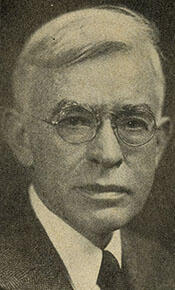
Here you will find contact information for Representative E. Wallace Chadwick, including email address, phone number, and mailing address.
| Name | E. Wallace Chadwick |
| Position | Representative |
| State | Pennsylvania |
| District | 7 |
| Party | Republican |
| Status | Former Representative |
| Term Start | January 3, 1947 |
| Term End | January 3, 1949 |
| Terms Served | 1 |
| Born | January 17, 1884 |
| Gender | Male |
| Bioguide ID | C000268 |
About Representative E. Wallace Chadwick
E. Wallace Chadwick (January 17, 1884 – August 18, 1969) was an American lawyer and Republican politician from Indiana who served one term in the United States House of Representatives as the member for Pennsylvania’s 7th congressional district from January 3, 1947, to January 3, 1949. His congressional service took place during the pivotal early Cold War and immediate post–World War II period, when the Eightieth Congress marked the first Republican majority on Capitol Hill since 1928.
Chadwick was born in Vincennes, Knox County, Indiana, on January 17, 1884. In 1890 he moved with his parents to Chester, Delaware County, Pennsylvania, which would remain the center of his personal and professional life. He attended the public schools of Chester and graduated from Chester High School in 1902. He then enrolled at the University of Pennsylvania in Philadelphia, receiving a Bachelor of Arts degree in 1906. A strong student, he was elected to Phi Beta Kappa. Continuing at the same institution, he studied law at the University of Pennsylvania Law School, earning an LL.B. in 1910.
In 1910 Chadwick was admitted to the Delaware County bar and commenced the practice of law in Chester. Over the following decades he built a substantial legal practice, representing, among others, Pennsylvania Governor William C. Sproul and a number of major corporations. His professional standing within the local bar grew steadily, and he served two years as president of the Delaware County Bar Association. Although long identified with the Republican Party, he initially operated largely outside the formal party machine. His first notable foray into organized politics came in 1940, when, as an independent Republican, he organized “Willkie for President” clubs in Delaware County in support of Wendell Willkie’s presidential campaign.
Chadwick’s judicial career began during World War II. On January 19, 1945, he was selected by Pennsylvania Senate Majority Leader Weldon Brinton Heyburn to fill the remaining year of a vacancy as president judge of the Delaware County Orphans’ Court. He was formally nominated for the post by Governor Edward Martin and unanimously confirmed by the Pennsylvania Senate by a vote of 48 to 0. Seeking to retain the office, Chadwick announced his candidacy for a full ten-year term that same year. His appointment, however, had been made independently of John J. McClure, chairman of the Delaware County Board of Republican Supervisors—known locally as the “War Board”—and Chadwick consequently faced the full opposition of the entrenched county machine. In a hard-fought primary in which McClure’s organization mobilized extensive resources, Chadwick was narrowly defeated by the War Board–endorsed candidate, E. Leroy van Roden, by a vote of 31,428 to 29,808. Although he carried communities such as Swarthmore by overwhelming margins and ran strongly in several suburban municipalities, he served as president judge only until the end of 1945.
Undeterred by this setback, Chadwick soon turned to congressional politics. On February 13, 1946, just as incumbent Representative James Wolfenden was announcing his retirement from Congress, Chadwick issued his own statement declaring his candidacy for the Republican nomination in Pennsylvania’s 7th congressional district. Despite rumors that McClure had previously promised the seat to another Republican, and despite the county organization’s endorsement of federal labor mediator James F. Dewey, Chadwick ran as a reform-minded independent Republican, urging voters to “reclaim Delaware County from the stigma of McClurism.” In the 1946 Republican primary he narrowly defeated Dewey by 287 votes out of 76,543 cast, carrying 31 of the district’s 49 municipalities and running particularly well in larger suburban communities such as Haverford, Lansdowne, Ridley Township, Springfield, Swarthmore, and Upper Darby. His victory marked a rare and notable defeat of the War Board’s machine in a countywide Republican primary for a major office.
In the general election of 1946, held against a national backdrop of postwar economic dislocation, labor unrest, and rising concern over communism, Chadwick benefited from a strong Republican tide. With the GOP campaign slogan “Had enough?” aimed at fourteen years of Democratic control in Washington, he faced Democratic nominee Vernon O’Rourke, who ran a comparatively low-profile campaign. Registered Republicans heavily outnumbered Democrats in Delaware County, and Chadwick won decisively, defeating O’Rourke by 76,021 votes to 38,253. His election contributed to the sweeping Republican gains that produced the Eightieth Congress, in which the party captured 56 additional House seats and 13 Senate seats, and in which Joseph W. Martin Jr. of Massachusetts became Speaker of the House and Wallace H. White of Maine became Senate Majority Leader.
Taking his seat in the House of Representatives on January 3, 1947, Chadwick established a record as a conservative Republican legislator with a pronounced anti-Communist stance and a strong interest in postwar economic and foreign policy issues. He introduced legislation to protect GI insurance benefits for veterans and sponsored a measure to transfer all federal interests in coastal tidelands to the states. He strongly defended appropriations for the House Un-American Activities Committee, reflecting his concern over communist influence. On major roll-call votes, he supported the Labor Disputes Act establishing a Mediation Board, voted for the Taft–Hartley Act to curb certain union practices—supporting its passage over President Harry S. Truman’s veto—backed a constitutional amendment limiting presidents to two terms, and voted to extend rent controls and reduce income taxes. In foreign affairs he supported aid to Greece and Turkey under the Truman Doctrine to resist communist aggression and delivered a forceful speech on March 31, 1948, in favor of the European Recovery Program, or Marshall Plan, calling it the only realistic alternative to war for preventing communist domination of Europe. While voting against the admission of Hawaii as a state and in favor of an anti–poll tax bill, he also emphasized in public addresses his belief that the American and Soviet peoples could ultimately find peaceful means of resolving their differences. He cultivated an unusually visible and responsive style of representation, personally answering constituent correspondence and using frequent radio broadcasts to explain his positions, arguing that effective constituent service was essential to maintaining faith in democratic government.
Chadwick’s independence from the Delaware County Republican machine, however, led to a fierce intra-party struggle over his renomination in 1948. The War Board, led by McClure, backed former state representative Benjamin F. James against him, and the primary campaign quickly became a test of machine power versus reformist Republicanism. Chadwick aligned himself with other independent Republicans, including Guy G. deFuria for state senator, and challenged the machine’s control in both speeches and litigation, even suing McClure in an unsuccessful attempt to prevent the use of the name “Republican Party of Delaware County” on machine campaign literature. The campaign was marked by bitter charges, including a controversial anti–deFuria billboard and the unprecedented intervention of Philadelphia Congressman George W. Sarbacher Jr., who publicly campaigned against Chadwick, reportedly at the behest of Philadelphia party boss Austin Meehan. Although Chadwick received endorsements from prominent Republicans, favorable coverage from local newspapers, and public support from national figures such as columnist Drew Pearson and fellow members of Congress, the organizational strength and resources of the McClure machine ultimately prevailed. In the April 1948 primary Chadwick lost the Republican nomination to James by a margin of 47,790 to 40,165, suffering decisive defeats in several of the district’s larger municipalities despite improving his vote in Chester. Local commentators, including the Chester Times, attributed his defeat to his refusal to conform to the will of the county machine, and he left Congress at the conclusion of his term on January 3, 1949.
After his congressional service ended, Chadwick returned to his law practice in Chester, resuming the career that had first brought him prominence in Delaware County. His legal and political experience continued to be recognized at the national level. In 1954 he was appointed chief counsel to a special United States Senate committee convened to study and investigate censure charges against Senator Joseph R. McCarthy, placing him at the center of one of the most consequential episodes of the early Cold War. That same year, Pennsylvania Military College in Chester (later Widener University) awarded him an honorary Doctor of Laws degree in recognition of his public service and professional achievements. In 1956 Secretary of State John Foster Dulles named Chadwick to a seven-member panel charged with reviewing the records of all career Foreign Service officers, a sensitive assignment reflecting both the era’s security concerns and Chadwick’s reputation for legal and political judgment.
E. Wallace Chadwick spent his later years in Chester, remaining a respected figure in local legal and civic circles. He died in Chester, Pennsylvania, on August 18, 1969, at the age of eighty-five. He was interred at Old Union Methodist Church Cemetery in Wallingford, Pennsylvania, closing a life that spanned from the late nineteenth century through the height of the Cold War and that encompassed service as a local judge, independent Republican reformer, and one-term member of the United States House of Representatives.