Representative Earl Lee Hogan
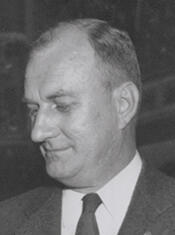
Here you will find contact information for Representative Earl Lee Hogan, including email address, phone number, and mailing address.
| Name | Earl Lee Hogan |
| Position | Representative |
| State | Indiana |
| District | 9 |
| Party | Democratic |
| Status | Former Representative |
| Term Start | January 7, 1959 |
| Term End | January 3, 1961 |
| Terms Served | 1 |
| Born | March 13, 1920 |
| Gender | Male |
| Bioguide ID | H000690 |
About Representative Earl Lee Hogan
Earl Lee Hogan (March 13, 1920 – June 3, 2007) was an American World War II veteran, law enforcement officer, and public official who served one term as a U.S. Representative from Indiana from 1959 to 1961. A member of the Democratic Party, he represented Indiana’s Ninth Congressional District in the Eighty-sixth Congress and contributed to the legislative process during a significant period in American history. He was born in Hope, Bartholomew County, Indiana, and he also died there, maintaining close ties to his native community throughout his life.
Hogan attended public schools in nearby Burney, Indiana, receiving his early education in the local school system. He later pursued higher education at Indiana University and the University of Kentucky, undertaking college studies that were interrupted and shaped by the onset of World War II. His formative years in rural Indiana and his subsequent academic work provided the foundation for a career that would combine military service, local law enforcement, and federal rural development policy.
As World War II approached, Hogan enlisted in the United States Army Air Corps in 1940. He remained in the service until 1945, serving as a bombardier on the B-17 Flying Fortress in the European theater. During his military service he saw combat action and distinguished himself for bravery and skill. He received the Distinguished Flying Cross, the Purple Heart, and the Air Medal with three Oak Leaf Clusters, reflecting repeated acts of meritorious achievement and wounds received in action. His wartime experience and decorations marked him as part of the generation of veterans whose service would heavily influence postwar American public life.
After returning from military service, Hogan embarked on a career in local law enforcement in Bartholomew County, Indiana. He was appointed deputy sheriff of Bartholomew County, serving from 1946 to 1950. Building on this experience and local reputation, he successfully ran for sheriff of Bartholomew County and held that office for two terms from 1950 to 1958. As sheriff, he was responsible for county law enforcement and administration of the county jail during a period of postwar growth and change in southern Indiana, which further established his standing as a public servant in his home region.
Approaching the end of his second term as sheriff, Hogan sought federal office as a Democrat. In 1958 he ran for the U.S. House of Representatives from Indiana’s Ninth District and was elected to the Eighty-sixth Congress. He served from January 3, 1959, to January 3, 1961. During his single term in Congress, Hogan participated in the democratic process and represented the interests of his constituents at a time when the nation was confronting Cold War tensions, the early stirrings of the civil rights movement, and debates over domestic economic policy. Although he sought reelection in 1960, he was unsuccessful in his bid for a second term and left the House at the conclusion of his term in 1961.
Following his congressional service, Hogan remained in Washington, D.C., and began a long career in federal rural development and agricultural credit programs. In 1961 he served as assistant to the administrator of the Farmers Home Administration, an agency of the U.S. Department of Agriculture responsible for providing credit and assistance to farmers and rural communities. That same year he became assistant to the administrator of the Rural Electrification Administration, serving in that capacity from 1961 to 1962 and contributing to efforts to expand and modernize rural electric service. From 1962 to 1966 he served as Midwest field representative in the Office of Rural Areas Development, working to coordinate federal initiatives aimed at improving economic conditions in rural regions.
Hogan continued his federal service with the Farmers Home Administration in a series of increasingly responsible positions. From 1966 to 1970 he served as a rural development specialist, focusing on programs to strengthen rural infrastructure and business opportunities. He then became special projects representative from 1971 to 1975, working on targeted initiatives to support rural communities. From 1975 until his retirement from federal service in 1980, he served as chief of the Business and Industrial Loan Division of the Farmers Home Administration, overseeing loan programs designed to foster industrial and commercial development in rural areas. In this role he helped shape federal policy tools that supported job creation and economic diversification outside urban centers.
In addition to his federal responsibilities, Hogan returned to Indiana state government service while continuing his work in rural development. Beginning in 1966, he served as secretary of the Indiana State Rural Development Committee, a position he held until 1980. In this capacity he helped coordinate state and federal efforts to improve conditions in Indiana’s rural communities. He also served as chairman of the state advisory board of Indiana Green Thumb, Inc., from 1975 to 1982, supporting programs that provided employment and community service opportunities, particularly for older and disadvantaged workers, in rural areas of the state.
Hogan’s personal life was rooted in his home community of Hope, Indiana. He was married to Alma Guy Benthal, who died in 2000. Together they raised a family of six children, and at the time of his death he was survived by his children, eight grandchildren, and two great-grandchildren. Earl Lee Hogan died in Hope, Indiana, on June 3, 2007, at the age of 87, closing a life that spanned military service in World War II, local law enforcement leadership, a term in the U.S. House of Representatives, and nearly two decades of influential work in federal and state rural development programs.