Representative Edgar Dean Crumpacker
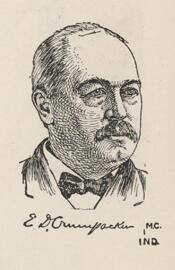
Here you will find contact information for Representative Edgar Dean Crumpacker, including email address, phone number, and mailing address.
| Name | Edgar Dean Crumpacker |
| Position | Representative |
| State | Indiana |
| District | 10 |
| Party | Republican |
| Status | Former Representative |
| Term Start | March 15, 1897 |
| Term End | March 3, 1913 |
| Terms Served | 8 |
| Born | May 27, 1851 |
| Gender | Male |
| Bioguide ID | C000958 |
About Representative Edgar Dean Crumpacker
Edgar Dean Crumpacker (May 27, 1851 – May 19, 1920) was an American lawyer, jurist, and Republican politician who served eight consecutive terms as a U.S. Representative from Indiana from 1897 to 1913. Over the course of his congressional career, he contributed to the legislative process during a significant period in American history, representing the interests of his Indiana constituents in the House of Representatives. He was the father of future Oregon Congressman Maurice E. Crumpacker and a cousin of Indiana Congressman Shepard J. Crumpacker Jr., extending his family’s influence across multiple generations of public service.
Crumpacker was born on May 27, 1851, in Westville, LaPorte County, Indiana. He was educated in the common schools of the region and later attended Valparaiso Academy in Valparaiso, Indiana, reflecting the typical educational path of aspiring professionals in the post–Civil War Midwest. His early life in Indiana, then a growing and increasingly influential state in the Union, provided the local grounding and civic awareness that would later shape his legal and political career.
Pursuing a career in law, Crumpacker studied in the law department of Indiana University at Bloomington. He was admitted to the bar in 1876 and commenced the practice of law in Valparaiso, Indiana. Establishing himself as a practicing attorney in Valparaiso, he quickly became a prominent figure in the local legal community, building the professional reputation that would support his later entry into public office.
Crumpacker’s formal public career began in the judicial system of Indiana. He served as prosecuting attorney for the Thirty-first Judicial District of Indiana from 1884 to 1888, a role in which he was responsible for representing the state in criminal prosecutions and enforcing its laws at the district level. His performance in that office led to further advancement when Governor Alvin P. Hovey appointed him as an appellate judge. Crumpacker served as an appellate judge from March 1891 until January 1, 1893, gaining experience in reviewing lower court decisions and interpreting state law, and further enhancing his standing as a legal authority in Indiana.
Building on his legal and judicial experience, Crumpacker entered national politics as a member of the Republican Party. He was elected as a Republican to the Fifty-fifth Congress and to the seven succeeding Congresses, serving in the U.S. House of Representatives from March 4, 1897, to March 3, 1913. During these eight terms, he represented Indiana through a period marked by industrial expansion, the Progressive Era, and significant debates over civil rights, economic regulation, and federal power. As a member of the House, he participated actively in the democratic process and contributed to shaping national legislation on behalf of his constituents.
Within Congress, Crumpacker attained a position of particular influence as chairman of the House Committee on the Census, a post he held during the Fifty-eighth through the Sixty-first Congresses. In that capacity, he oversaw legislative matters related to the federal census, a critical instrument for apportioning representation and allocating federal resources. His work on the committee placed him at the center of debates over population, representation, and the political balance among the states at a time when demographic changes and questions of voting rights were increasingly contentious.
Crumpacker was also notable for his efforts to address the disenfranchisement of African American voters in the South. In 1901, prior to his chairmanship of the Census Committee, he attempted to invoke Section 2 of the Fourteenth Amendment to the Constitution to reduce the representation of certain Southern states in the House of Representatives because of their systematic suppression of African American suffrage. He argued that the language of the Constitution was “clear, direct, and mandatory,” leaving Congress no discretion when states abridged the right to vote. In speeches on the House floor, he warned that denying African Americans political rights invited broader abuses, including mob violence and lynching, and contended that federal action was necessary to prevent the emergence of conditions “practically as bad as slavery.” Specifically, he proposed reducing Louisiana’s House seats from seven to four, Mississippi’s from seven to four, North Carolina’s from nine to six, and South Carolina’s from six to four, on the grounds that each had adopted state constitutions that made it nearly impossible for African Americans to vote. His motion to consider revising state apportionments was defeated by a vote of 94 to 136, but the effort marked a significant, if unsuccessful, attempt to use constitutional mechanisms to challenge racial disfranchisement.
After eight terms in Congress, Crumpacker sought reelection in 1912 to the Sixty-third Congress but was unsuccessful. In the 1912 United States House of Representatives elections, he was defeated by Democrat John B. Peterson, ending his sixteen-year tenure in the House. Following his departure from Congress in March 1913, he returned to Valparaiso, Indiana, where he resumed the practice of law. He continued to live and work there until his death, remaining a respected figure in the community he had long served both as attorney and legislator.
Edgar Dean Crumpacker died in Valparaiso, Indiana, on May 19, 1920. He was interred in Graceland Cemetery in Valparaiso. His career, spanning local prosecution, appellate judging, and extended congressional service, reflected the trajectory of a late nineteenth- and early twentieth-century Midwestern Republican who combined legal expertise with an active role in national debates over representation, civil rights, and the constitutional order.