Representative Edgar Howard
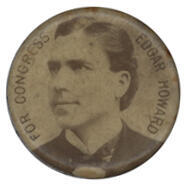
Here you will find contact information for Representative Edgar Howard, including email address, phone number, and mailing address.
| Name | Edgar Howard |
| Position | Representative |
| State | Nebraska |
| District | 3 |
| Party | Democratic |
| Status | Former Representative |
| Term Start | December 3, 1923 |
| Term End | January 3, 1935 |
| Terms Served | 6 |
| Born | September 16, 1858 |
| Gender | Male |
| Bioguide ID | H000836 |
About Representative Edgar Howard
Edgar Howard (September 16, 1858 – July 19, 1951) was a Nebraska newspaper editor, lawyer, and Democratic politician who served as the fifteenth lieutenant governor of Nebraska and represented Nebraska in the United States House of Representatives from 1923 to 1935. Over six consecutive terms in Congress, he played an active role in the legislative process during a transformative period in American history, including the early years of the New Deal.
Howard was born in Osceola, Iowa, on September 16, 1858. He attended the Western Collegiate Institute and later studied law at the Iowa College of Law. Drawn early to journalism, he worked as a reporter and editor for various newspapers in his youth. This combination of legal training and experience in the press would shape his public career, giving him both a platform and a professional grounding in public affairs.
In 1884 Howard moved to Nebraska, where he became editor of the Papillion Times in Papillion, Nebraska. That same year he married Elizabeth Burtch; the couple had four children: Findley, Mary, Martha, and Helen. The death of his daughter Martha in the early 1900s deeply affected him and inspired his poem “A Christmas Vision,” written in her memory. While editing the Papillion Times, Howard became increasingly involved in civic life and Democratic Party politics, using his newspaper as a vehicle for commentary on local and state issues.
Howard entered elective office in the 1890s. He was elected to the Nebraska House of Representatives in 1894, serving until 1896. In 1896 he was elected probate judge of Sarpy County, Nebraska, and in the same year served as a delegate to the 1896 Democratic National Convention, reflecting his growing prominence in party affairs. Also in 1896 he passed the state bar examination and established a law practice in Papillion, combining legal work with his ongoing involvement in journalism and politics. He concluded his term as probate judge in 1900.
In 1900 Howard relocated to Columbus, Nebraska, where he purchased the weekly Columbus Telegram. Under his ownership and editorship, the paper became an influential voice in central Nebraska. He published the Telegram for decades and, in 1922, expanded it into a daily newspaper, the Columbus Daily Telegram. His work as an editor and publisher continued throughout his political career and after his service in public office, providing him with a consistent platform for his views on state and national issues.
Howard’s statewide political career advanced when he was elected lieutenant governor of Nebraska in 1916. He served as the fifteenth lieutenant governor from 1917 to 1919, presiding over the state senate and participating in the administration of state government during the World War I era. His tenure in this office further established his reputation as a leading Democrat in a predominantly Republican state and set the stage for his subsequent election to national office.
In 1922 Howard was elected as a Democrat to the Sixty-eighth United States Congress and was reelected to the five succeeding Congresses, serving in the U.S. House of Representatives from March 4, 1923, to January 3, 1935. As a member of the House of Representatives from Nebraska, he represented the interests of his constituents through years marked by the prosperity of the 1920s, the onset of the Great Depression, and the early New Deal reforms. During the Seventy-second and Seventy-third Congresses, he chaired the U.S. House Committee on Indian Affairs. In that role he was a co-sponsor of the Indian Reorganization Act and was notably concerned with ending what he described as “the staggering losses of Indian lands.” He strongly supported the termination of the allotment system that had broken up communal tribal lands, seeking to protect and restore Native American landholdings and self-governance. His legislative work on Indian affairs was among the most consequential aspects of his congressional service.
Howard’s congressional career ended when he lost his bid for reelection in 1934 to Republican Karl Stefan. He sought to regain his former seat in 1938 but was again defeated by Stefan. After each electoral loss, Howard returned to Columbus and resumed full-time management and publication of the Columbus Daily Telegram, remaining active in public discourse even after leaving elective office. He continued to be recognized as a significant figure in Nebraska journalism and Democratic politics well into his later years.
Edgar Howard died in Columbus, Nebraska, on July 19, 1951. He was interred in Columbus Cemetery. His long life spanned from the Civil War era into the mid-twentieth century, and his career as editor, lawyer, state legislator, lieutenant governor, and six-term member of Congress reflected a sustained engagement with the political and social issues of his time, particularly in the realms of press freedom, state governance, and federal Indian policy.