Representative Edith Green
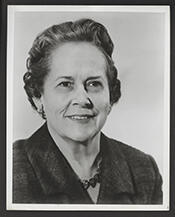
Here you will find contact information for Representative Edith Green, including email address, phone number, and mailing address.
| Name | Edith Green |
| Position | Representative |
| State | Oregon |
| District | 3 |
| Party | Democratic |
| Status | Former Representative |
| Term Start | January 5, 1955 |
| Term End | January 3, 1975 |
| Terms Served | 10 |
| Born | January 17, 1910 |
| Gender | Female |
| Bioguide ID | G000407 |
About Representative Edith Green
Edith Louise Starrett Green (January 17, 1910 – April 21, 1987) was an American politician and educator from Oregon who served as a Representative from Oregon in the United States Congress from 1955 to 1975. A member of the Democratic Party, she was the second Oregonian woman to be elected to the U.S. House of Representatives, after Nan Wood Honeyman, and one of only 17 women in the House at the time of her election. Over ten terms in office, representing Oregon’s 3rd congressional district, she became a leading national figure on education policy, women’s issues, library support, and social reform, and played an instrumental role in the development and passage of the 1972 Equal Opportunity in Education Act, better known as Title IX.
Green was born Edith Louise Starrett in Trent, South Dakota, on January 17, 1910. In 1916 her family moved to Oregon, where she grew up in Salem. She attended local schools and graduated from Salem High School (now North Salem High School) in 1927. That same year she enrolled at Willamette University and attended from 1927 to 1929. In 1929 she began working as a schoolteacher and advocate of education, and in 1930 she married Arthur N. Green. She left college to begin a family, but her early experience in the classroom and her growing interest in public affairs laid the foundation for her later career in educational policy and politics.
Determined to complete her education, Green returned to school in 1939 and earned a bachelor’s degree from the University of Oregon. She pursued graduate study at Stanford University, further deepening her expertise in education and public policy. During the 1940s she became a radio commentator and writer, using the medium to discuss public issues and to promote educational causes. Her commitment to improving schools led her to become a lobbyist for the Oregon Education Association, where she gained practical experience in legislative advocacy and built relationships that would prove crucial when she later sought elective office. She was also recognized as an honorary member of Delta Sigma Theta sorority, reflecting her engagement with broader civic and social networks.
A Democrat, Green first ran for political office in 1952 as the party’s candidate for Oregon Secretary of State. She was narrowly defeated by the incumbent, Earl T. Newbry, but the campaign raised her profile statewide. In 1954 she ran for Congress from Oregon’s 3rd congressional district and was elected to the U.S. House of Representatives, defeating Republican nominee Tom McCall, who would later become governor of Oregon. Taking office in January 1955, she began what would become ten consecutive terms in the House, serving until her resignation on December 31, 1974. Throughout her service in Congress, which spanned a significant period in American history marked by the Cold War, the civil rights movement, and major expansions of federal involvement in education, Green participated actively in the legislative process and represented the interests of her Portland-area constituents.
During her congressional career, Green emerged as one of the most influential voices on education in the federal government. In 1955 she proposed the Equal Pay Act to ensure that men and women were paid equally for equal work; the measure was ultimately signed into law eight years later, in 1963. She introduced and supported major legislation including the Alaska Mental Health Enabling Act of 1956, which reformed the mental health care system in the then-territory of Alaska, and the Library Services Act, which expanded access to libraries in rural communities. She played a central role in shaping the Higher Education Facilities Act of 1963, which President Lyndon B. Johnson described as “the greatest step forward in the field since the passage of the Land-Grant Act of 1862,” and she was a key architect of the Higher Education Act of 1965 and its 1967 amendments. Green also contributed significantly to the National Defense Education Act of 1958, designed to strengthen American education in science and technology in response to the Soviet Union’s launch of Sputnik 1. Her sustained legislative work on schools, colleges, and libraries earned her epithets such as “the Mother of Higher Education” and “Mrs. Education.”
Green was equally prominent in advancing women’s rights and gender equity in education. In the late 1960s she observed that while programs existed to keep boys in school, there were no comparable efforts for girls. Seeking to correct this imbalance, she helped to develop higher education legislation that incorporated provisions on gender equity. Working closely with Representative Patsy T. Mink and Senator Birch Bayh, she helped shape the hearings and legislative language that culminated in the passage of Title IX of the Education Amendments of 1972, formally known as the Equal Opportunity in Education Act and now called the Patsy T. Mink Equal Opportunity in Education Act. The law prohibited sex discrimination in federally funded educational institutions and became one of the most consequential statutes in the history of women’s education and athletics. Earlier, in 1964, she had been the only woman in the House to vote against including sex as a protected class in Title VII of the Civil Rights Act of 1964, a provision introduced by Representative Howard W. Smith in what many viewed as an attempt to derail the bill. Green argued that to ensure passage of the core protections against discrimination based on race, color, religion, or national origin, she was willing to forgo the inclusion of sex at that time, remarking that “For every discrimination that I have suffered, the Negro woman has suffered ten times that amount of discrimination.”
Beyond her legislative work, Green held a notable place in national Democratic politics. Senator Mark Hatfield, a Republican from Oregon who served alongside her, called her “the most powerful woman ever to serve in the Congress.” Adlai Stevenson selected her to second his nomination at the 1956 Democratic National Convention, and John F. Kennedy likewise chose her to second his nomination at the 1960 Democratic National Convention. She headed Oregon state primary campaigns for John F. Kennedy, Robert F. Kennedy, and Henry M. “Scoop” Jackson, underscoring her influence within the party. Green was repeatedly mentioned as a potential candidate for the U.S. Senate, most prominently in 1966 in a race ultimately won by Mark Hatfield, but she declined to run, unwilling to trade her accumulated seniority in the House for junior status in the Senate.
Edith Starrett Green decided not to seek an eleventh term in 1974 and resigned from Congress on December 31, 1974, just before her final term expired; she was succeeded by Robert B. Duncan. After leaving the House, she returned to Portland, Oregon, and became a professor of government at Warner Pacific College, continuing her long engagement with education by teaching and mentoring students. In 1976 she served as co-chairwoman of National Democrats for Gerald Ford, reflecting her independent judgment and willingness to cross party lines in presidential politics. She was appointed to the Oregon State Board of Higher Education in 1979, where she continued to influence educational policy at the state level. Later residing in Wilsonville, she was appointed by President Ronald Reagan in 1981 to the President’s Commission on White House Fellowships, further extending her public service into the 1980s.
Edith Green died on April 21, 1987, in Tualatin, Oregon, and was buried at Mountain View Cemetery in Corbett, Oregon. Her legacy in public life, particularly in the areas of education and women’s rights, is commemorated in part by the Edith Green – Wendell Wyatt Federal Building in downtown Portland, named in her honor along with Congressman Wendell Wyatt, with whom she served during part of her tenure in Congress. Throughout her career, from her early work as a teacher and education advocate to her decades in the House of Representatives and her later roles in higher education governance, Green advanced women’s issues, education, library support, and social reform, leaving a lasting imprint on both Oregon and the nation.