Representative Edmund Nelson Carpenter
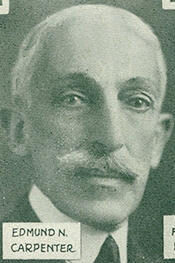
Here you will find contact information for Representative Edmund Nelson Carpenter, including email address, phone number, and mailing address.
| Name | Edmund Nelson Carpenter |
| Position | Representative |
| State | Pennsylvania |
| District | 12 |
| Party | Republican |
| Status | Former Representative |
| Term Start | December 7, 1925 |
| Term End | March 4, 1927 |
| Terms Served | 1 |
| Born | June 27, 1865 |
| Gender | Male |
| Bioguide ID | C000168 |
About Representative Edmund Nelson Carpenter
Edmund Nelson Carpenter (June 27, 1865 – November 4, 1952) was a Republican member of the U.S. House of Representatives from Pennsylvania who served one term in Congress from 1925 to 1927. A lifelong Pennsylvanian, he combined a background in manufacturing and military service with a brief but notable period of federal legislative service during a significant era in American political and economic development.
Carpenter was born on June 27, 1865, in Wilkes-Barre, Luzerne County, Pennsylvania. He was the son of Benjamin Gardner Carpenter and Sarah Ann Feld and one of five children in the family. Through his father’s line he was a descendant of William Carpenter (1605–1658/1659), an English immigrant who settled in Rehoboth, in the Plymouth Colony, in the mid-1630s and became the founder of the Rehoboth Carpenter family in America. This New England ancestry placed him within a longstanding American lineage that had been present in the colonies since the early seventeenth century.
Carpenter received his early education in the public schools of Wilkes-Barre and continued his studies at Wyoming Seminary in Kingston, Pennsylvania, a well-regarded preparatory school that drew students from across the Wyoming Valley. After completing his schooling, he developed an interest in industrial pursuits, particularly in mining and the manufacture of sheet-metal products, sectors that were central to the economy of northeastern Pennsylvania in the late nineteenth and early twentieth centuries. His involvement in these enterprises provided him with practical experience in business and industry at a time when the region was a major center of coal production and related manufacturing.
In addition to his business activities, Carpenter pursued a parallel career in military service. He enlisted as a private in the Pennsylvania National Guard in 1893 and advanced through the ranks, ultimately attaining the rank of major. During the Spanish–American War, he served on active duty as a first lieutenant and quartermaster in the Ninth Regiment of the Pennsylvania Volunteer Infantry in 1898. His responsibilities as quartermaster involved overseeing supplies and logistics for his unit, experience that complemented his organizational and managerial skills developed in private industry. After the war, he remained associated with the National Guard, reflecting a continued commitment to state and national defense.
Carpenter’s interest in public affairs led him into politics as a member of the Republican Party, which was then dominant in much of Pennsylvania. He first sought federal office as a candidate for the U.S. House of Representatives in 1918 but was unsuccessful in that election. Undeterred, he remained active in Republican circles and in civic life, building a reputation grounded in his military record and business background. His political efforts culminated in his election several years later to represent Pennsylvania in Congress.
Carpenter was elected as a Republican to the Sixty-ninth Congress and served in the U.S. House of Representatives from March 4, 1925, to March 3, 1927. His tenure in Congress coincided with the administration of President Calvin Coolidge and a period of economic expansion and political conservatism in the United States. As a member of the House of Representatives, Edmund Nelson Carpenter participated in the democratic process, contributed to the legislative work of the chamber, and represented the interests of his Pennsylvania constituents in national affairs. His service in Congress occurred during a significant period in American history, marked by debates over economic policy, government regulation, and America’s role in world affairs following World War I.
In 1926 Carpenter stood for reelection but was an unsuccessful candidate for a second term. After leaving Congress in March 1927, he returned to private life and resumed his manufacturing interests, again focusing on the mining and sheet-metal industries that had formed the core of his earlier career. He continued to reside in Pennsylvania and remained identified with the business and civic life of his home state.
Edmund Nelson Carpenter died in Philadelphia, Pennsylvania, on November 4, 1952. He was interred in Hollenback Cemetery in Wilkes-Barre, returning in death to the city of his birth. His life reflected the trajectory of a late nineteenth- and early twentieth-century Pennsylvanian who combined industrial enterprise, military service, and a period of national legislative responsibility in the service of his state and country.