Senator Edmund Gibson Ross
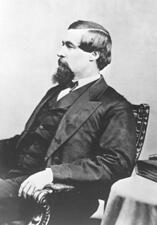
Here you will find contact information for Senator Edmund Gibson Ross, including email address, phone number, and mailing address.
| Name | Edmund Gibson Ross |
| Position | Senator |
| State | Kansas |
| Party | Republican |
| Status | Former Representative |
| Term Start | January 1, 1866 |
| Term End | March 3, 1871 |
| Terms Served | 1 |
| Born | December 7, 1826 |
| Gender | Male |
| Bioguide ID | R000445 |
About Senator Edmund Gibson Ross
Edmund Gibson Ross (December 7, 1826 – May 8, 1907) was an American politician, journalist, and Union Army officer who represented Kansas in the United States Senate from 1866 to 1871 and later served as governor of the New Mexico Territory. He is best known for casting the decisive vote in 1868 against the conviction of President Andrew Johnson on articles of impeachment, a decision that allowed Johnson to remain in office by a single vote and that cost Ross his political standing in Kansas for many years.
Ross was born in Ashland, Ohio, on December 7, 1826, the third of fourteen children of Sylvester Ross Sr. and Cynthia (Rice) Ross. Educated in local schools, he was apprenticed at age eleven as a printer at the Huron, Ohio, Commercial Advertiser. In 1841 he moved to Sandusky, Ohio, to work on the Sandusky Mirror, a newspaper owned by his brother Sylvester. During the late 1840s and early 1850s he worked as a journeyman printer and typesetter, traveling throughout Ohio and neighboring states and taking temporary positions as they became available. A Democrat who opposed slavery, he moved in 1852 to Milwaukee, Wisconsin, where he worked first for the Milwaukee Free Democrat and then the Milwaukee Daily Sentinel. In 1854 he was among the Milwaukee residents who stormed the local jail to free Joshua Glover, an escaped slave who had been recaptured under the Fugitive Slave Act, and helped secure Glover’s escape to Canada. With the founding of the Republican Party in the 1850s, Ross’s strong antislavery convictions led him to join the new organization.
An ardent opponent of slavery’s expansion, Ross moved to Topeka, Kansas, during the violent contest over whether Kansas would enter the Union as a free or slave state, a conflict later known as “Bleeding Kansas.” Several members of his family, also antislavery, settled there as well. Ross joined the Free-State militia and became a leader in the movement through his work in journalism. He published the Topeka Tribune from 1856 to 1858 and in 1859 founded the Kansas State Record. He also became a promoter and director of the Atchison, Topeka & Santa Fe Railway, serving on its board of directors and helping to advance the line’s development. In 1859 he was elected a delegate to the Kansas constitutional convention, which met from 1859 to 1861 and framed the constitution under which Kansas was admitted to the Union in 1861.
During the Civil War, Ross supported the Union cause and entered military service in 1862 as a private in the Union Army. He was commissioned captain of Company E, 11th Kansas Volunteer Cavalry Regiment, and later promoted to major. His regiment saw action in several engagements in the western theater, including the Second Battle of Lexington, the Battle of Little Blue River, the Second Battle of Independence, the Battle of Byram’s Ford, the Battle of Westport, the Battle of Mine Creek, and the fighting at Platte Bridge Station/Red Buttes. He was mustered out of service after the Confederate surrender in 1865 and returned to Kansas, where he resumed his newspaper career as editor of the Kansas Tribune from 1865 to 1866.
Ross’s entry into national politics came in 1866, when Kansas Governor Samuel J. Crawford appointed him to the United States Senate as a Republican to fill the vacancy created by the death of Senator James H. Lane. The Kansas legislature subsequently elected him to complete Lane’s term, and Ross served in the Senate from July 19, 1866, to March 3, 1871. A member of the Republican Party during his Senate tenure, he represented Kansas during the turbulent Reconstruction era and contributed to the legislative process over one full term in office. He served as chairman of the Committee on Enrolled Bills in the Fortieth Congress and the Committee on Engrossed Bills in the Forty-first Congress. He was an unsuccessful candidate for reelection to the term beginning March 4, 1871, and left the Senate after a single term.
Ross’s Senate career was defined by his role in the impeachment trial of President Andrew Johnson in 1868. As one of seven Republican senators who broke with their party to oppose conviction, Ross was the last of the seven to cast his vote and thus the man whose decision determined Johnson’s fate. On the crucial article of impeachment, the Senate voted 35–19 in favor of conviction, one vote short of the two-thirds majority required by the Constitution, and Johnson remained in office. Ross’s motives have been debated ever since. Some contemporaries and later critics alleged that he was influenced by patronage considerations involving his Kansas colleague Samuel C. Pomeroy and Senator Benjamin Wade, or that he sought favors from Johnson’s administration. Others have argued that Ross believed Johnson had the legal authority to remove Secretary of War Edwin M. Stanton, who had been appointed under President Abraham Lincoln, or that although Ross thought Johnson had violated the Tenure of Office Act, he did not regard that violation as warranting removal from office. Kansas newspapers at the time widely condemned Ross, asserting that he had abandoned his radical Republican leanings under the influence of his former Civil War commander, Thomas Ewing Jr., an outspoken supporter of Johnson. Ewing later praised Ross in a letter, calling him “preeminent for courage” for both his conduct in battle and his willingness to risk his career by opposing conviction, noting that Ross knew the decision would likely consign him to private life and the denunciation of most of his party. Allegations of bribery surrounded several of the Republican senators who voted for acquittal, and there is significant evidence suggesting that Ross may have been offered inducements; however, a subsequent investigation by the House of Representatives found no proof of criminal conduct. His stand later attracted national attention when he was included as one of eight U.S. senators profiled in John F. Kennedy’s 1956 Pulitzer Prize–winning book “Profiles in Courage,” which portrayed his vote as an act of political bravery.
After leaving the Senate in 1871, Ross briefly returned to journalism, launching a newspaper in Coffeyville, Kansas. Disillusioned with the Republican Party, he left it after 1872 and thereafter affiliated with the Democratic Party. In 1880 he ran unsuccessfully as a Democrat for governor of Kansas. A visit to New Mexico in 1882 improved his health, and he decided to relocate there permanently. Settling in Albuquerque, he studied law, was admitted to the bar, and practiced law while also beginning work on a history of the Johnson impeachment. His political career resumed when President Grover Cleveland, a Democrat, appointed him governor of the New Mexico Territory, a post he held from 1885 to 1889. Later he served as secretary of the New Mexico Bureau of Immigration from 1894 to 1896. In 1896 he published “History of the Impeachment of Andrew Johnson,” presenting his own account and defense of his actions in 1868. Over time, public opinion in Kansas softened, and many Kansans came to view his impeachment vote more favorably. In 1907 General Hugh Cameron of Lawrence, Kansas, visited Ross in New Mexico and brought written testimonials from numerous Kansas citizens expressing renewed respect and appreciation.
In his personal life, Ross married Fannie Lathrop (1827–1899) in 1848 in Sandusky, Ohio. The couple had several children, including Lillian, Arthur, Pitt, Flynt, Edmundie, Kay, and Fannie. Edmund Gibson Ross died in Albuquerque, New Mexico, on May 8, 1907 (contemporary accounts also record May 9, 1907, as the date of death). He was interred at Fairview Memorial Park Cemetery in Albuquerque.