Representative Edward Stuyvesant Bragg
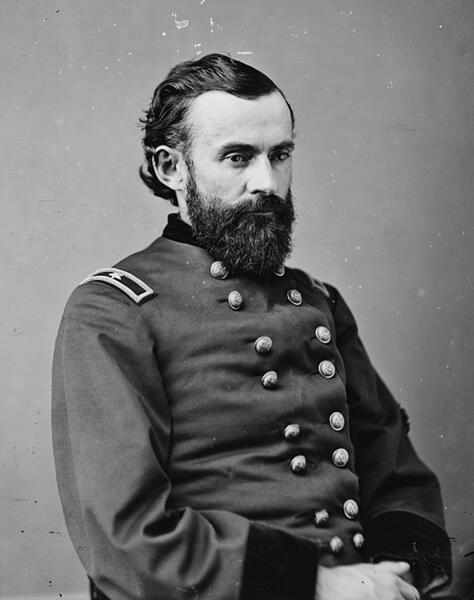
Here you will find contact information for Representative Edward Stuyvesant Bragg, including email address, phone number, and mailing address.
| Name | Edward Stuyvesant Bragg |
| Position | Representative |
| State | Wisconsin |
| District | 2 |
| Party | Democratic |
| Status | Former Representative |
| Term Start | October 15, 1877 |
| Term End | March 3, 1887 |
| Terms Served | 4 |
| Born | February 20, 1827 |
| Gender | Male |
| Bioguide ID | B000757 |
About Representative Edward Stuyvesant Bragg
Edward Stuyvesant Bragg (February 20, 1827 – June 20, 1912) was an American lawyer, soldier, diplomat, and Democratic politician from Fond du Lac, Wisconsin, who became one of the leading Democrats in Wisconsin in the latter half of the nineteenth century. He served four terms as a Representative from Wisconsin in the United States Congress from 1877 to 1887, representing eastern Wisconsin from 1877 to 1883 and again from 1885 to 1887. A prominent Union officer in the American Civil War, he rose to the rank of brigadier general, commanding the 6th Wisconsin Infantry Regiment and later the famed Iron Brigade of the Army of the Potomac. In later years he served the United States in several diplomatic posts, including minister to Mexico and consul general to Cuba and Hong Kong.
Bragg was born in Unadilla, Otsego County, New York, the son of Margarette (Kohl) Bragg and Joel B. Bragg. He attended local district schools as a child, then continued his studies at a local academy and at Geneva College in Geneva, New York, now Hobart College. While at Geneva he was one of the charter members of the Kappa Alpha Society. He left college without taking a degree in 1847 and read law in the office of Judge Charles C. Noble. Admitted to the New York bar in 1848, he practiced as a junior partner with Judge Noble until 1850. That year he traveled west on a prospecting tour in Wisconsin intending to settle near Green Bay, but, passing through Fond du Lac and recognizing the name of a former schoolmate on a sign there, he decided instead to make that community his permanent home.
In Fond du Lac, Bragg quickly rose in local prominence and allied himself with the Democratic Party. He established a law practice and, within a few years, was elected district attorney of Fond du Lac County in 1853. His growing political influence was reflected in his selection as a delegate to the 1860 Democratic National Convention in Charleston, South Carolina, which ultimately nominated Stephen A. Douglas for President and Herschel V. Johnson for Vice President. By the outbreak of the Civil War he was a well-known Democratic lawyer in eastern Wisconsin.
When news of the Confederate attack on Fort Sumter reached Wisconsin in April 1861, Bragg was in Oshkosh engaged as defense counsel in a murder trial. He requested a recess, returned immediately to Fond du Lac, and that night addressed a public assembly at which a full company of three‑month volunteers was raised. As the Lincoln administration called for additional three‑year regiments, Bragg recruited another company, which became known as “Bragg’s Rifles” and was mustered as Company E of the 6th Wisconsin Volunteer Infantry Regiment. The 6th Wisconsin was organized at Camp Randall in Madison and mustered into federal service on July 16, 1861, under Colonel Lysander Cutler. Ordered to Washington, D.C., the regiment was placed in the brigade of General Rufus King and soon joined with the 2nd Wisconsin, 7th Wisconsin, and 19th Indiana to form what became known as the Iron Brigade of the Army of the Potomac. Bragg participated in nearly every major engagement of the Iron Brigade from 1861 through 1864.
During the fall of 1861 and spring of 1862, the 6th Wisconsin performed picket duty near Washington, building fortifications and drilling. Bragg was promoted to major on September 17, 1861, and to lieutenant colonel on June 21, 1862, after Benjamin Sweet left to command the 21st Wisconsin Infantry. In the summer of 1862, as the Iron Brigade operated along the Rappahannock River, Bragg took part in a daring raid on Frederick’s Hall on the Virginia Central Railroad. Detached with part of the 6th Wisconsin to the North Anna River, he joined other officers in urging that the raid proceed despite the risk of encirclement, and the mission succeeded in destroying several miles of track before the force safely returned to Falmouth. Later that summer, at the engagement near Gainesville, Virginia, on August 28, 1862—the opening day of the Second Battle of Bull Run—Bragg assumed command of the 6th Wisconsin when Colonel Cutler was severely wounded. The regiment, on the right of the Iron Brigade’s line, helped hold off repeated attacks by elements of Stonewall Jackson’s corps in a hard-fought action that contributed to the brigade’s “Iron Brigade” sobriquet.
Bragg led the 6th Wisconsin at the Battle of South Mountain on September 14, 1862, where the Iron Brigade attacked Alfred H. Colquitt’s Confederate brigade at Turner’s Gap along the National Road. Maneuvering his regiment over difficult terrain to secure a favorable field of fire, he drew praise from General George B. McClellan, who wrote Wisconsin’s governor commending the conduct of the state’s regiments as “equal to the best troops in any army in the world.” Three days later, at the Battle of Antietam, Bragg commanded the 6th Wisconsin on the far right of the I Corps advance. Wounded early in the fighting, he nevertheless directed his men to reform and return fire before collapsing and being carried from the field. Erroneous reports of his death circulated in Wisconsin newspapers, and obituaries were printed before he was able to return to the regiment later that day, though not yet fit for duty. Before Antietam he had been solicited to run for Congress as a War Democrat on the National Union ticket and had replied that he would not leave his regiment “in times like these.” Despite his reluctance, he was nominated in absentia but lost the election to anti-war Democrat Charles A. Eldredge.
Through the winter campaigns of 1862–63, Bragg continued to lead the 6th Wisconsin at Fredericksburg and during the abortive “Mud March,” though the regiment saw limited heavy fighting. He was promoted to colonel, effective March 10, 1863, and was among a group of officers invited to meet President Abraham Lincoln. In the Chancellorsville campaign, he was ordered to force a crossing of the Rappahannock River at Fitz Hughes Crossing to protect engineers constructing a pontoon bridge. Bragg’s rapid assault secured the far bank within an hour and netted nearly 200 Confederate prisoners, earning special commendation from division commander General James S. Wadsworth. Soon afterward he fell seriously ill, possibly aggravated by harsh weather and an injury from being kicked by a horse, and was sent to a Washington hospital. His illness caused him to miss the Gettysburg Campaign, during which Lieutenant Colonel Rufus Dawes led the 6th Wisconsin in its celebrated stand on the first day of the Battle of Gettysburg. Bragg attempted to rejoin the regiment shortly after the battle but was still too weak and had to return to medical care.
Bragg returned to the 6th Wisconsin about August 28, 1863, finding the regiment camped near Rappahannock Station. During the Bristoe and Mine Run campaigns that autumn, the Iron Brigade engaged in rapid maneuvering but little major combat. In January 1864 the 6th Wisconsin was designated a veteran regiment, and those who re‑enlisted, including Bragg, were granted furloughs to Wisconsin. They were honored at a ceremony in Milwaukee hosted by former Governor Edward Salomon, Milwaukee Mayor Edward O’Neill, and General Lucius Fairchild, Bragg’s former counterpart in the 2nd Wisconsin and then Wisconsin’s secretary of state. Returning to the front in March 1864, the Iron Brigade was reorganized as the 1st Brigade, 4th Division, V Corps, under the overall command of General Ulysses S. Grant, who had assumed direction of Union armies in the Virginia theater.
In the Overland Campaign of 1864, Bragg led the 6th Wisconsin into the Wilderness, where on May 5–6 the Iron Brigade fought in confused and bloody engagements in dense woods. On May 6, after the brigade was shifted south to support II and VI Corps, it attacked the left of A. P. Hill’s Confederate corps but was driven back when James Longstreet’s troops counterattacked. In the aftermath, division commander General Lysander Cutler relieved Colonel Roy Stone and placed Bragg in command of the all‑Pennsylvania 3rd Brigade—often called the “Pennsylvania Bucktail Brigade.” Under Bragg’s leadership the brigade’s performance improved markedly, and it fought creditably at Spotsylvania Court House, North Anna, Totopotomoy Creek, and Cold Harbor. At Spotsylvania his brigade participated in repeated assaults on the Confederate works at Laurel Hill between May 8 and 12 and later fought at the “Bloody Angle.” Once again, erroneous reports of Bragg’s death circulated in Wisconsin newspapers, though he was not killed. After further maneuvering southward, his command crossed the North Anna River on May 23, 1864, repelling an attack by A. P. Hill’s corps in the opening of the Battle of North Anna, and then continued with Grant’s army through the trench warfare at Cold Harbor. On June 6, 1864, in the midst of that battle, Bragg was detached from the Pennsylvanian brigade and placed in command of the Iron Brigade itself. His detailed account of the Pennsylvania brigade’s actions in the Overland Campaign was later published in the Official Records of the War of the Rebellion (Series I, Volume 36, Part 1, Item 141). By the end of the war he had risen to the rank of brigadier general of volunteers.
After the Civil War, Bragg returned to Fond du Lac and resumed the practice of law while remaining active in Democratic politics. He became one of the principal leaders of the Wisconsin Democratic Party in the postwar decades and was frequently mentioned in connection with state and national offices. In 1876 he was elected as a Democrat to the Forty-fifth Congress from Wisconsin, beginning his service in the U.S. House of Representatives on March 4, 1877. He served continuously through the Forty-sixth and Forty-seventh Congresses until March 3, 1883, representing the interests of his eastern Wisconsin constituents during a period of significant national change in the aftermath of Reconstruction and the onset of the Gilded Age. After a brief interval out of office, he was again elected and served in the Forty-ninth Congress from March 4, 1885, to March 3, 1887, completing a total of four terms in the House. As a member of the Democratic Party, he participated in the legislative process on issues of economic policy, veterans’ affairs, and civil service, and was widely regarded as one of the most influential Democrats from his state.
Following his congressional service, Bragg embarked on a diplomatic career. In 1888 President Grover Cleveland appointed him United States minister to Mexico, a post in which he represented American interests during a critical period in U.S.–Mexican relations. During the 1890s he broke with many in his party over the populist and free‑silver policies championed by William Jennings Bryan, aligning himself instead with the more conservative, gold‑standard wing of the Democrats. Under Republican President Theodore Roosevelt, Bragg returned to government service as consul general to the Republic of Cuba and later to British Hong Kong, reflecting the bipartisan respect he commanded for his experience and judgment in foreign affairs.
In his later years, Bragg resided principally in Wisconsin, remaining a respected figure in veterans’ organizations and Democratic circles and occasionally commenting on public affairs. He died on June 20, 1912, in Fond du Lac, Wisconsin, closing a public career that had spanned from the antebellum bar and the battlefields of the Civil War to the halls of Congress and American diplomatic posts abroad.