Representative Edward Breitung
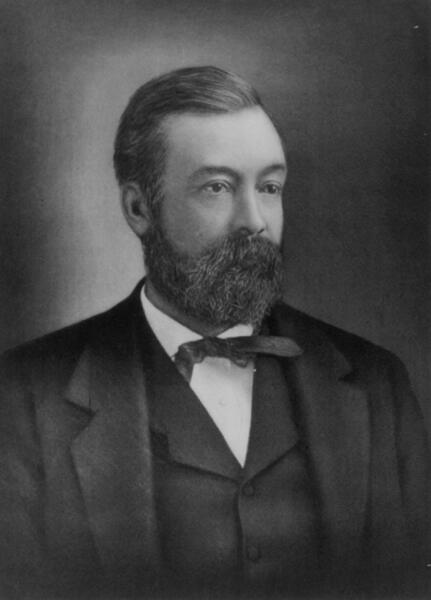
Here you will find contact information for Representative Edward Breitung, including email address, phone number, and mailing address.
| Name | Edward Breitung |
| Position | Representative |
| State | Michigan |
| District | 11 |
| Party | Republican |
| Status | Former Representative |
| Term Start | December 3, 1883 |
| Term End | March 3, 1885 |
| Terms Served | 1 |
| Born | November 10, 1831 |
| Gender | Male |
| Bioguide ID | B000795 |
About Representative Edward Breitung
Edward Breitung (November 10, 1831 – March 3, 1887) was a German-born American mining entrepreneur and Republican politician from Michigan who served one term in the United States House of Representatives from 1883 to 1885. Representing Michigan’s 11th congressional district in the Forty-eighth Congress, he participated in the legislative process during a significant period in American history and represented the interests of his Upper Peninsula constituents.
Breitung was born in the city of Schalkau in the Duchy of Saxe-Meiningen, Germany (now in Sonneberg District, Thuringia), the son of John M. Breitung, a Lutheran minister. He attended the College of Mining in Meiningen, then regarded as one of the celebrated schools in Germany for scientific and classical studies. In 1849, in the aftermath of the revolutions in Germany, he immigrated to the United States and settled in Kalamazoo County, Michigan. Two years later, in 1851, he moved to Detroit, where he became a clerk in a mercantile house, beginning a career that combined commercial activity with technical knowledge of mining.
In the mid-1850s Breitung moved north to the developing iron range of Michigan’s Upper Peninsula. He settled in Marquette and engaged in mercantile pursuits until 1859, when he relocated to Negaunee and continued in the mercantile business. His store there burned in 1860, prompting a shift in his professional focus. After the fire, he operated the Pioneer Blast Furnace in Negaunee with Israel Case under a four-year contract. By 1864 he had turned exclusively to iron-mining operations, exploring for iron deposits in Marquette and Menominee Counties. From 1864 to 1867 he located several profitable mines, establishing himself as a leading figure in the region’s mineral development. He later extended his interests beyond Michigan, becoming involved in iron mining in Minnesota and in gold and silver mining ventures in Colorado.
On November 28, 1870, Breitung married Mary Paulin, originally from Belgium, Wisconsin. At the time of their marriage, Mary had been working as a chambermaid at a boarding house in Republic (Smith’s Mine), Michigan, where Breitung owned the Republic Mine. The couple’s first child, Edward N. Breitung Jr., was born on November 1, 1871, in Negaunee. Their second child, William, was born around March 1874, also in Negaunee, but became ill soon thereafter. William died on August 26, 1874, from cholera, while his father was away on duties in Lansing and unable to return in time, a personal tragedy that occurred as Breitung’s public career was beginning to advance.
Breitung entered public office in the 1870s, building on his prominence as a mining entrepreneur. He served as a member of the Michigan State House of Representatives in 1873 and 1874, representing the interests of the Upper Peninsula during a period of rapid industrial and resource development. He then served in the Michigan State Senate in 1877 and 1878. At the local level, he was elected mayor of Negaunee in 1879, 1880, and again in 1882, reflecting the confidence placed in him by the growing mining community. His state and municipal service helped to shape policies affecting mining, transportation, and settlement in northern Michigan.
In national politics, Breitung was elected as a Republican to the United States House of Representatives from Michigan’s 11th congressional district for the Forty-eighth Congress. He served from March 4, 1883, to March 3, 1885, completing a single term in office. During this time he contributed to the legislative process as a member of the House of Representatives, participating in the democratic governance of the post–Civil War United States and advocating for the interests of his constituents in Michigan’s Upper Peninsula. He declined to be a candidate for renomination in 1884, choosing not to seek a second term.
After leaving Congress, Breitung continued to manage and expand his mining and business interests. He was instrumental in the development of the Soudan Mine in Minnesota in the 1880s, work that would later be recognized in the naming of Breitung Township, Minnesota, in his honor. Breitung Township, Michigan, was also named after him, reflecting his importance in the history of iron mining and settlement in the region. He planned substantial residential projects, including a winter house in Eastman, Georgia, and a new home in Marquette, Michigan, but did not live to see these plans realized.
Breitung died on March 3, 1887, in Eastman, Georgia, before he was able to move into the winter house he had built there and before construction was due to begin on his new house in Marquette. He was interred in the Breitung Mausoleum at Park Cemetery in Marquette, Michigan. After his death, his widow, Mary, married into the Samuel R. Kaufman family of Marquette, wedding Samuel’s son Nathan Kaufman. Mary had previously placed Nathan in effective charge of several Breitung businesses while Edward was away in Congress, and the alliance between the Breitung and Kaufman families continued into the next generation. Breitung’s son, Edward N. Breitung Jr., carried on his father’s successful mining enterprises in the Upper Peninsula and in other regions, and he too married into the Kaufman family by wedding Nathan’s sister Charlotte. Edward Jr. and Charlotte had one child, Juliet, whose later life, along with that of her parents and the extended family, reflected both the prominence and the controversies associated with the Breitung name, including Edward Jr.’s attempts to profit from an impounded German ship during World War I and the involvement of his nephew and associates in plots against American factories and merchant ships.