Representative Edward Degener
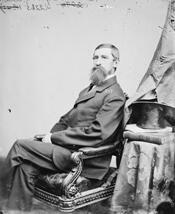
Here you will find contact information for Representative Edward Degener, including email address, phone number, and mailing address.
| Name | Edward Degener |
| Position | Representative |
| State | Texas |
| District | 4 |
| Party | Republican |
| Status | Former Representative |
| Term Start | March 4, 1869 |
| Term End | March 3, 1871 |
| Terms Served | 1 |
| Born | October 20, 1809 |
| Gender | Male |
| Bioguide ID | D000195 |
About Representative Edward Degener
Edward Degener (October 20, 1809 – September 11, 1890) was a German-born American politician who served as a Republican U.S. Representative from Texas during the Reconstruction era. He represented Texas’s 4th Congressional District in the United States House of Representatives from March 31, 1870, to March 3, 1871, serving one term in Congress. His congressional service took place during a significant period in American history, as former Confederate states were being readmitted to representation and the federal government was reshaping political and civil life in the post–Civil War South.
Degener was born in Brunswick in the Kingdom of Prussia (now part of Germany) on October 20, 1809. He pursued an academic course in both Germany and England, receiving an education that prepared him for public life. Before emigrating, he became active in German politics and was twice a member of the legislative body in Anhalt-Dessau. In 1848 he served as a member of the first German National Assembly at Frankfurt-am-Main, participating in the revolutionary movement that sought constitutional reform and national unification in the German states.
In 1850 Degener immigrated to the United States and settled in Sisterdale, Texas, a community in the Texas Hill Country west of San Antonio that attracted a substantial German immigrant population. In his new home he engaged in agricultural pursuits and became part of a German-Texan community noted for its liberal political views and, in many cases, opposition to slavery and secession. By the time of the American Civil War, Texas had joined the Confederacy as a slave-holding state, but Degener remained loyal to the Union.
Degener’s Unionist stance brought him under suspicion and persecution by Confederate authorities. During the Civil War he was arrested by the Confederate army and charged with being “a dangerous and seditious person and an enemy to the government.” The accusations included criticizing the Confederacy, corresponding with its alleged enemies, and failing to report known Union sympathizers. Degener pleaded not guilty, and his legal counsel challenged both the authority of the military to try him and the charge of sedition, which was not a crime formally recognized by the Confederate government. Despite these arguments, he was found guilty and ordered to post a $5,000 bond as a guarantee of his loyalty to the Confederacy. His family also suffered directly from the conflict: his sons Hugo and Hilmar were killed in the Nueces massacre, in which Confederate forces murdered Unionist German Texans attempting to flee to Mexico. To honor their memory and that of other Unionist victims, Degener, together with Eduard Steves and William Heuermann, purchased land for the establishment of the German-language Treue der Union Monument at Comfort, Texas, later listed on the National Register of Historic Places on November 29, 1978.
With the end of the Civil War, Degener emerged as a Republican leader in Texas during Reconstruction. He served as a member of the Texas constitutional conventions of 1866 and 1868, bodies charged with restructuring the state’s government and laws to conform to postwar federal requirements. At the 1868 convention he served on the Committee for Immigration, working alongside Julius Scheutze, H. H. Foster, George W. Smith, Erwin Wilson, John Morse, and Stephen Curtis, the lone Black member of the committee. His work in these conventions reflected both his long-standing interest in representative government and his commitment to integrating Texas into the restored Union.
Upon the readmission of the State of Texas to representation in Congress, Degener was elected as a Republican to the Forty-first Congress. He took his seat on March 31, 1870, and served until March 3, 1871. During his single term in office, he participated in the legislative process at a time when Congress was addressing the political reintegration of the former Confederate states, the protection of civil rights for newly freed African Americans, and the broader reconstruction of Southern society. As a member of the House of Representatives, Degener represented the interests of his Texas constituents and contributed to the debates and decisions that shaped Reconstruction policy. He was an unsuccessful candidate for reelection in 1870 to the Forty-second Congress, ending his brief tenure in national office.
After leaving Congress, Degener continued his public service at the local level. He served as a member of the city council of San Antonio, Texas, from 1872 to 1878, participating in municipal governance during a period of growth and change in the city. His council service extended his long record of civic engagement, from his early legislative work in German states to his later roles in Texas state and local government.
Edward Degener died in San Antonio, Texas, on September 11, 1890, at the age of 80. A German revolutionary turned American legislator, he left a legacy as a steadfast Unionist, a participant in foundational constitutional assemblies on two continents, and a Reconstruction-era representative who helped guide Texas back into the federal Union.