Representative Edward deGraffenried
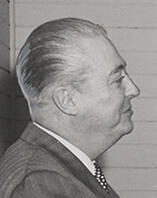
Here you will find contact information for Representative Edward deGraffenried, including email address, phone number, and mailing address.
| Name | Edward deGraffenried |
| Position | Representative |
| State | Alabama |
| District | 6 |
| Party | Democratic |
| Status | Former Representative |
| Term Start | January 3, 1949 |
| Term End | January 3, 1953 |
| Terms Served | 2 |
| Born | June 30, 1899 |
| Gender | Male |
| Bioguide ID | D000198 |
About Representative Edward deGraffenried
Edward Wadsworth deGraffenried Jr. (June 30, 1899 – November 5, 1974) was a Democratic U.S. Representative from Alabama who served in the United States Congress from 1949 to 1953. Over the course of two terms in the House of Representatives, he participated in the legislative process during a significant period in American history and represented the interests of his Alabama constituents.
DeGraffenried was born in Eutaw, Alabama, on June 30, 1899. He was the son of Edward deGraffenried (1861–1922), a prominent Alabama lawyer who served as a judge of the Alabama Court of Appeals, a member of the Alabama Constitutional Convention of 1901, and legal adviser to the Governor of Alabama in 1910, and who was known as a noted orator and author. Through his family line, Edward W. deGraffenried Jr. was the second direct male descendant of Baron Christoph de Graffenried, the founder of New Bern, North Carolina, to be elected to Congress. Known familiarly as “Mr. Ed,” he was raised in Greensboro, Alabama, where he attended local public schools before pursuing further education.
For his secondary education, deGraffenried attended Gulf Coast Military Academy in Gulfport, Mississippi, graduating in 1917. While at the academy he was active in student life and leadership, serving as editor of the Portlight and the Conch Shell, the monthly and annual publications of the academy. He also held positions as chairman of the Honor Committee and president of the Literary Society, early indications of the organizational and rhetorical skills that would later characterize his legal and political career.
In the fall of 1917, deGraffenried entered the University of Alabama, where he enrolled in the Reserve Officers’ Training Corps (R.O.T.C.). During World War I he volunteered for service as a private in the United States Army. He was honorably discharged from the Army at Camp Pike, Arkansas, on December 5, 1918. Subsequently offered an appointment to the United States Military Academy at West Point, he declined this opportunity and chose instead to return to the University of Alabama to study law. He entered the University of Alabama School of Law in 1919 and received his Bachelor of Laws degree in 1921.
Admitted to the bar in June 1921, deGraffenried commenced the practice of law in Tuscaloosa, Alabama, joining his father in legal practice. He quickly established himself in the profession and entered public service as a prosecutor. He served as solicitor of the sixth judicial circuit of Alabama from 1927 through 1934. After an unsuccessful campaign for reelection as solicitor in 1934 and an unsuccessful bid for office in 1938, he returned to private practice but remained active in public affairs. DeGraffenried was again elected solicitor of the sixth judicial circuit and served a second tenure from January 1943 to January 1947. In 1946 he sought the Democratic nomination to the Eightieth Congress but was unsuccessful, continuing instead in his legal career until his eventual election to national office.
DeGraffenried was elected as a Democrat to the Eighty-first and Eighty-second Congresses, serving in the U.S. House of Representatives from January 3, 1949, to January 3, 1953. His service in Congress took place in the post–World War II era, a time marked by the early Cold War, domestic economic adjustment, and evolving national policy debates. As a member of the House of Representatives, Edward deGraffenried contributed to the legislative process and participated in the democratic governance of the nation, representing his Alabama district and its constituents within the broader framework of federal policymaking. He was an unsuccessful candidate for renomination in 1952, bringing his congressional career to a close after two terms in office.
Following his departure from Congress, deGraffenried resumed the practice of law in Tuscaloosa. He continued in active practice until shortly before his death, serving as senior partner in the firm of de Graffenried, de Graffenried and de Graffenried, a prominent law firm he formed with two of his sons, William Ryan de Graffenried and Jeffries Blunt de Graffenried. He remained a well-known figure in the legal community and in Alabama public life during these later years.
In his personal life, deGraffenried married twice. With his first wife, Grace, he had five children—four sons and one daughter. Three of his sons, Edward III, Jeff, and Ryan, served in the military during World War II, continuing the family’s tradition of public and military service. His youngest son, Christopher, was an alumnus of the University of Alabama, and his daughter, Grace, was an alumna of Huntingdon College in Montgomery, Alabama. On October 21, 1935, in Fort Worth, Texas, he married his second wife, Motie Gay Holman of Pickens County, Alabama.
Edward Wadsworth deGraffenried Jr. died in Tuscaloosa, Alabama, on November 5, 1974. Shortly before his death he had retired from active legal practice. He was interred in Evergreen Cemetery in Tuscaloosa, closing a life marked by military service, a distinguished legal career, and two terms in the United States Congress as a Representative from Alabama.