Representative Edward J. Derwinski
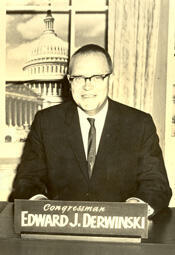
Here you will find contact information for Representative Edward J. Derwinski, including email address, phone number, and mailing address.
| Name | Edward J. Derwinski |
| Position | Representative |
| State | Illinois |
| District | 4 |
| Party | Republican |
| Status | Former Representative |
| Term Start | January 7, 1959 |
| Term End | January 3, 1983 |
| Terms Served | 12 |
| Born | September 15, 1926 |
| Gender | Male |
| Bioguide ID | D000269 |
About Representative Edward J. Derwinski
Edward Joseph Derwinski (September 15, 1926 – January 15, 2012) was an American politician who served as a Republican Representative from Illinois in the United States Congress from 1959 to 1983 and later as the first Cabinet-level United States Secretary of Veterans Affairs. Over 12 terms in the House of Representatives, he represented the south and southwest suburbs of Chicago and contributed to the legislative process during a significant period in American history. He subsequently held senior positions in the U.S. Department of State under President Ronald Reagan and led the newly elevated Department of Veterans Affairs under President George H. W. Bush from March 15, 1989, to September 26, 1992.
Derwinski was born in Chicago, Illinois, on September 15, 1926, to Polish American parents Sophia Zmijewski and Casimir Ignatius Derwinski, who died in 1947. Raised in Chicago, he was part of the city’s large and politically active ethnic community, a background that later informed his interest in Eastern European affairs and ethnic outreach in American politics. He attended Loyola University of Chicago, but his education was interrupted by World War II. During the war he served in the United States Army in the Pacific Theater and later took part in the postwar U.S. occupation of Japan. After his military service, he returned to Loyola University Chicago, graduating in 1951. While there, he was a celebrated member of the Alpha Delta Gamma National Fraternity.
Derwinski’s political career began in Illinois state government. In 1957, he was elected to the Illinois House of Representatives, where he served one term. Building on this experience and his growing reputation in suburban Chicago politics, he successfully ran for the United States House of Representatives in 1958. Taking office in January 1959, he began what would become 12 consecutive terms in Congress as a Republican representative from Illinois’s 4th District, a suburban region south and west of Chicago. Throughout his tenure, he participated actively in the democratic process and represented the interests of his constituents during a period marked by the Cold War, the civil rights movement, and significant domestic and foreign policy debates.
In Congress, Derwinski became particularly associated with foreign affairs. He rose to become the ranking member of the House Foreign Affairs Committee, known during some periods as the International Relations Committee. His expertise in international issues led to several diplomatic assignments. He served as a delegate to the United Nations General Assembly from 1971 to 1972 and as chairman of the U.S. delegation to the Interparliamentary Union from 1970 to 1972 and again from 1978 to 1980. In October 1978, he agreed to accompany fellow U.S. Representative Leo Ryan on an investigative trip to Jonestown in Guyana, in connection with concerns about the Peoples Temple; Derwinski was added to the delegation to comply with Foreign Affairs Committee guidelines encouraging multiple members on foreign travel. He later withdrew from the trip, and during the November 1978 visit Ryan was murdered and members of the Peoples Temple committed mass suicide.
Derwinski’s House career came to an end following redistricting after the 1980 Census. A Democratic redistricting plan substantially altered the 4th District, with only about 15 percent of its territory retained and the remainder redistributed among other districts. The new configuration placed Derwinski and fellow Republican Congressman George M. O’Brien in the same district. In the 1982 Republican primary, O’Brien prevailed, benefiting from having a larger portion of his previous district included in the redrawn seat. After Derwinski’s defeat, President Ronald Reagan appointed him Counselor to the Department of State. In 1987, Reagan further elevated his role by appointing him Under Secretary of State for Security Assistance, Science and Technology, a position he held until the end of the Reagan administration.
Following his State Department service, Derwinski moved into veterans’ affairs at the federal level. In the final days of the Reagan administration he was appointed Administrator of Veterans Affairs, heading the Veterans Administration. When the agency was elevated to Cabinet status as the Department of Veterans Affairs in 1989, President George H. W. Bush appointed Derwinski as the first United States Secretary of Veterans Affairs. He served in this Cabinet-level post from March 15, 1989, to September 26, 1992, overseeing the transition of the Veterans Administration into a full executive department and managing programs affecting millions of American veterans. His leadership at the new department placed him at the center of federal policy on veterans’ health care, benefits, and services during and after the end of the Cold War.
A Polish American, Derwinski was widely noted for his efforts on behalf of Eastern Europe throughout his career. He took a particular interest in historical justice issues arising from World War II and the Cold War. Among his most prominent initiatives was his role in the rehabilitation of Serbian Royalist General Draža Mihailović. Mihailović had received the Legion of Merit for his resistance efforts against the Axis, but the award and its citation were kept secret at the behest of the State Department so as not to damage relations with Marshal Josip Broz Tito, the postwar ruler of Yugoslavia and Mihailović’s wartime rival. After airmen involved in Operation Halyard—who had been rescued by Mihailović’s forces—pressed for recognition and reported rumors of the award, Derwinski insisted that the State Department release President Harry S. Truman’s citation. The eventual publication of the citation confirmed that Mihailović had not collaborated with the Nazis. Reflecting his longstanding engagement with ethnic communities, Derwinski later served as head of “Ethnic Americans for Dole/Kemp” during the 1996 presidential election.
In his personal life, Derwinski resided in Glen Ellyn, Illinois, with his wife, the former Bonita “Bonnie” Hickey. He had two adult children, Maureen and Michael, from his first marriage to Patricia Derwinski. Even after leaving public office, he remained an influential figure in Illinois and national Republican politics, maintaining extensive connections in Chicago’s diverse ethnic neighborhoods. On January 15, 2012, Edward Joseph Derwinski died in a nursing home from Merkel cell carcinoma at the age of 85. He was buried in Arlington National Cemetery in Arlington, Virginia. Upon learning of his death, former United States Senator Peter Fitzgerald of Illinois described him as “a giant in Illinois politics” and noted that “he had incredible connections in all the different ethnic neighborhoods in Chicago, he was really loved by everybody on both sides.”