Representative Edward James Devitt
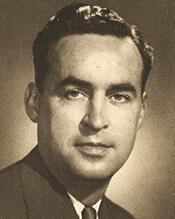
Here you will find contact information for Representative Edward James Devitt, including email address, phone number, and mailing address.
| Name | Edward James Devitt |
| Position | Representative |
| State | Minnesota |
| District | 4 |
| Party | Republican |
| Status | Former Representative |
| Term Start | January 3, 1947 |
| Term End | January 3, 1949 |
| Terms Served | 1 |
| Born | May 5, 1911 |
| Gender | Male |
| Bioguide ID | D000280 |
About Representative Edward James Devitt
Edward James Devitt (May 5, 1911 – March 2, 1992) was a U.S. Representative from Minnesota and a United States district judge of the United States District Court for the District of Minnesota. A member of the Republican Party, he served one term in the United States Congress from 1947 to 1949 and later became one of the longest-serving federal judges in Minnesota, including more than two decades as Chief Judge.
Devitt was born on May 5, 1911, in Saint Paul, Minnesota. He was educated in Minnesota Catholic institutions, graduating from Saint John’s Preparatory School in Collegeville in 1930. He then attended Saint John’s University from 1930 to 1932 before pursuing legal studies. Moving to North Dakota for his higher education, he earned a Bachelor of Laws from the University of North Dakota School of Law in 1935. He continued his academic work there and received a Bachelor of Science degree from the University of North Dakota in 1938, combining legal training with broader undergraduate study.
Upon completion of his legal education, Devitt entered private practice in East Grand Forks, Minnesota, where he practiced law from 1935 to 1939. During this period he also served as a municipal judge of the Minnesota Municipal Court in East Grand Forks, gaining early judicial experience while still a young attorney. In 1939 he was appointed an assistant state attorney general of Minnesota, a position he held until 1942. With the onset of World War II, Devitt entered military service; from 1942 to 1946 he served in the United States Naval Reserve as a lieutenant commander, contributing to the war effort before returning to civilian and political life.
Devitt’s congressional career began in the immediate postwar era, a significant period in American history marked by reconversion to a peacetime economy and the early Cold War. Running as a Republican, he was elected from Minnesota’s 4th congressional district to the 80th Congress and served from January 3, 1947, to January 3, 1949. As a member of the House of Representatives, Edward James Devitt participated in the democratic process and represented the interests of his constituents, contributing to the legislative work of that Congress. He sought reelection in 1948 but was defeated by Democrat Eugene McCarthy, who would later gain national prominence as a U.S. Senator and presidential candidate. Devitt remains the most recent Republican to have represented Minnesota’s 4th congressional district.
After leaving Congress, Devitt returned to the practice of law. He resumed private practice in Saint Paul from 1949 to 1950, reestablishing his legal career in his native city. In 1950 he was elected judge of the Minnesota Probate Court for Ramsey County, a position he held until 1954. His work on the probate bench further solidified his reputation as a capable jurist and prepared him for service on the federal judiciary.
On December 10, 1954, President Dwight D. Eisenhower gave Devitt a recess appointment to the United States District Court for the District of Minnesota, filling the vacancy created by the death of Judge Matthew M. Joyce. Eisenhower formally nominated him to the same seat on January 10, 1955. The United States Senate confirmed Devitt on February 4, 1955, and he received his commission on February 7, 1955. Devitt quickly assumed a leadership role on the court, serving as Chief Judge from 1959 to 1981, one of the longest tenures in that capacity in the district’s history. He assumed senior status on May 1, 1981, but continued to carry a substantial caseload.
During his decades on the federal bench, Devitt presided over a wide range of significant cases. In 1979 he oversaw the criminal trial arising from the Red Lake Indian Reservation uprising, a major incident in Minnesota and Native American affairs. He imposed a 26-year prison sentence on uprising leader Harry S. Hanson Jr. and sentenced Hanson’s four co-defendants to prison terms ranging from 10 to 16 years. Beyond his trial work, Devitt contributed to the administration and improvement of the federal courts nationally. He served as a board member of the Federal Judicial Center from 1968 to 1971, helping guide research and education programs for the federal judiciary. From 1985 to 1992 he also served as a judge of the United States Foreign Intelligence Surveillance Court, participating in the confidential review of applications for national security surveillance under federal law.
Devitt’s influence on the federal judiciary has been commemorated in several ways. Since 1983, the American Judicature Society has presented the Edward J. Devitt Distinguished Service to Justice Award annually to an Article III judge in recognition of exemplary judicial service; the first recipient was Judge Albert Branson Maris. In Minnesota, his name is also associated with the Edward J. Devitt U.S. Courthouse and Federal Building in Fergus Falls, reflecting his long service on the federal bench in the state. Edward James Devitt remained in senior status on the United States District Court for the District of Minnesota until his death in Saint Paul on March 2, 1992.