Representative Edward Clayton Eicher
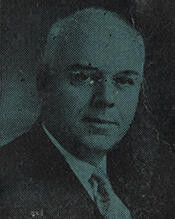
Here you will find contact information for Representative Edward Clayton Eicher, including email address, phone number, and mailing address.
| Name | Edward Clayton Eicher |
| Position | Representative |
| State | Iowa |
| District | 1 |
| Party | Democratic |
| Status | Former Representative |
| Term Start | March 9, 1933 |
| Term End | January 3, 1939 |
| Terms Served | 3 |
| Born | December 16, 1878 |
| Gender | Male |
| Bioguide ID | E000094 |
About Representative Edward Clayton Eicher
Edward Clayton Eicher (December 16, 1878 – November 30, 1944) was a United States Representative from Iowa, a federal securities regulator, and Chief Justice of the District Court of the United States for the District of Columbia. A member of the Democratic Party, he was considered a consummate New Deal liberal and contributed to the legislative process during three terms in the United States Congress from 1933 to 1939.
Eicher was born on a farm near the unincorporated town of Noble, Washington County, Iowa. He was raised in a Mennonite family; his father, Benjamin Eicher, was a Mennonite bishop, and his older brother, H. M. Eicher, later served as an assistant district attorney during the administration of President Grover Cleveland. Eicher attended public schools in Iowa and then pursued preparatory studies at Washington Academy in Washington, Iowa, and at Morgan Park Academy in Morgan Park, Chicago, Illinois. He enrolled at the University of Chicago, from which he received a Bachelor of Philosophy degree in 1904, and then studied law at the University of Chicago Law School.
Admitted to the bar in 1906, Eicher briefly practiced law in Washington, Iowa, before returning to the University of Chicago to serve as its assistant registrar. In 1909 he went back to Iowa, settling in Burlington, where he became an assistant attorney for the Chicago, Burlington and Quincy Railroad, a position he held until 1918. That year he resumed private practice in Washington, Iowa, as a partner in the firm of Livingston and Eicher. Over the next decade and a half he built a regional reputation as a capable attorney, which helped lay the groundwork for his later political career.
Eicher became active in Democratic Party politics during the early years of the Great Depression. He was a delegate to the Democratic National Convention in 1932, which nominated Franklin D. Roosevelt for the presidency. In the same year, he was elected as a Democrat to the United States House of Representatives from Iowa’s 1st congressional district. Twice re-elected, he served from March 4, 1933, until December 2, 1938. His service in Congress occurred during a significant period in American history, as the nation confronted the economic crisis of the Great Depression and the implementation of the New Deal. As a member of the House of Representatives, Eicher participated in the democratic process, represented the interests of his constituents, and aligned himself with Roosevelt’s New Deal agenda, earning a reputation as a loyal and energetic supporter of the administration. Time magazine later described him as “a wheelhorse in a pasture of mavericks.” He withdrew from the 1938 race for the Democratic nomination for his own seat, bringing his congressional career to a close after three terms in office.
As his final congressional term ended in 1938, President Roosevelt appointed Eicher to the United States Securities and Exchange Commission. He served as a member of the SEC from 1938 to 1942 and was its chair between 1941 and 1942. In that capacity he helped oversee and enforce the federal securities laws enacted in the New Deal era, contributing to the development of modern federal securities regulation. Within the Roosevelt administration, New Dealers supported Eicher’s desire to be named to one of two newly created judgeships on the United States Court of Appeals for the Eighth Circuit. However, Iowa Senator Guy M. Gillette, who resented Eicher and Roosevelt for their unsuccessful efforts to purge him from Congress in 1938, opposed the appointment, and no Iowan ultimately received either of the new appellate judgeships.
Instead, Eicher’s judicial career advanced in the nation’s capital. He was nominated by President Franklin D. Roosevelt on December 30, 1941, to the Chief Justice seat on the District Court of the United States for the District of Columbia (now the United States District Court for the District of Columbia), succeeding Judge Alfred Adams Wheat. The United States Senate confirmed his nomination on January 20, 1942, and he received his commission on January 23, 1942. As Chief Justice of the District Court, he presided over significant wartime cases and administered one of the most important federal trial courts in the country. His service on the court continued until his death on November 30, 1944.
Eicher died of a heart attack in Alexandria, Virginia, at the age of 65. At the time of his death, he had been presiding for more than seven months over the trial of 30 suspected Axis conspirators and sympathizers, a proceeding that Time magazine characterized as the “biggest and noisiest sedition trial in United States history.” The magazine reported that “no one in Washington doubted that a ludicrously undignified trial had hastened the death of a scrupulously dignified judge.” His sudden death resulted in a mistrial. After the end of World War II, the government chose not to reprosecute the case, and Judge Bolitha James Laws dismissed the charges against the defendants. Edward Clayton Eicher was interred in Woodlawn Cemetery in Washington, Iowa. His papers are preserved in the University of Iowa Libraries Special Collections & Archives, documenting his career as a New Deal legislator, federal regulator, and chief judge.