Representative Edward Everett Holland
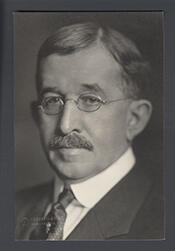
Here you will find contact information for Representative Edward Everett Holland, including email address, phone number, and mailing address.
| Name | Edward Everett Holland |
| Position | Representative |
| State | Virginia |
| District | 2 |
| Party | Democratic |
| Status | Former Representative |
| Term Start | April 4, 1911 |
| Term End | March 3, 1921 |
| Terms Served | 5 |
| Born | February 26, 1861 |
| Gender | Male |
| Bioguide ID | H000716 |
About Representative Edward Everett Holland
Edward Everett Holland (February 26, 1861 – October 23, 1941) was an American lawyer, banker, and Democratic politician who served as a U.S. Representative from Virginia from 1911 to 1921. Over the course of five consecutive terms in the House of Representatives, he participated in the legislative process during a significant period in American history, representing the interests of his constituents and contributing to the work of Congress in the years surrounding World War I.
Holland was born near Suffolk, Virginia, to Zechariah Holland and the former Ann Scott Pretlow. He was educated in private schools before pursuing higher education in the Commonwealth. He attended Richmond College (later the University of Richmond), and subsequently studied law at the University of Virginia School of Law in Charlottesville. After completing his legal studies, he was admitted to the bar in 1882 and commenced the practice of law in Suffolk, Virginia, establishing himself as a local attorney at a relatively young age.
Holland quickly became active in public affairs and local government. He was elected mayor of Suffolk, serving from 1885 to 1887, a role in which he gained early administrative and political experience. In 1887 he was elected Commonwealth’s attorney (prosecutor) for Nansemond County, a position he held for two decades, from 1887 to 1907. Alongside his legal and political work, Holland entered the banking field; in 1892 he became president of the Farmers Bank of Nansemond, reflecting his growing prominence in the business and financial life of his community.
Holland’s state-level political career began in earnest when he was elected to the Senate of Virginia, serving from 1908 to 1911. From this position in the state legislature, he advanced to national office. In 1910, running as a Democrat, he was elected to the U.S. House of Representatives, defeating Republican H. H. Humble and Independent C. E. Good with 78.99 percent of the vote. He took his seat in the Sixty-second Congress on March 4, 1911, and was subsequently re-elected to the four succeeding Congresses, serving continuously until March 3, 1921.
During his decade in Congress, Holland solidified his standing as a Democratic representative from Virginia. In 1912 he was re-elected by a wide margin, defeating Progressive Nathaniel T. Green and Independents Isaiah A. Chesman and B. D. Downey with 89.07 percent of the vote. In 1914 he again secured re-election, defeating Socialist E. B. Everton and Socialist Labor candidate S. L. Ford with 88 percent of the vote. In the 1916 election he prevailed over Republican Luther B. Way and Socialist Robert D. McElvary, winning 83.06 percent of the vote. In 1918 he was re-elected unopposed. Throughout these five terms, Holland served in the House during a transformative era that included the Progressive reforms of the early twentieth century and the United States’ involvement in World War I. He was not a candidate for renomination in 1920, thereby concluding his initial period of congressional service on March 3, 1921.
After leaving the House of Representatives, Holland resumed his banking pursuits, continuing his long-standing association with financial institutions in Suffolk and Nansemond County. He remained an influential figure within the Democratic Party, serving as a delegate to the Democratic National Convention in 1920 and again in 1924, participating in the national deliberations of his party during the interwar period. His public service in elective office was renewed at the state level when he returned to the Senate of Virginia, where he served from 1930 until his death in 1941, thus extending his legislative career well into the mid-twentieth century.
Edward Everett Holland died in Suffolk, Virginia, on October 23, 1941. He was interred in Cedar Hill Cemetery in Suffolk. His longtime residence in Suffolk, known as the Building at 216 Bank Street, was later recognized for its historical significance and was added to the National Register of Historic Places in 1985.