Senator Edward E. Kaufman
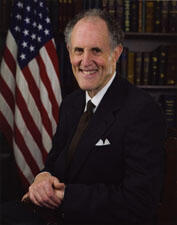
Here you will find contact information for Senator Edward E. Kaufman, including email address, phone number, and mailing address.
| Name | Edward E. Kaufman |
| Position | Senator |
| State | Delaware |
| Party | Democratic |
| Status | Former Representative |
| Term Start | January 16, 2009 |
| Term End | November 15, 2010 |
| Terms Served | 1 |
| Born | March 15, 1939 |
| Gender | Male |
| Bioguide ID | K000373 |
About Senator Edward E. Kaufman
Edward Emmett Kaufman (born March 15, 1939) is a retired American politician, businessman, and longtime adviser to President Joe Biden who served as a United States senator from Delaware from 2009 to 2010. A member of the Democratic Party, he was appointed to the Senate to fill the vacancy created when Senator Biden resigned to become vice president in 2009, and he served one term, choosing not to run for a full term. During his brief but active tenure, Kaufman contributed to the legislative process on issues ranging from financial regulation and economic recovery to foreign policy and science and engineering education. He later chaired the Congressional Oversight Panel for the Troubled Asset Relief Program (TARP), becoming the second and final person to hold that position, succeeding Elizabeth Warren. Personally and politically close to Biden for decades, Kaufman has often been described as Biden’s “best friend” and alter ego.
Kaufman was born in Philadelphia, Pennsylvania, on March 15, 1939, the son of Helen (née Carroll), a teacher, and Manuel Kaufman, a social worker. His father was of Russian Jewish ancestry and his mother was a Catholic of Irish descent; he was raised in his mother’s Catholic faith. Kaufman attended Central High School in Philadelphia and went on to Duke University, where he earned a Bachelor of Science degree in mechanical engineering. He later received a Master of Business Administration degree from the Wharton School of the University of Pennsylvania, combining technical training with advanced business education that would shape his early professional career.
In 1966, Kaufman moved to Delaware to work as an engineer for the DuPont Company, beginning a long association with the state he would later represent in the Senate. While employed at DuPont, he became involved in politics as a volunteer on Joe Biden’s 1972 campaign for the U.S. Senate, which at the time was widely regarded as a long shot. After Biden’s upset victory that year, Kaufman took a one-year leave of absence from DuPont to organize and head Biden’s Delaware Senate office. In 1976 he left DuPont and became Biden’s chief of staff and administrative assistant, a position he held until 1995. In that role he managed Biden’s Senate operations and worked on all of Biden’s subsequent Senate campaigns, becoming one of his closest political advisers.
After leaving Biden’s Senate staff, Kaufman continued a career in public service and public affairs. From August 11, 1995, to December 1, 2008, he served as a member of the Broadcasting Board of Governors (BBG), the federal body overseeing U.S. government–sponsored international broadcasting. He was appointed to the BBG by Presidents Bill Clinton and George W. Bush and was confirmed by the U.S. Senate for four terms, and he was succeeded on the board by Dana Perino. Beginning in 1991, Kaufman also taught a course on the United States Congress at Duke University School of Law, later adding a course titled “Government, Business, and Public Policy in the Global Economy” for law and business students. From 1995 to 1999 he served as co-chair of the Duke Law School Center for the Study of the Congress. In Delaware and the broader nonprofit sector, he served on the Board of Directors of Children and Families First and WHYY, and on the Board of Trustees of Christiana Care, reflecting his engagement in civic and community affairs.
On November 24, 2008, Delaware Governor Ruth Ann Minner announced her intention to appoint Kaufman to the U.S. Senate seat being vacated by Vice President–elect Biden. Kaufman was formally appointed on January 15, 2009, the day Biden resigned his Senate seat, and he was sworn in on January 16, 2009. He served as a senator from Delaware until November 15, 2010, when his successor, Democrat Chris Coons—elected in a 2010 special election defeating Republican nominee Christine O’Donnell—was sworn in under Delaware law and Senate rules. Kaufman had pledged not to run for a full term, viewing his role as that of a caretaker senator. Upon entering the Senate, he inherited Biden’s committee assignments on the Committee on Foreign Relations and the Committee on the Judiciary, and he also served on the Committee on Armed Services and the Committee on Homeland Security and Governmental Affairs. Within the Judiciary Committee he served on the Subcommittees on Administrative Oversight and the Courts; Antitrust, Competition Policy and Consumer Rights; the Constitution; Crime and Drugs; and Terrorism, Technology and Homeland Security, and he sat on the Impeachment Trial Committee on the Articles against Judge G. Thomas Porteous Jr. On the Foreign Relations Committee he served on subcommittees including Near Eastern and South and Central Asian Affairs; African Affairs; International Operations and Organizations, Human Rights, Democracy and Global Women’s Issues; and European Affairs.
Kaufman’s Senate service coincided with the aftermath of the 2008 financial crisis and major debates over economic recovery and financial regulation. Early in his term he supported the American Recovery and Reinvestment Act of 2009, a stimulus package that brought more than $800 million in federal funding to support Delaware’s economic recovery. As a member of the Judiciary Committee, he joined Senators Patrick Leahy and Chuck Grassley in introducing the Fraud Enforcement and Recovery Act of 2009 (FERA), bipartisan legislation to strengthen tools and increase resources available to federal prosecutors to combat financial fraud; President Barack Obama signed FERA into law on May 20, 2009. Kaufman also became a prominent voice on financial market reform, urging the Securities and Exchange Commission to address abusive short selling and other forms of market manipulation. He advocated reinstating the “uptick rule” to promote market stability and repeatedly called for a pre-borrow requirement or “hard locate” system for short sales, delivering multiple floor statements and letters to the SEC on these issues. In 2010, he and Senator Sherrod Brown introduced the Brown–Kaufman amendment to the proposed Dodd–Frank Wall Street Reform and Consumer Protection Act, seeking to limit the non-deposit liabilities of large banks to two percent of gross domestic product and thereby constrain their size in the spirit of the Glass–Steagall Act of 1933. The amendment was defeated in the Senate by a vote of 61 to 33 on May 6, 2010, but it underscored Kaufman’s commitment to stricter oversight of “too big to fail” financial institutions.
Kaufman was active in judicial and legal matters during his Senate tenure. He participated in the Senate Judiciary Committee’s Supreme Court confirmation hearings for Judge Sonia Sotomayor in July 2009 and Judge Elena Kagan in June 2010. In questioning Sotomayor, he focused on the Court’s treatment of business cases and her judicial philosophy, and in both cases he voted to send the nominees’ names to the full Senate for confirmation votes. He also used his Senate platform to defend federal employees, responding to what he perceived as a growing tendency to disparage the federal workforce. Beginning in May 2009, he delivered weekly floor speeches highlighting the contributions of individual federal employees, a practice he continued until the end of his term.
Foreign policy and national security were additional areas of focus for Kaufman. In April 2009 he made his first trip as senator to Iraq, Afghanistan, and Pakistan, where he met with U.S. troops, foreign leaders, and other officials to assess U.S. strategy in the region; he later returned to Afghanistan, Iraq, and Pakistan twice more. He co-sponsored the Enhanced Partnership with Pakistan Act of 2009, which tripled non-military aid to Pakistan to $1.5 billion per year for five years for development purposes. Emphasizing the importance of civilian-military cooperation in counterinsurgency and stability operations, he joined Senators Richard Lugar and Jack Reed in introducing an amendment to the 2009 Defense Supplemental Appropriations Bill to enhance such training. In May 2009 he visited Israel, Syria, and Turkey to discuss regional security and areas of mutual interest and cooperation with government officials, military leaders, political figures, and civil society representatives. During the 2009–2010 Iranian election protests, Kaufman introduced a Senate resolution supporting the protesters that passed unanimously. He also authored the Victim of Iranian Censorship (VOICE) Act as an amendment to the 2009 National Defense Authorization Act; unanimously adopted by the Senate, the VOICE Act authorized funding for the Broadcasting Board of Governors to expand transmission capability and programming for Radio Farda and the Persian News Network. He spoke out in support of freedom of the press in China and other authoritarian environments.
Kaufman also worked to advance science, technology, engineering, and mathematics (STEM) education and national service. He sponsored the Science, Technology, Engineering and Mathematics (STEM) Education Coordination Act to establish a committee to coordinate federal STEM education programs, and he supported the Edward M. Kennedy National Service Act, which expanded service opportunities for engineers and scientists to help inspire a new generation of students in science and technology fields. In recognition of his efforts to promote STEM education, the American Society of Mechanical Engineers presented him with its 2010 President’s Award. His committee work on Armed Services, Homeland Security and Governmental Affairs, and Judiciary further reflected his interest in the intersection of technology, security, and public policy.
After leaving the Senate, Kaufman continued to play a significant role in financial oversight and in Biden’s political career. On October 1, 2010, Senate Majority Leader Harry Reid appointed him to the Congressional Oversight Panel for the Oversight of the Troubled Asset Relief Program, replacing Elizabeth Warren. Three days later, he was unanimously elected as the panel’s second chairman, and he continued to serve in that capacity even after his Senate term expired, overseeing the panel’s final work on TARP. In the years that followed, he remained active in education and international affairs, serving as a member of the board of trustees of the Institute of International Education and as co-chair of the Delaware STEM Council. In September 2014 he joined the board of directors of the National Democratic Institute for International Affairs. Following Biden’s victory in the 2020 presidential election, Kaufman—who had already been selected ahead of the election as a co-chair of the Biden–Harris Transition Team—headed Biden’s presidential transition, reprising his long-standing role as a key strategist and organizational leader for Biden’s political endeavors.
Kaufman and his wife, Lynne, have been married since 1960 and reside in Wilmington, Delaware. They have three daughters and seven grandchildren. In addition to his formal public roles, Kaufman’s long personal and professional association with Joe Biden has been a defining feature of his public life, and he has frequently been characterized as Biden’s closest confidant and “best friend.”