Representative Edward Aloysius Kenney
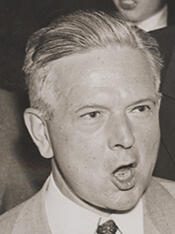
Here you will find contact information for Representative Edward Aloysius Kenney, including email address, phone number, and mailing address.
| Name | Edward Aloysius Kenney |
| Position | Representative |
| State | New Jersey |
| District | 9 |
| Party | Democratic |
| Status | Former Representative |
| Term Start | March 9, 1933 |
| Term End | January 3, 1939 |
| Terms Served | 3 |
| Born | August 11, 1884 |
| Gender | Male |
| Bioguide ID | K000120 |
About Representative Edward Aloysius Kenney
Edward Aloysius Kenney (August 11, 1884 – January 27, 1938) was a Democratic member of the United States House of Representatives from New Jersey, elected to three consecutive terms and serving from 1933 until his death in 1938. Over the course of his tenure in Congress, which spanned the Seventy-third, Seventy-fourth, and Seventy-fifth Congresses, he represented his New Jersey constituents during a transformative period in American history marked by the Great Depression and the New Deal, contributing to the legislative process over three terms in office.
Kenney was born on August 11, 1884, in Clinton, Massachusetts, where he attended the public schools and graduated from Clinton High School in 1902. He pursued higher education at Williams College in Williamstown, Massachusetts, graduating in 1906. Intending to enter the legal profession, he continued his studies at the law department of New York University in New York City, from which he graduated in 1908, thereby laying the foundation for a career that would combine law and public service.
In 1908 Kenney was admitted to the New York bar and commenced the practice of law in New York City. He built his early legal career there before relocating in 1916 to Cliffside Park, New Jersey, where he continued to practice law. His move to New Jersey marked the beginning of his direct involvement in that state’s civic and political life, as he increasingly combined his legal work with public responsibilities and local political activity.
During the First World War, in 1917, Kenney served as a member of the legal advisory draft board of New Jersey, providing legal guidance related to conscription and wartime obligations. He subsequently held judicial office as judge of the recorders court in Cliffside Park from 1919 to 1923, presiding over local matters and gaining experience in the administration of justice. In addition to his judicial duties, he became chairman of the Cliffside Park Housing Commission in 1922 and 1923, reflecting his engagement with local governance and housing issues.
Kenney’s political affiliations and ambitions evolved over the 1920s. He was an unsuccessful candidate for mayor of Cliffside Park three times: first as an Independent in 1921, then as a Republican in 1923, and later as a Democrat in 1927. He also served as a member of the Republican county committee in 1925 and 1926. These shifting affiliations illustrate both the fluidity of local politics in that era and Kenney’s persistent interest in elective office and public policy at the municipal level, before he ultimately aligned himself with the Democratic Party in his successful bid for national office.
In 1932 Kenney was elected as a Democrat to the Seventy-third Congress, taking his seat in the U.S. House of Representatives on March 4, 1933. He was subsequently reelected to the Seventy-fourth and Seventy-fifth Congresses, serving continuously from March 4, 1933, until his death in 1938. As a member of the House of Representatives during the New Deal period, he participated in the democratic process at the federal level and represented the interests of his New Jersey constituents while the nation grappled with economic crisis and far-reaching legislative reforms. His service in Congress thus coincided with a significant period in American history, during which he contributed to the work of the national legislature.
Kenney’s congressional career was cut short when he died in office in Washington, D.C., on January 27, 1938. His death resulted from an accidental fall from a window of the Carleton Arms Hotel. At the time of his passing, he was still serving in the Seventy-fifth Congress, and his death placed him among the members of the United States Congress who died in office in the first half of the twentieth century. He was interred in St. John’s Cemetery in his hometown of Clinton, Massachusetts, closing a life that had taken him from small-town New England through the legal and political arenas of New York and New Jersey to the national legislature in Washington.