Representative Edward McPherson
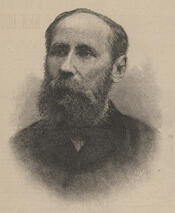
Here you will find contact information for Representative Edward McPherson, including email address, phone number, and mailing address.
| Name | Edward McPherson |
| Position | Representative |
| State | Pennsylvania |
| District | 17 |
| Party | Republican |
| Status | Former Representative |
| Term Start | December 5, 1859 |
| Term End | March 3, 1863 |
| Terms Served | 2 |
| Born | July 31, 1830 |
| Gender | Male |
| Bioguide ID | M000591 |
About Representative Edward McPherson
Edward McPherson (July 31, 1830 – December 14, 1895) was an American newspaper editor, lawyer, and politician who served as a Republican Representative from Pennsylvania in the United States Congress from 1859 to 1863, and later as Clerk of the House of Representatives for three separate periods. He was also a prominent figure in the preservation of the Gettysburg Battlefield as a director of the Gettysburg Battlefield Memorial Association, where he helped to protect and mark key portions of the field.
McPherson was born in Gettysburg, Adams County, Pennsylvania, on July 31, 1830. He attended Pennsylvania College in Gettysburg (now Gettysburg College), where he studied law and botany and graduated in 1848 as valedictorian of his class. After graduation he read law in Lancaster, Pennsylvania, in the firm of Thaddeus Stevens, under whose influence he became a Whig. His early legal career was interrupted by illness, which led him to shift his focus from law to journalism.
In 1851 McPherson moved to Harrisburg, Pennsylvania, where he became editor of the Harrisburg American. Later that year he took over the Lancaster Independent Whig, which he edited from 1851 to 1854. In 1855 he founded and edited the Pittsburgh Evening Times, an American Party newspaper. He returned to Gettysburg in 1856 and resumed the practice of law. In 1858 he inherited his father’s farm west of Gettysburg along the Chambersburg Turnpike, a property that would later lie near the first day’s fighting at the Battle of Gettysburg. By this time he had aligned himself with the emerging Republican Party and became active in state and national politics, serving as a member of the Republican National Committee in 1860.
McPherson was elected as a Republican to the Thirty-sixth and Thirty-seventh Congresses, representing a district that included Adams, Franklin, Fulton, Bedford, and Juniata counties, and served in the United States House of Representatives from 1859 to March 3, 1863. His service in Congress occurred during a significant period in American history, spanning the secession crisis and the early years of the Civil War. As a member of the House of Representatives, he participated in the legislative process and represented the interests of his Pennsylvania constituents. During his tenure he served on the Committee on Military Affairs and the Joint Committee on the Library, contributing to legislation and oversight related to the Union war effort and the administration of congressional and national collections.
At the outset of the Civil War, McPherson organized Company K of the First Pennsylvania Reserves, reflecting his support for the Union cause. In the 1862 elections he was defeated for reelection after his congressional district was redrawn to substitute Somerset County for Juniata County, bringing in a constituency that included opponents aligned with Radical Republicans. In 1863 President Abraham Lincoln appointed him Deputy Commissioner of Revenue, a federal post he held while the war continued. After the Battle of Gettysburg in July 1863, McPherson became an officer of the Gettysburg Battlefield Memorial Association, maintaining an office at the corner of Baltimore and Middle streets in Gettysburg and playing a central role in early efforts to preserve and mark the battlefield.
Through the influence of Thaddeus Stevens, following a nomination by Congressman James K. Moorhead, McPherson was appointed Clerk of the House of Representatives, serving his first tenure from December 8, 1863, to December 5, 1875. In this position he oversaw the administrative and record-keeping functions of the House during the Civil War and Reconstruction. During this period he also became known for directing federal printing contracts away from Radical Republican newspapers and toward more moderate outlets. Among these actions, he diverted contracts from the Jacksonville Florida Times to the Florida Union in Florida, and from Albion W. Tourgée’s Union Register to William Woods Holden’s Raleigh Daily Standard in North Carolina, and awarded contracts to two newspapers edited by former Confederate officers. He initially granted a contract to The New Orleans Tribune, a Black-owned newspaper supported by Radical Republicans, but revoked it in 1868 at the request of Thomas W. Conway.
After leaving the clerkship in 1875, McPherson remained active in national Republican politics. He presided over the Republican National Convention in 1876. President Rutherford B. Hayes appointed him director of the United States Bureau of Engraving and Printing, a post he held from 1877 to 1878. He simultaneously returned to journalism, serving as editor of the Philadelphia Press from 1877 until 1880. From 1877 to 1895 he was editor of the New York Tribune Almanac, and from 1880 until his death he was editor and proprietor of a newspaper in Gettysburg. He also served as the American editor of the Almanach de Gotha. McPherson was again chosen Clerk of the House of Representatives from December 1881 to December 1883, and for a third term from December 1889 to December 1891, underscoring his long-standing influence in congressional administration.
In addition to his political and editorial work, McPherson was a recognized authority on the political history of the Civil War and Reconstruction eras. His published works included Political History of the United States of America During the Great Rebellion (first issued in 1864, with later editions) and The Political History of the United States of America During the Period of Reconstruction (1871). He also wrote numerous articles, including “Remarks of Hon. Edward McPherson,” published in The Star and Sentinel on September 12, 1889. In the 1890s he continued his involvement with the Gettysburg Battlefield Memorial Association and served as attorney in the 1893 legal challenge to the Gettysburg Electric Railway, a case that reached the United States Supreme Court as United States v. Gettysburg Electric Railway Co., helping to establish federal authority to preserve historic battlefields.
McPherson married Annie D. Crawford in 1862, and the couple had four sons and one daughter. He remained a resident of Gettysburg for most of his life and was closely associated with the civic and historical life of the community. On December 14, 1895, he died in Gettysburg of accidental poisoning. He was interred in Evergreen Cemetery in Adams County, Pennsylvania. His papers were added to the collections of the Library of Congress in 1941, and the Edward McPherson Society was later named in his honor. His legacy has also been reflected in popular culture; in the 2012 film “Lincoln,” he was portrayed by actor Christopher Evan Welch.