Representative Edward Sloman Minor
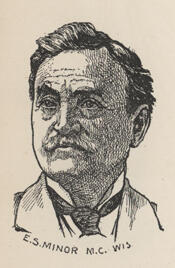
Here you will find contact information for Representative Edward Sloman Minor, including email address, phone number, and mailing address.
| Name | Edward Sloman Minor |
| Position | Representative |
| State | Wisconsin |
| District | 9 |
| Party | Republican |
| Status | Former Representative |
| Term Start | December 2, 1895 |
| Term End | March 3, 1907 |
| Terms Served | 6 |
| Born | December 13, 1840 |
| Gender | Male |
| Bioguide ID | M000798 |
About Representative Edward Sloman Minor
Edward Sloman Minor (December 13, 1840 – July 26, 1924) was an American businessman, Republican politician, Union Army officer, and Wisconsin pioneer who became a prominent public figure in northeastern Wisconsin. He served six consecutive terms in the United States House of Representatives from 1895 to 1907, representing first Wisconsin’s 8th congressional district and, after redistricting, the 9th congressional district. A member of the Republican Party, he contributed to the legislative process during a significant period in American history and was particularly active on issues related to rivers, harbors, and the merchant marine. In addition to his congressional service, he was the 7th and 16th mayor of Sturgeon Bay, Wisconsin, represented Door County for seven years in the Wisconsin Legislature, and held various state and local offices that reflected his long-standing engagement in public affairs.
Minor was born on December 13, 1840, in Jefferson County, New York, one of five children of Martin Minor and his wife Abigail (née St. Ores). The Minor family were descendants of early British colonists to the Massachusetts Bay Colony. During his childhood, his parents moved west to the Wisconsin Territory, settling first in the town of Greenfield in Milwaukee County. They soon relocated to the city of Milwaukee, where his father worked as a ship calker and Edward attended the public schools. In 1852 the family moved again, this time to a homestead in Sheboygan County, Wisconsin, where they worked as farm laborers and continued to establish themselves on the frontier.
In the spring of 1858, Minor went north to Door County, Wisconsin, to secure land for his family. He traveled on foot from Baileys Harbor to Fish Creek to claim a plot of land from the United States General Land Office, and the rest of the family joined him there in July of that year. This move marked the beginning of his long association with Door County and the Sturgeon Bay area, where he would later build his business and political career. In 1867 he married Mathilda Eloiza “Tillie” Graham, daughter of Oliver Perry Graham, a fellow Door County pioneer who erected the first lumber mill at Sturgeon Bay. Edward and Tillie Minor had at least six children, five of whom survived him; their eldest son, Stanton Minor, later served as his private secretary during his years in Congress and was an unsuccessful candidate for the Wisconsin State Assembly.
At the outbreak of the American Civil War, Minor volunteered for service in the Union Army. He was enrolled as a private in Company G of the 2nd Wisconsin Cavalry Regiment, which served in the western theater of the war and west of the Mississippi River. Over the course of his service he was promoted successively to corporal and sergeant and re-enlisted as a veteran with the regiment after the expiration of his initial three-year enlistment. Near the close of the war he received a commission as a second lieutenant and was subsequently promoted to first lieutenant on July 29, 1865. He mustered out with the regiment in November 1865, concluding more than four years of active military service. His Civil War record and status as a veteran later underpinned his involvement in veterans’ organizations and his standing in public life.
Following the war, Minor returned to Door County and established himself as a merchant in Fish Creek, dealing primarily in timber products at a time when the lumber industry was central to the region’s economy. His business activities and familiarity with local commercial needs helped shape his later advocacy for transportation and harbor improvements. His entry into public office came with his election to the Wisconsin State Assembly in 1877, representing Door County in the 31st Wisconsin Legislature. Although he did not seek re-election in 1878, he returned to the Assembly and won elections in 1879 and 1880, thereby serving Door County for a total of seven years in the Wisconsin Legislature. During his early legislative service he strongly supported construction of the Sturgeon Bay Ship Canal, a project that would become a defining feature of his public work.
In 1882, Minor advanced to the Wisconsin State Senate, winning a four-year term representing the 1st State Senate district, which then encompassed most of the northeast quadrant of the state. During the 1885 session he was elected president pro tempore of the Senate, reflecting the confidence of his colleagues in his leadership. While serving in the Senate, he was appointed superintendent of the Sturgeon Bay Ship Canal, a position that prompted his move to Sturgeon Bay, Wisconsin. He oversaw the canal from his appointment through 1891, and during this period he also served for four years as a member of the Wisconsin Fish Commission, further deepening his involvement in issues of waterways, fisheries, and natural resources. In 1894 he was elected mayor of Sturgeon Bay, becoming the city’s 7th mayor and later returning as its 16th mayor, thereby cementing his role in local as well as state governance.
Later in 1894, Minor was nominated as the Republican candidate for the United States House of Representatives in Wisconsin’s 8th congressional district. He defeated incumbent Democrat Lyman E. Barnes in the general election and took his seat in the 54th Congress in March 1895. He was subsequently re-elected three times in the 8th district, in 1896, 1898, and 1900. Following the 1900 United States census, Wisconsin gained an additional congressional district, and in the ensuing redistricting Minor’s home county was shifted from the 8th to the 9th congressional district. He successfully stood for election in the 9th district and was returned to Congress for two more terms, serving continuously until March 1907. His six terms in the House of Representatives spanned the 54th through the 59th Congresses, a period marked by industrial expansion, growing federal involvement in economic regulation, and the early years of the Progressive Era.
During his congressional service, Minor was particularly active on the House Committee on Merchant Marine and Fisheries, where he focused on securing funding for improvements to rivers and harbors, consistent with his long-standing interest in maritime and canal development. He also served as chairman of the Committee on Expenditures in the Department of the Interior during the 58th and 59th Congresses, overseeing matters related to administrative efficiency and federal spending within that department. Known among the political class in Washington, D.C., he was regarded as a trusted friend of President Theodore Roosevelt, aligning with the administration on many issues of national development and conservation. His work in Congress reflected both his regional priorities and his broader commitment to infrastructure and resource management. In 1906, however, he was defeated in the Republican primary by Gustav Küstermann, who went on to succeed him in the House in 1907.
After leaving Congress, Minor remained active in public service. He was appointed postmaster of Sturgeon Bay, serving from 1911 through 1915, a position that kept him closely connected to the community he had long represented. In 1918 he was again elected mayor of Sturgeon Bay, returning to lead the city during the closing year of World War I and the onset of postwar adjustments. Outside of elective and appointive office, he participated in civic and fraternal organizations, including the Independent Order of Odd Fellows, the Military Order of the Loyal Legion of the United States, and the Grand Army of the Republic, reflecting both his Civil War service and his engagement in community life.
Edward Sloman Minor died at his home in Sturgeon Bay, Wisconsin, on July 26, 1924, after a month-long decline in health. He was interred at Bayside Cemetery in Sturgeon Bay. He was survived by his wife, Mathilda, and most of their children, including his son Stanton. Remembered as a pioneer settler, Civil War officer, businessman, and long-serving Republican officeholder, Minor’s career spanned local, state, and national government during a transformative era in Wisconsin and American history.