Representative Edward William Pou
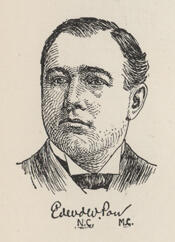
Here you will find contact information for Representative Edward William Pou, including email address, phone number, and mailing address.
| Name | Edward William Pou |
| Position | Representative |
| State | North Carolina |
| District | 4 |
| Party | Democratic |
| Status | Former Representative |
| Term Start | December 2, 1901 |
| Term End | January 3, 1935 |
| Terms Served | 17 |
| Born | September 9, 1863 |
| Gender | Male |
| Bioguide ID | P000474 |
About Representative Edward William Pou
Edward William Pou (September 9, 1863 – April 1, 1934) was an American politician who served as a Democratic Representative from North Carolina in the United States Congress from 1901 until his death in 1934. Over the course of 17 consecutive terms in office, he became one of the most senior members of the House of Representatives. From March 1933 to April 1934, he was the longest-serving current member of Congress and held the honorary title of dean of the United States House of Representatives, reflecting his length of service and experience in national legislative affairs.
Pou was born in Tuskegee, Macon County, Alabama, on September 9, 1863, during the closing years of the Civil War. In 1867, when he was still a young child, he moved with his parents to North Carolina, the state that would become his lifelong home and the base of his political career. Growing up in the postwar South, he came of age during Reconstruction and its aftermath, experiences that helped shape his outlook as a Southern Democrat in the late nineteenth and early twentieth centuries.
Pou pursued higher education at the University of North Carolina at Chapel Hill, one of the leading institutions in the South at the time. While at the university he studied law and became a member of the Alpha Tau Omega fraternity. After completing his legal studies, he was admitted to the bar and established a law practice in Smithfield, North Carolina. He practiced law there for a number of years, building a professional reputation and local standing that would later support his entry into elective office.
Pou’s national political career began with his election as a Democrat to the United States House of Representatives from North Carolina’s 4th congressional district. He took his seat in March 1901 and remained continuously in Congress until his death in 1934, serving during a period that encompassed the Progressive Era, World War I, the postwar Red Scare, the 1920s, and the early years of the Great Depression. As a member of the House of Representatives, Edward William Pou participated in the democratic process and represented the interests of his constituents in North Carolina, contributing to the legislative process across more than three decades of major political and social change.
During his long tenure, Pou held important committee leadership positions that gave him significant influence over House procedure and legislation. He served as chairman of the Committee on Claims, a standing committee that handled private claims against the federal government until it was abolished in 1946. Later, he became chairman of the powerful House Rules Committee, which controls the flow of legislation to the House floor and plays a central role in shaping the legislative agenda. Through these posts, Pou exercised substantial authority in managing and directing the consideration of bills and resolutions, and he was regarded as a key figure within the Democratic caucus.
Pou is particularly noted for his role in a prominent civil liberties controversy arising from the aftermath of World War I and the Palmer Raids. In 1920, Louis F. Post, Assistant Secretary of Labor and head of the Bureau of Immigration, came under attack for reversing many deportation orders issued during the anti-radical campaign led by Attorney General A. Mitchell Palmer and his aide J. Edgar Hoover. On April 15, 1920, Representative Homer Hoch of Kansas accused Post of abusing his power and called for his impeachment. The House Committee on Rules, on which Pou served and later chaired, considered asking the President to remove Post instead of pursuing impeachment. Post requested and was granted an opportunity to testify, and on May 7–8, 1920, he defended his actions and criticized the conduct of the Justice Department. In a widely noted exchange, Pou—though generally a supporter of the broader anti-radical campaign—publicly praised Post, declaring, “I believe you have followed your sense of duty absolutely,” and then walked out of the hearing room, leaving it in stunned silence. Following this dramatic intervention and Post’s testimony, the Rules Committee took no further action against Post.
In addition to his legislative work, Pou occasionally commented on matters of personal and public interest, including the pronunciation of his own surname. Asked how to say his name, he told The Literary Digest that although it was spelled “Pou,” it was pronounced as though it were spelled “pew” or “pugh.” His long service, committee leadership, and role as dean of the House made him a familiar figure in Washington political circles during the early twentieth century.
Edward William Pou died in Washington, D.C., on April 1, 1934, while still in office, bringing to a close more than three decades of continuous congressional service. His death placed him among the members of the United States Congress who died in office between 1900 and 1949. He was remembered in contemporary accounts, including an obituary in the New York Times, as a veteran legislator and a prominent Democratic leader who had played a significant role in the House of Representatives during a transformative era in American history.