Representative Edward R. Roybal
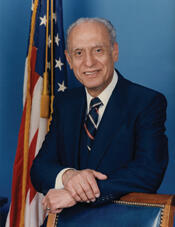
Here you will find contact information for Representative Edward R. Roybal, including email address, phone number, and mailing address.
| Name | Edward R. Roybal |
| Position | Representative |
| State | California |
| District | 25 |
| Party | Democratic |
| Status | Former Representative |
| Term Start | January 9, 1963 |
| Term End | January 3, 1993 |
| Terms Served | 15 |
| Born | February 10, 1916 |
| Gender | Male |
| Bioguide ID | R000485 |
About Representative Edward R. Roybal
Edward Ross Roybal (February 10, 1916 – October 24, 2005) was an American politician and a long-serving Democratic Representative from California in the United States Congress from 1963 to 1993. Over 15 consecutive terms in the House of Representatives, he represented portions of Downtown and East Los Angeles and became a prominent national advocate for civil rights, public health, the elderly, veterans, and Latino communities. Earlier, he was the first Latino American to be elected to the Los Angeles City Council, serving from 1949 to 1962 and emerging as a leading spokesman for minority groups on the city’s East Side.
Roybal was born on February 10, 1916, in Albuquerque, New Mexico, into a Mexican family whose roots in the area extended back eight generations to the period of Spanish rule. In 1922, when a railroad strike left his father unable to work, the family moved to the Boyle Heights neighborhood of East Los Angeles. Roybal attended local schools and graduated from Roosevelt High School in 1934. After high school he joined the Civilian Conservation Corps, gaining early experience in public service during the New Deal era. He later studied business at the University of California, Los Angeles (UCLA) and attended Southwestern Law School, and he served a stint in the United States Army, where he worked as an accountant for an infantry unit.
Roybal’s professional career began in public health. In 1942 he became a public health educator with the California Tuberculosis Association. After his military service he returned to Los Angeles and served as director of health education for the Los Angeles County Tuberculosis and Health Association, a position he held from 1949 until his election to the City Council. His work in health education and his organizing efforts in East Los Angeles brought him into close contact with community leaders and laid the foundation for his later political career. In 1949 he helped form the Community Service Organization (CSO) with organizer Fred Ross and Anthony “Tony” P. Rios, uniting religious, political, and labor groups to combat discrimination and conduct voter registration and get-out-the-vote drives. In 1960 he helped organize the Mexican American Political Association (MAPA) and served as its first president from 1960 to 1962, further solidifying his role as a key figure in emerging Latino political movements.
Roybal first sought elective office in 1947, running unsuccessfully for the Los Angeles City Council’s 9th District seat, which then encompassed Boyle Heights, Bunker Hill, the Civic Center, Chinatown, Little Tokyo, and the Central Avenue corridor. In that race he placed third in a field of five. Two years later, in 1949, he again challenged incumbent Parley Parker Christensen and, drawing on the organizational strength of the CSO and broad community support, defeated him in a runoff election for a two-year term. He was reelected in every subsequent contest and served on the City Council until 1962, becoming president pro tempore in his final term. On the Council, Roybal was widely recognized as a spokesman for minority groups and a “consistent supporter” of subsidized low-cost public housing. He cast the sole negative vote in 1950 against an ordinance requiring “Communists and other subversives” to register with the police, warning that it placed citizens “at the mercy of any biased crackpot.” He opposed corporal punishment as a response to juvenile delinquency, advocated closer cooperation between police and youth agencies, supported mandatory rabies vaccination for dogs in 1953, and in 1958 backed the creation of a city Fair Employment Practices Commission. He opposed the use of Chavez Ravine as the site for a Major League Baseball stadium, favored Wrigley Field in South Los Angeles, and in 1959 threatened a filibuster to secure regular reports on the fate of residents displaced by the Bunker Hill redevelopment project. In 1960 he publicly demanded an apology from Police Chief William H. Parker for remarks disparaging Latino residents of East Los Angeles, highlighting Roybal’s willingness to confront discriminatory rhetoric at the highest levels of local government.
During his City Council tenure, Roybal was encouraged to seek higher office. In 1954 he ran for lieutenant governor of California as a Democrat, losing to Republican incumbent Harold J. Powers by a margin of 1,764,035 votes (44.66 percent) to 2,185,918 (55.34 percent). In 1958 he campaigned for a seat on the Los Angeles County Board of Supervisors against Ernest E. Debs in a bitterly contested race. Roybal held a narrow lead on election night, but after four recounts Debs was declared the winner. Despite these setbacks, Roybal remained a central figure in Los Angeles politics and Latino civic life, and his continued organizing and advocacy positioned him for a successful bid for Congress in the next decade.
In 1962 Roybal ran for the U.S. House of Representatives from California’s 25th District, which included Boyle Heights, East Los Angeles, Downtown Los Angeles, and parts of Hollywood. He won the election and took office on January 3, 1963, becoming the first Latino member of Congress from California since Romualdo Pacheco’s election in 1879. A member of the Democratic Party, he served 15 terms in the House, from 1963 to 1993, during a significant period in American history that encompassed the civil rights movement, the Vietnam War, the Great Society, and the end of the Cold War. In his early terms he served on the Interior and Insular Affairs Committee and the Post Office Committee, and later on the Foreign Affairs Committee and the Veterans’ Affairs Committee. Roybal participated actively in the legislative process and consistently supported landmark civil rights legislation, voting in favor of the Civil Rights Act of 1964, the Voting Rights Act of 1965, and the Civil Rights Act of 1968.
Beginning in 1971 Roybal served for more than two decades on the powerful House Appropriations Committee, where he developed a reputation for a generally low-key but effective legislative style. He authored and supported numerous measures aimed at assisting groups he regarded as disenfranchised, including veterans, the elderly, and Mexican Americans. In 1967 he introduced the first federal bill providing support for bilingual education, helping to establish specialized language instruction for immigrant and non-English-speaking students. As chairman of the House Select Committee on Aging, he led a successful effort to restore $15 million in funding for low-cost health programs for senior citizens and to expand public housing programs for the elderly. In 1982 he worked to preserve the Meals on Wheels program and veterans’ preferences in federal hiring. In the early 1980s, he advocated increased federal funding for AIDS research, taking that position despite opposition from many constituents, and underscoring his concern with public health and vulnerable populations.
Roybal was also a key architect of Latino political representation at the national level. In 1976 he was a founder of the Congressional Hispanic Caucus (CHC), which provided a collective voice for Hispanic and Latino members of Congress. He later co-founded the National Association of Latino Elected and Appointed Officials (NALEO), becoming its Founder Emeritus and helping to build a nationwide network of Latino officeholders. As chair of the Congressional Hispanic Caucus in 1986, he led the unsuccessful opposition to the Simpson–Mazzoli Act, the immigration reform bill that ultimately became the Immigration Reform and Control Act of 1986. His leadership in these organizations and in Congress contributed significantly to the growth of Latino political influence in California and across the United States.
In 1978 Roybal became entangled in the Koreagate investigation, which examined allegations of vote-buying by South Korean interests. He failed to report properly to the House Ethics Committee a $1,000 gift from South Korean lobbyist Tongsun Park and initially testified that he had never met Park. Park later stated that he had met Roybal briefly four years earlier for less than two minutes and barely remembered him, and the record showed that Roybal had voted against every bill that would have benefited Park. The Ethics Committee originally considered censure but, after testimony from Hispanic leaders and colleagues such as Representatives Ronald Dellums and Phillip Burton, reduced the recommended punishment to a reprimand, the same sanction imposed on two other members involved. In a letter dated November 29, 1978, Thomas H. Henderson Jr., Chief of the Public Integrity Section, noted that the Committee found Roybal’s changed testimony was not intentionally untruthful as originally charged. Roybal ran for reelection that year and won with approximately 70 percent of the vote, continuing to serve his district and maintain his influence in Congress.
Roybal retired from Congress in 1993 after thirty years in office. That year, following redistricting, his daughter Lucille Roybal-Allard was elected to represent California’s 33rd District, which contained part of his former constituency, while Xavier Becerra, with Roybal’s endorsement, won election in the 30th District, which included much of the remaining territory of Roybal’s old 25th District. After leaving Congress, Roybal and his wife established the Lucille and Edward R. Roybal Foundation, which awards scholarships to Latino students pursuing careers in health-related fields, reflecting his long-standing commitment to public health and educational opportunity. He resided in Pasadena, California, where he was regarded as one of the deans of local and national politics and remained active in public life by endorsing candidates and advising community leaders.
On January 8, 2001, Roybal was presented with the Presidential Citizens Medal by President Bill Clinton in recognition of his decades of public service. At the time of his death, more buildings in Los Angeles were named for him than for any other individual. Among these are the Edward R. Roybal Federal Building in downtown Los Angeles, located in his former home district, and the Edward R. Roybal Institute on Aging at the University of Southern California. The main campus of the Centers for Disease Control and Prevention in Atlanta, Georgia, also bears his name. In 2008 the Los Angeles Unified School District named Central Los Angeles High School #11 the Edward R. Roybal Learning Center; the school opened on September 3, 2008. In August 2022 the Roybal School of Film and Television Production Magnet opened within the Roybal Learning Center to expand opportunities for students from underrepresented backgrounds to enter below-the-line careers in film and television. The Metro Gold Line Edward R. Roybal Línea de Oro Eastside Extension, opened in November 2009, runs through East Los Angeles from Union Station to Atlantic. Each February, NALEO holds the Edward R. Roybal Legacy Gala in Washington, D.C., honoring his contributions to the nation and to Latino political representation. He was awarded a posthumous Presidential Medal of Freedom by President Barack Obama on November 24, 2014.
Edward Ross Roybal died of respiratory failure complicated by pneumonia on October 24, 2005, at Huntington Hospital in Pasadena, California, at the age of 89. A funeral service was held at the Cathedral of Our Lady of the Angels in Los Angeles, and he was buried at Calvary Cemetery in East Los Angeles. He was survived by his wife, Lucille, and their children Lucille Roybal-Allard, Lillian Roybal-Rose, and Edward Roybal Jr. His life and career, spanning local public health work, pioneering service on the Los Angeles City Council, and three decades in Congress, left a lasting imprint on civil rights, public health policy, aging policy, and Latino political empowerment in California and the United States.