Representative Edward Sauerhering
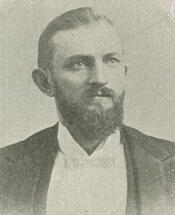
Here you will find contact information for Representative Edward Sauerhering, including email address, phone number, and mailing address.
| Name | Edward Sauerhering |
| Position | Representative |
| State | Wisconsin |
| District | 2 |
| Party | Republican |
| Status | Former Representative |
| Term Start | December 2, 1895 |
| Term End | March 3, 1899 |
| Terms Served | 2 |
| Born | June 24, 1864 |
| Gender | Male |
| Bioguide ID | S000071 |
About Representative Edward Sauerhering
Edward Sauerhering (June 24, 1864 – March 1, 1924) was a German American pharmacist and Republican politician from Dodge County, Wisconsin, who served two terms in the United States House of Representatives from 1895 to 1899. A member of the Republican Party, he represented Wisconsin’s 2nd congressional district in the 54th and 55th Congresses and contributed to the legislative process during a significant period in American history. He was the author of one of the first significant federal dairy laws, which defined cheese as a pure dairy product and imposed taxes and regulations on pseudo-dairy products such as margarine and “filled cheese.”
Sauerhering was born in Mayville, Dodge County, Wisconsin, on June 24, 1864, one of five children of Rudolf Sauerhering and Henrietta (née Hartwig) Sauerhering. Both of his parents were German American immigrants from East Prussia (in present-day Poland). His father, Rudolf, and his uncle, Adolph Sauerhering, were pharmacists educated at the University of Königsberg who emigrated to Wisconsin in the early 1850s and became among the first drug store operators in eastern Dodge County. Rudolf Sauerhering was a prominent local figure and became the first village president of Mayville, providing Edward with an early example of civic engagement and public service in a German American immigrant community.
Sauerhering attended the public schools of Mayville until the age of sixteen, when he left formal schooling to work in his father’s drug store. Pursuing professional training in pharmacy, he enrolled at the Chicago College of Pharmacy and graduated in 1885. After completing his studies, he remained in Chicago for three years, working in the drug business and gaining practical experience in his profession. He then returned to Mayville, where he resumed work in the family drug store, establishing himself as a local pharmacist and businessman.
Around the time of his return to Mayville, Sauerhering became active in Republican politics in Wisconsin. As a German Catholic Republican in the 1890s, he was a demographic outlier in a state where German American political loyalties were sharply divided along religious lines, with Protestants tending to support the Republicans and Catholics generally favoring the Democrats. Tensions were heightened in this period by the so‑called Bennett Law of 1889, a compulsory English-language education law that alienated many German Americans, and by remarks from the Republican governor that were widely interpreted as xenophobic and anti-Catholic. Despite this political climate, Sauerhering aligned with the Republican Party. In 1891 he was nominated on the Republican slate for the Mayville city council but was not elected. The following year, in 1892, he was chosen chairman of the Dodge County Republican Party and was nominated as the Republican candidate for the Wisconsin State Assembly from Dodge County’s 1st Assembly district, covering roughly the northeastern quarter of the county. Because of litigation over redistricting, nominations that year were unusually late, and he received the nomination on October 22, just seventeen days before the general election. He faced Democratic incumbent Bennett Sampson and was defeated by nearly a two-to-one margin. Undeterred, he ran for mayor of Mayville the next spring but again lost, this time to Carl A. Barwig, son of Democratic Congressman Charles Barwig.
Sauerhering’s rise to national office began with the Republican convention for Wisconsin’s 2nd congressional district in 1894, at which he appeared as chairman of the Dodge County Republicans. At that time the 2nd district comprised Dane, Dodge, Columbia, and Jefferson counties in south-central Wisconsin. The delegates’ preferred candidate, state representative George Grimm of Jefferson County, declined the nomination, and the convention ultimately turned to Sauerhering. Contemporary newspapers speculated that his selection was influenced by the fact that he came from the same city, Mayville, as the Democratic incumbent, Charles Barwig. In the general election of 1894, held amid widespread public discontent following the Panic of 1893, the political mood had shifted sharply against the Democrats, whom Republicans blamed for economic hardship and for free trade policies. In a national Republican wave that produced a gain of 104 seats in the U.S. House of Representatives, Sauerhering won one of the closest contests in the country, defeating Barwig by just 265 votes. He secured reelection in 1896 by a much wider margin, defeating former Madison mayor William H. Rogers.
During his two terms in Congress, from March 4, 1895, to March 3, 1899, Sauerhering participated in the deliberations of the 54th and 55th Congresses and represented the interests of his south-central Wisconsin constituents at a time of economic and political transition. His most notable legislative achievement was the sponsorship and passage of a federal act defining cheese as a pure dairy product, prohibiting the addition of other animal fats or vegetable oils, and placing taxes and regulatory controls on margarine and other “filled cheese” products. This measure was one of the earliest significant federal dairy laws and reflected both the importance of dairy farming to Wisconsin’s economy and the broader national debate over food purity and product labeling. After two terms, he declined to be a candidate for renomination in 1898 and left Congress at the conclusion of his second term, returning to his family’s drug business in Mayville.
In his later years, Sauerhering remained engaged in local public affairs while continuing his work as a pharmacist. He served as Mayville’s superintendent of public works from 1909 to 1918, during which he played a role in the construction and development of a new municipal waterworks system for the city. He also held judicial responsibilities as a justice of the peace from 1912 to 1920, further extending his record of local public service. Outside of formal office, he continued to be identified with the Republican Party and with the civic life of Mayville.
On June 29, 1889, Sauerhering married Eugenia Langenbach, herself a first-generation American and the daughter of German emigrants. The couple had three children. Their son Adolph served in the United States Army during World War I, and both of their sons later adopted the shortened surname “Sauer.” Edward Sauerhering suffered from prolonged illness in his final years and died at his home in Mayville on March 1, 1924, after approximately five years of declining health. He was interred in Graceland Cemetery in Mayville, leaving a legacy as a German American pharmacist, local civic leader, and Republican congressman who helped shape early federal regulation of dairy products.