Representative Edward Scull
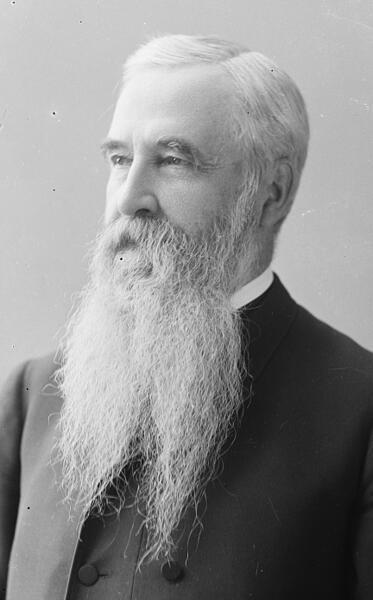
Here you will find contact information for Representative Edward Scull, including email address, phone number, and mailing address.
| Name | Edward Scull |
| Position | Representative |
| State | Pennsylvania |
| District | 20 |
| Party | Republican |
| Status | Former Representative |
| Term Start | December 5, 1887 |
| Term End | March 3, 1893 |
| Terms Served | 3 |
| Born | February 5, 1818 |
| Gender | Male |
| Bioguide ID | S000205 |
About Representative Edward Scull
Edward Scull (February 5, 1818 – July 10, 1900) was an American politician, lawyer, newspaperman, and banker from Pennsylvania who served as a Republican member of the U.S. House of Representatives from 1887 to 1893. Over the course of three consecutive terms, he represented Pennsylvania’s 17th congressional district from 1887 to 1889 and the 20th congressional district from 1889 to 1893, participating actively in the legislative process and representing the interests of his constituents during a significant period in American political and economic development.
Scull was born on February 5, 1818, in Pittsburgh, Pennsylvania. He attended the common schools in Pittsburgh and later pursued preparatory studies in Steubenville, Ohio. After completing his early education, he studied law and was admitted to the bar of Westmoreland County, Pennsylvania, in 1844. Two years later, in 1846, he moved to Somerset, Pennsylvania, where he established a law practice that he maintained until 1857. During this early phase of his career, he also served as prothonotary and clerk of the court for three years, gaining experience in local judicial and administrative affairs.
In addition to his legal work, Scull became deeply involved in journalism and local civic life. In 1852 he began publishing and editing the Somerset Herald, a position he held for thirty-five years until 1887. Through the Herald he became a prominent voice in regional political discourse and an influential figure in Republican Party circles. His editorial leadership coincided with the turbulent antebellum, Civil War, and Reconstruction eras, and his newspaper work helped establish his reputation as a committed party organizer and public advocate in Somerset County and beyond.
Scull’s public service expanded significantly during the Civil War and Reconstruction periods. In 1863 President Abraham Lincoln appointed him collector of internal revenue for the Sixteenth district of Pennsylvania, placing him in a key federal revenue post at a time when the national government was financing the war effort. He served in that capacity until September 1866, when he was removed by President Andrew Johnson amid the broader political conflicts of the era. Remaining active in Republican politics, Scull served as a delegate to the Republican National Convention in 1864, and he later returned as a delegate in 1876 and 1884, reflecting his continuing influence within the party at the state and national levels.
Scull also held important state and federal fiscal positions during the postwar years. In April 1869 President Ulysses S. Grant appointed him assessor of internal revenue, further underscoring the trust placed in him in matters of federal taxation and finance. On March 22, 1873, he was again appointed collector of internal revenue, a post he held until August 1883, when his district was consolidated with another. At the state level, he served as a member of the Pennsylvania State Senate for the 20th district in 1871, adding legislative experience in Harrisburg to his growing record of public office. These roles, combined with his long tenure as a newspaper editor, positioned him as a prominent Republican leader in southwestern Pennsylvania.
Building on this extensive background in law, journalism, and revenue administration, Scull was elected as a Republican to the Fiftieth, Fifty-first, and Fifty-second Congresses. He served in the U.S. House of Representatives from March 4, 1887, to March 3, 1893. During these three terms in office, he represented Pennsylvania’s 17th congressional district from 1887 to 1889 and, following redistricting, the 20th congressional district from 1889 to 1893. His congressional service took place during a period marked by debates over tariffs, monetary policy, veterans’ issues, and industrial regulation, and he contributed to the legislative process as a member of the House, advancing the interests and concerns of his Pennsylvania constituents within the broader national dialogue.
After leaving Congress in 1893, Scull retired from elective office and returned to Somerset, where he continued to play a leading role in local economic life. He served as president of the First National Bank of Somerset, a position he held until his death, reflecting his longstanding engagement with financial and commercial affairs in the community. His combined careers in law, journalism, public finance, and banking made him a central figure in the civic and economic development of Somerset over several decades.
Edward Scull died in Somerset, Pennsylvania, on July 10, 1900. His long life spanned from the early industrial growth of Pennsylvania through the Civil War and Reconstruction to the closing years of the nineteenth century, and his varied service at the local, state, and national levels left a durable imprint on both his region and his state’s political history.