Representative Edward Voigt
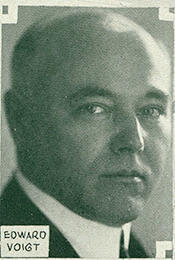
Here you will find contact information for Representative Edward Voigt, including email address, phone number, and mailing address.
| Name | Edward Voigt |
| Position | Representative |
| State | Wisconsin |
| District | 2 |
| Party | Republican |
| Status | Former Representative |
| Term Start | April 2, 1917 |
| Term End | March 4, 1927 |
| Terms Served | 5 |
| Born | December 1, 1873 |
| Gender | Male |
| Bioguide ID | V000110 |
About Representative Edward Voigt
Edward Voigt (December 1, 1873 – August 26, 1934) was a Republican member of the United States House of Representatives from Wisconsin who represented Wisconsin’s 2nd congressional district from 1917 to 1927. Over the course of five consecutive terms in Congress, he contributed to the legislative process during a significant period in American history, including the First World War and the early postwar years, and participated actively in representing the interests of his constituents.
Voigt was born in Bremen, Germany, on December 1, 1873. In 1883 he immigrated to the United States with his parents, who settled in Milwaukee, Wisconsin. Growing up in Milwaukee, he entered the workforce at a young age and was employed in law and insurance offices for several years. This early exposure to legal and business affairs helped shape his interest in the law and public service and provided practical experience that preceded his formal legal education.
Pursuing higher education in his adopted state, Voigt enrolled in the law department of the University of Wisconsin–Madison. He graduated in 1899 and was admitted to the bar that same year. Immediately after his admission, he commenced the practice of law in Sheboygan, Wisconsin. Establishing himself as an attorney in Sheboygan, he built a legal career that soon led to positions of public responsibility at the local and county levels.
Voigt’s early public career was rooted in local government and legal administration. He served as district attorney of Sheboygan County from 1905 to 1911, prosecuting cases and representing the county in legal matters for six years. After a brief interval in private practice, he continued his service in municipal law as city attorney for Sheboygan from 1913 to 1917. In these roles he gained experience in public law and governance that would later inform his work as a legislator at the national level.
In 1916 Voigt was elected as a Republican to the Sixty-fifth Congress as the representative of Wisconsin’s 2nd congressional district, beginning his service on March 4, 1917. He was subsequently reelected to the four succeeding Congresses, serving continuously until March 3, 1927. His decade in the House of Representatives coincided with a transformative era in American and world affairs. On April 5, 1917, during the debate over U.S. entry into World War I, he was among those who voted against declaring war on Germany, a notable stance for a representative of German birth. Throughout his tenure, he participated in the democratic process of lawmaking and represented the interests of his Wisconsin constituents during wartime mobilization, postwar adjustment, and the early years of the 1920s. He also took part in national party affairs as a delegate to the Republican National Convention in 1924. Voigt chose not to be a candidate for reelection in 1926 to the Seventieth Congress, thereby concluding his congressional service after five terms.
After leaving Congress in 1927, Voigt returned to Sheboygan and resumed the practice of law. His legal and political experience soon led him back into public office in the judicial branch. In 1928 he was elected judge of the fourth judicial circuit court of Wisconsin. He assumed his judicial duties in January 1929 and served on the bench until his death, presiding over a wide range of civil and criminal matters and continuing his long record of public service within the state’s legal system.
Edward Voigt died on August 26, 1934, at his summer home at Crystal Lake in rural Sheboygan County near Elkhart Lake, Wisconsin, while still serving as a circuit court judge. He was interred in Forest Home Cemetery in Milwaukee, Wisconsin, the city where he had first settled as an immigrant and begun the path that led to his career as an attorney, legislator, and judge.