Representative Edward Butterfield Vreeland
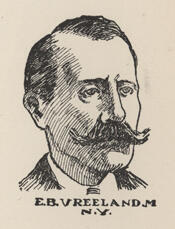
Here you will find contact information for Representative Edward Butterfield Vreeland, including email address, phone number, and mailing address.
| Name | Edward Butterfield Vreeland |
| Position | Representative |
| State | New York |
| District | 37 |
| Party | Republican |
| Status | Former Representative |
| Term Start | December 4, 1899 |
| Term End | March 3, 1913 |
| Terms Served | 7 |
| Born | December 7, 1856 |
| Gender | Male |
| Bioguide ID | V000122 |
About Representative Edward Butterfield Vreeland
Edward Butterfield Vreeland (December 7, 1856 – May 8, 1936) was an American banker, businessman, educator, and Republican politician who represented southern Western New York—principally Allegany, Chautauqua, and Cattaraugus counties—in the United States House of Representatives from 1899 to 1913. A member of the Republican Party, he served seven consecutive terms in Congress and is best remembered as an author and namesake of the Aldrich–Vreeland Act, which established the National Monetary Commission in response to the Panic of 1907, on which he served as vice chairman.
Vreeland was born on December 7, 1856, in Cuba, Allegany County, New York. In 1869 he moved with his family to Salamanca, New York, a growing railroad and commercial center in Cattaraugus County that would remain his home for the rest of his life. He attended local schools and later studied at Friendship Academy in Friendship, New York, from which he graduated in 1877. On February 27, 1881, he married Myra S. Price; the couple had three children. His early years in western New York, in a region shaped by railroads, commerce, and later the oil industry, provided the backdrop for his subsequent careers in education, law, business, and politics.
After completing his education, Vreeland began his professional life in the field of education. He served as superintendent of the Salamanca public schools from 1877 to 1882, overseeing the administration of the local school system at a time when public education was expanding and becoming more formalized in small cities and towns across New York State. During this period he also studied law and was admitted to the bar in 1881, though he chose not to engage in active legal practice. Instead, he turned to business pursuits that would define much of his later influence in financial and legislative matters.
Vreeland’s business career developed alongside the economic growth of Salamanca and the surrounding region. He became involved in banking, as well as in the oil and insurance industries, sectors that were increasingly important in western New York in the late nineteenth century. From 1889 to 1893 he served as postmaster of Salamanca, a federal appointment that placed him at the center of local civic and commercial communications. In 1891 he became president of the Salamanca Trust Company, a position that solidified his standing as a leading banker and businessman in the community and provided him with practical experience in finance that would later inform his work on national monetary policy.
Vreeland entered national politics at the close of the nineteenth century. He was elected as a Republican to the Fifty-sixth Congress to fill the vacancy caused by the resignation of Representative Warren B. Hooker and took his seat on November 7, 1899. He was subsequently reelected to the Fifty-seventh and to the five succeeding Congresses, serving continuously in the House of Representatives from November 7, 1899, to March 3, 1913. During these seven terms, he represented the interests of his constituents in southern Western New York and participated actively in the legislative process during a significant period in American history marked by industrial expansion, financial instability, and progressive-era reforms.
Within the House of Representatives, Vreeland became particularly associated with financial and banking legislation. He served as chairman of the Committee on Banking and Currency during the Sixty-first Congress, a role that placed him at the forefront of congressional efforts to address the nation’s recurring banking panics and currency problems. In the wake of the Panic of 1907, he worked closely with Senator Nelson W. Aldrich to develop legislation aimed at stabilizing the financial system. This collaboration produced the Aldrich–Vreeland Act of 1908, for which he is best remembered. The act authorized the issuance of emergency currency under certain conditions and, critically, established the National Monetary Commission to study banking and currency systems in the United States and abroad. Vreeland was appointed a member of this commission and served as its vice chairman from 1909 to 1912, contributing to the body of research and recommendations that would later influence the creation of the Federal Reserve System.
Although he remained a prominent figure in financial legislation, Vreeland chose not to seek renomination in 1912 and thus concluded his congressional service with the end of the Sixty-second Congress on March 3, 1913. His decision marked the close of more than thirteen years in the House, during which he had helped shape national monetary policy and represented his district through a period of rapid economic and political change. After leaving Congress, he returned to Salamanca and resumed his former business pursuits, continuing his involvement in banking and local enterprises.
Vreeland remained active in business life in Salamanca until shortly before his death. He retired from active business on January 1, 1936, after a long career that had spanned education, law, banking, and public service at both the local and national levels. He died at his home in Salamanca, New York, on May 8, 1936. He was interred in Wildwood Cemetery in Salamanca, leaving a legacy as a regional business leader and a national legislator whose work on the Aldrich–Vreeland Act and the National Monetary Commission contributed to the modernization of the American financial system.