Senator Edwin Chick Burleigh
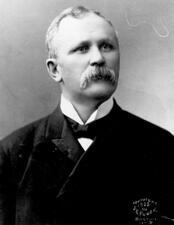
Here you will find contact information for Senator Edwin Chick Burleigh, including email address, phone number, and mailing address.
| Name | Edwin Chick Burleigh |
| Position | Senator |
| State | Maine |
| Party | Republican |
| Status | Former Representative |
| Term Start | March 15, 1897 |
| Term End | March 3, 1917 |
| Terms Served | 8 |
| Born | November 27, 1843 |
| Gender | Male |
| Bioguide ID | B001105 |
About Senator Edwin Chick Burleigh
Edwin Chick Burleigh (November 27, 1843 – June 16, 1916) was an American politician and newspaper proprietor who served as the 42nd governor of Maine from 1889 to 1893 and later represented Maine in both houses of the United States Congress. A member of the Republican Party, he held federal office first in the United States House of Representatives for Maine’s 3rd congressional district from 1897 to 1911 and subsequently in the United States Senate from 1913 until his death in 1916. His congressional service occurred during a significant period in American history, and as a member of the Senate he participated in the democratic process and represented the interests of his constituents.
Burleigh was born on November 27, 1843, in Linneus, Aroostook County, Maine, the son of Parker Prescott Burleigh and Caroline Peabody (Chick) Burleigh. He was raised in rural northern Maine and attended the common schools before pursuing further study at Houlton Academy. His early education in the local schools and academy prepared him for a variety of occupations in his youth, including work as a teacher, surveyor, and farmer. These early experiences in education and land-related work helped to shape his familiarity with the agricultural and land-use concerns that would later figure in his public service.
After working in teaching and surveying, Burleigh entered state government service in Augusta and Bangor. He first served as a clerk in the office of the state adjutant general, gaining administrative experience in a period when Maine was still adjusting to the post–Civil War era. From 1870 to 1876 he was clerk in the state land office at Bangor, Maine, where he dealt with issues related to public lands and development in a largely rural state. In 1876 he moved to Augusta, the state capital, and became state land agent, a position he held from 1876 to 1878. During this period he also served as an assistant clerk in the Maine House of Representatives until 1878, further acquainting himself with the workings of the legislative process.
Burleigh’s responsibilities in state finance and administration expanded in the 1880s. From 1880 to 1884 he served in the office of the Maine State Treasurer, and in 1884 he was elected Maine State Treasurer himself, holding that office for four years. His tenure as treasurer coincided with a period of economic development and political consolidation for the Republican Party in Maine. In addition to his public duties, he became the principal owner of the Kennebec Journal, a prominent Augusta newspaper, thereby combining political leadership with influence in the state’s press. The paper remained associated with his family, and a great-grandson later became a writer for the Kennebec Journal, extending the family’s connection to Maine journalism.
In 1889 Burleigh was elected the 42nd governor of Maine. He served three consecutive one-year terms as governor, from 1889 to 1893, during which he oversaw state government at a time of industrial growth, expanding rail and timber interests, and continued Republican dominance in Maine politics. His administration reflected his background in finance and land management, and it strengthened his position as a leading Republican figure in the state. After leaving the governorship in 1893, he remained active in business and party affairs, maintaining his role in the newspaper and in Republican politics.
Burleigh entered federal office in the closing years of the nineteenth century. In 1897 he was elected to the United States House of Representatives from Maine’s 3rd congressional district to fill the vacancy caused by the death of Representative Seth L. Milliken. He served in the House from 1897 to 1911, a period of fourteen years encompassing eight terms in office. As a Republican member of the House during the administrations of William McKinley, Theodore Roosevelt, and William Howard Taft, he participated in the legislative process on issues of economic policy, national expansion, and regulatory reform that marked the Progressive Era. Unsuccessful in his campaign for reelection in 1910, he left the House at the end of his term in 1911 and returned to his business interests in Maine for the next several years.
Burleigh resumed federal service in the Senate in the second decade of the twentieth century. He was elected to the United States Senate in 1912 as a Republican from Maine and took his seat in 1913. As a senator, he served during a transformative period that included the early years of the Woodrow Wilson administration and the lead-up to American involvement in World War I. His Senate service, which extended from 1913 until his death in 1916, continued his long record of representing Maine at the national level and contributing to the work of Congress over nearly two decades in both chambers.
In his later years Burleigh divided his time between his senatorial duties in Washington and his home and business interests in Augusta. His personal life was marked by loss in 1916, when his wife died in May of that year. Edwin Chick Burleigh died a month later, on June 16, 1916, in Augusta, Maine, while still serving in the United States Senate, placing him among the members of Congress who died in office in the early twentieth century. He was interred with his wife in the family plot at Forest Grove Cemetery in Augusta, closing a career that had spanned local, state, and national office and had left a lasting imprint on Maine’s political and journalistic life.