Senator Edwin Leard Mechem
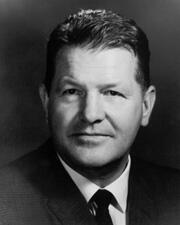
Here you will find contact information for Senator Edwin Leard Mechem, including email address, phone number, and mailing address.
| Name | Edwin Leard Mechem |
| Position | Senator |
| State | New Mexico |
| Party | Republican |
| Status | Former Representative |
| Term Start | November 30, 1962 |
| Term End | January 3, 1965 |
| Terms Served | 1 |
| Born | July 2, 1912 |
| Gender | Male |
| Bioguide ID | M000623 |
About Senator Edwin Leard Mechem
Edwin Leard Mechem (July 2, 1912 – November 27, 2002) was an American attorney, politician, and jurist from New Mexico who served as a United States Senator from New Mexico from 1962 to 1965, as the 15th, 17th, and 19th governor of New Mexico, and later as a United States district judge of the United States District Court for the District of New Mexico. He was the first person born in the 20th century to become governor of New Mexico and the first person born in New Mexico after statehood to ascend to that office. Born in Alamogordo, Otero County, New Mexico, he attended public schools in Alamogordo and Las Cruces. He was the son of Edwin Mechem Sr., a respected state district judge in Las Cruces, and the nephew of Merritt C. Mechem, who had also served as governor of New Mexico, situating him within a prominent New Mexico legal and political family.
Mechem pursued higher education at New Mexico A&M College (now New Mexico State University), attending in 1930–1931 and again in 1935. While there, he was a member of Alpha Delta Theta fraternity and, when that organization became a chapter of Sigma Pi fraternity, he was among the first alumni to be initiated into the national fraternity. Between his periods of study, from 1932 to 1935, he worked as a land surveyor for the United States Bureau of Reclamation in Las Cruces, gaining early experience in federal service and in the development of the region’s water and land resources. He later transferred his college credits to the University of Arkansas School of Law, where he completed his legal education and received a Bachelor of Laws degree in 1939.
Admitted to the New Mexico Bar in 1939, Mechem began practicing law in Las Cruces and later in Albuquerque. During World War II he entered federal law enforcement, serving as a special agent of the Federal Bureau of Investigation from 1942 to 1945. After the war, he returned to New Mexico and entered elective politics, winning a seat in the New Mexico House of Representatives and serving from 1947 to 1948. Alongside his growing legal practice, he became active in professional and governmental advisory work, including membership in the American Law Institute and service on the Committee on Government Security from 1956 to 1957, reflecting his interest in legal reform and national security issues.
Mechem was elected governor of New Mexico as a Republican in 1950 and was reelected in 1952, serving as the state’s 15th governor. He chose not to run in 1954 and instead sought a seat in the United States Senate, but was defeated by incumbent Senator Clinton Presba Anderson. Returning to state politics, he was elected governor again in 1956, making him the 17th governor, but was defeated for reelection in 1958. He won a fourth term as governor in 1960, becoming the 19th governor of New Mexico. During these nonconsecutive terms, he oversaw state administration during a period of postwar growth and modernization and participated in efforts to reorganize and strengthen the executive branch, later serving on the New Mexico Commission on Reorganization of the Executive Branch and the New Mexico State Police Commission. Mechem lost his bid for reelection on November 6, 1962, but remained in office when, later that month, long-serving U.S. Senator Dionisio “Dennis” Chavez died.
Exercising his authority under the Seventeenth Amendment to the United States Constitution, Mechem, still serving as governor, arranged his own appointment to the United States Senate to fill the vacancy caused by Chavez’s death. He took office in 1962 and served until November 1964, completing one term in the Senate. A member of the Republican Party, he represented New Mexico during a pivotal period in American history marked by the civil rights movement and significant domestic and foreign policy debates. During his tenure, he was one of five non-Southern Republican senators to vote against the Civil Rights Act of 1964, a stance that placed him in a small minority within his party outside the South. He was defeated in his bid to retain the seat in the 1964 United States Senate election in New Mexico and, after leaving the Senate in November 1964, he resumed the practice of law in New Mexico while continuing to serve on various state commissions.
Mechem’s federal judicial career began when President Richard Nixon nominated him on September 3, 1970, to a new seat on the United States District Court for the District of New Mexico, authorized by 84 Stat. 294. The United States Senate confirmed his nomination on October 8, 1970, and he received his commission on October 14, 1970. As a United States district judge, he presided over a wide range of federal civil and criminal matters. Among his notable judicial actions was a ruling that protected the rights of American Indians on Indian lands from government interference, reflecting his engagement with issues of tribal sovereignty and federal authority in the Southwest. He assumed senior status on July 3, 1982, continuing to hear cases in a reduced capacity while remaining an influential figure in the federal judiciary in New Mexico.
In his personal life, Mechem experienced both the continuity and sacrifice associated with public service. His family’s longstanding involvement in New Mexico law and politics was marked by his own rise to the governorship and the federal bench, as well as by loss: his son, Jesse Mechem, served as a second lieutenant in the United States Army and was killed in combat during the Vietnam War. Edwin Leard Mechem remained in New Mexico throughout his later years, continuing to serve as a senior federal judge until his death in Albuquerque on November 27, 2002, at the age of 90. His judicial service on the United States District Court for the District of New Mexico terminated upon his death, concluding a public career that had spanned state legislative service, four terms as governor, a term in the United States Senate, and more than three decades on the federal bench.