Representative Edwin Reinecke
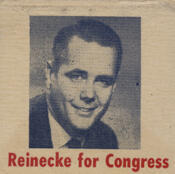
Here you will find contact information for Representative Edwin Reinecke, including email address, phone number, and mailing address.
| Name | Edwin Reinecke |
| Position | Representative |
| State | California |
| District | 27 |
| Party | Republican |
| Status | Former Representative |
| Term Start | January 4, 1965 |
| Term End | January 3, 1971 |
| Terms Served | 3 |
| Born | January 7, 1924 |
| Gender | Male |
| Bioguide ID | R000159 |
About Representative Edwin Reinecke
Howard Edwin “Ed” Reinecke (January 7, 1924 – December 24, 2016) was an American politician from California who served three terms as a Representative from California in the United States Congress from 1965 to 1971 and was the 39th lieutenant governor of California from 1969 until his resignation in 1974 in connection with a federal conviction for perjury. A member of the Republican Party, he was associated with the conservative wing of California Republican politics and played a visible role in state and national affairs during a turbulent period in American history.
Reinecke was born in Medford, Oregon, on January 7, 1924. His family later moved to Southern California, where he graduated from Beverly Hills High School in 1942. During World War II, he served in the United States Navy as a radioman, contributing to the war effort in a technical communications role. After his military service, he pursued higher education at the California Institute of Technology, from which he graduated in 1950 with a degree in mechanical engineering. Following his graduation, he entered private enterprise and, together with his sister Charlotte and his brothers Fred and Bill, founded FEBCO, a manufacturing company based in Southern California, reflecting his engineering background and entrepreneurial interests.
Reinecke’s political career developed against the backdrop of the postwar growth of California and the rise of modern conservatism within the Republican Party. He was elected to the U.S. House of Representatives as a Republican from California and served in Congress between 1965 and 1969, completing three terms in office. His service in Congress occurred during a significant period in American history marked by the civil rights movement, the escalation of the Vietnam War, and major domestic policy debates. As a member of the House of Representatives, he participated in the democratic process and represented the interests of his constituents in California, contributing to the legislative process over the course of his tenure.
During his time in the House, Reinecke served on the Interior Committee, where he worked on issues affecting the American West, including efforts to preserve Western rivers. He was involved in debates over proposed dam projects, notably those that would have affected the Colorado River within the Grand Canyon, and he supported measures aimed at protecting those natural resources. In the realm of civil rights legislation, he voted in favor of the Voting Rights Act of 1965. He also voted for the initial House resolution for what became the Civil Rights Act of 1968, although he later voted against accepting the final Senate amendments to that Act, reflecting the complex and often contentious legislative negotiations of the era.
Reinecke’s congressional service led directly to his elevation to statewide office. In 1969, President Richard Nixon appointed California’s lieutenant governor, Robert Finch, to serve as U.S. Secretary of Health, Education, and Welfare. To fill the resulting vacancy, Governor Ronald Reagan appointed then-Congressman Reinecke as lieutenant governor on January 9, 1969. He was subsequently elected in his own right and re-elected to the office in 1970. As lieutenant governor, he became a prominent figure in California politics and a key ally of Reagan, aligning himself with the conservative faction of the state Republican Party and positioning himself as a potential successor to the governor.
In 1974, when Governor Reagan chose not to seek a third term, Reinecke entered the race for the Republican nomination for governor of California. Running as a conservative alternative to the more moderate State Controller, Houston Flournoy, he initially enjoyed strong support from conservative activists and held an early lead in the primary campaign. He secured the endorsement of the California Republican Assembly, a leading conservative organization in the state. However, his campaign was soon overshadowed by legal troubles arising from the broader Watergate-era investigations into political conduct at the federal level.
Reinecke’s legal difficulties stemmed from his 1972 testimony before the United States Senate during the confirmation hearings for Richard Kleindienst, President Nixon’s nominee for Attorney General. The Senate Judiciary Committee questioned Reinecke about an offer by Sheraton Hotels, a division of ITT Inc., then under federal antitrust investigation, to underwrite the 1972 Republican National Convention. The committee sought to determine whether he had discussed the offer with Attorney General John N. Mitchell before or after ITT settled its case with the government. Reinecke told Senator Hiram Fong that the conversation with Mitchell had occurred after the settlement, despite an earlier statement to a reporter indicating that the conversation had taken place several months earlier. On April 3, 1974, a federal grand jury indicted him for perjury, an offshoot of the broader Watergate-related inquiries.
Despite the indictment, Reinecke remained in the gubernatorial race but was defeated in the Republican primary by Flournoy, who later lost the general election to Democrat Jerry Brown. In July 1974, Reinecke was convicted of perjury in federal court. California law barred anyone convicted of perjury from holding public office in the state, but the state attorney general ruled that this prohibition would not take effect until formal sentencing. Reinecke refused to resign immediately and continued to serve as lieutenant governor until October 2, 1974, when he was sentenced to an 18‑month suspended term and resigned from office the same day. On December 8, 1975, an appeals court overturned his conviction, ruling that the Senate Judiciary Committee before which he had testified had failed to publish its rule permitting a one-man quorum, a procedural defect that undermined the basis for the perjury charge.
In his later years, Reinecke focused on business and ranching interests in California. He married Jean Hrabec, a former model who used the pseudonyms Jean Mills and Keith Kierrgan. The couple owned the Diamond R Ranch on Bucks Bar Road in Placerville, California, where they became the first ranchers to import and breed Charolais cattle in El Dorado County. Expanding their ventures beyond ranching, they opened the restaurant “Zachary Jacques” in 1981, which became known locally for its prime rib and live musical entertainment. They also operated a real estate brokerage firm, Reinecke Realty Residential, reflecting a continued engagement with private enterprise after his departure from elective office.
Howard Edwin “Ed” Reinecke died of natural causes on December 24, 2016, in Laguna Hills, California, at the age of 92. His long life spanned military service in World War II, a career in engineering and manufacturing, three terms in the United States House of Representatives, and a tenure as lieutenant governor of California that intersected with some of the most consequential political controversies of the late twentieth century.