Representative Edwin Hanson Webster
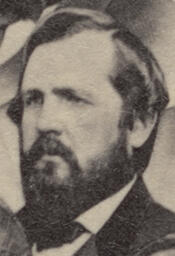
Here you will find contact information for Representative Edwin Hanson Webster, including email address, phone number, and mailing address.
| Name | Edwin Hanson Webster |
| Position | Representative |
| State | Maryland |
| District | 2 |
| Party | Unconditional Unionist |
| Status | Former Representative |
| Term Start | December 5, 1859 |
| Term End | March 3, 1867 |
| Terms Served | 4 |
| Born | March 31, 1829 |
| Gender | Male |
| Bioguide ID | W000239 |
About Representative Edwin Hanson Webster
Edwin Hanson Webster (March 31, 1829 – April 24, 1893) was a U.S. Congressman from Maryland who represented the state’s 2nd congressional district during the tumultuous years surrounding the American Civil War. A member at various times of the American Party, the Unionist Party, and the Unconditional Unionist Party, he served in the United States House of Representatives from March 4, 1859, until his resignation in July 1865, completing four terms in office. His career combined law, state and national politics, military service, and later federal administrative and banking roles.
Webster was born on March 31, 1829, near Churchville, Harford County, Maryland, to Henry Webster and Martha (née Hanson) Webster. He received a classical education, attending the Churchville Academy in his native county and later the New London Academy in Chester County, Pennsylvania. He then enrolled at Dickinson College in Carlisle, Pennsylvania, from which he graduated in 1847. After college, Webster taught at a classical school near his father’s home for about eighteen months while reading law in the office of Otho Scott in Bel Air, Maryland. He was admitted to the bar in 1851 and commenced the practice of law in Bel Air, forming a partnership with Stevenson Archer that lasted for four years.
Even before his formal admission to the bar, Webster entered public life. In 1851 he was nominated by the Whig Party for the office of state’s attorney, but he was narrowly defeated by William H. Dallam by a margin of ten votes. He soon turned to legislative politics and was elected to the Maryland Senate, defeating Ramsey McHenry. Webster served in the state senate from 1855 to 1859 and was chosen president of that body in 1856. Also in 1856, he served as a presidential elector, further establishing his prominence in Maryland political affairs on the eve of the Civil War.
Webster’s national career began with his election to the U.S. House of Representatives. He was first elected as a candidate of the American Party (Know Nothing) to the Thirty-sixth Congress, again defeating Ramsey McHenry, and took his seat on March 4, 1859, representing Maryland’s 2nd congressional district. As the sectional crisis deepened, he aligned with the Unionist cause, winning reelection as a Unionist to the Thirty-seventh Congress and as an Unconditional Unionist to the Thirty-eighth and Thirty-ninth Congresses. His service in Congress thus extended from 1859 to 1867, though he resigned his seat in July 1865. During his tenure, he participated in the legislative process at a time of national upheaval and represented the interests of his Maryland constituents as the state navigated its divided loyalties. He twice declined appointments as a brigadier general and, in Congress, supported key wartime measures, including voting for the abolition of slavery in the United States.
In addition to his legislative duties, Webster played an active role in the Union war effort. During the American Civil War, he helped organize Maryland troops and, in the summer of 1862, recruited the 7th Maryland Infantry Regiment. He entered the Union Army as colonel of that regiment. On January 1, 1863, he relinquished command of the 7th Maryland to Charles E. Phelps in order to return to his congressional duties. After a short session of Congress, he again assumed command of the regiment on March 4, 1863. He resigned his military commission in September (other accounts place the resignation in December) after securing reelection to Congress, returning full-time to legislative service. In the summer of 1864, following the Confederate invasion of Maryland, Webster offered his services to Governor Augustus Bradford, who appointed him to draft a military code for the Maryland state militia, a task he completed in 1864.
Webster’s congressional service concluded in the immediate aftermath of the Civil War. He was again elected to the House in November 1864 as an Unconditional Unionist to the Thirty-ninth Congress and continued to represent Maryland’s 2nd district. He resigned his seat in July 1865, shortly after the war’s end, having served through four consecutive terms during one of the most consequential periods in American history. His tenure encompassed the secession crisis, the conduct of the war, and the early stages of Reconstruction policy, and he was identified throughout as an unwavering supporter of the Union.
Following his resignation from Congress, Webster moved into federal administrative service and private enterprise. On July 27, 1865, President Abraham Lincoln appointed him collector of customs at the Port of Baltimore, a significant federal post in a major commercial city. A list of Maryland appointments, including Webster’s, was found in Lincoln’s pocket at the time of the president’s assassination. Webster served as collector of customs from July 27, 1865, to April 15, 1869, after which he resumed the practice of law in Bel Air. He was again appointed collector of customs at Baltimore by President Chester A. Arthur on February 17, 1882, and held that office until February 23, 1886. Beginning in 1882, he also engaged in banking, and in his later years he served as president of the Harford National Bank in Harford County, Maryland, a position he held until his death.
In his personal life, Webster married Caroline H. (née McCormick) Earl in June 1855. The couple had at least four children: J. Edwin, Ida M., Bessie, and Caroline H. His daughter Bessie married William H. Harlan, a Bel Air educator and law partner of Webster’s son J. Edwin, thereby extending the family’s involvement in local legal and educational affairs. Edwin Hanson Webster died in Bel Air, Maryland, on April 24, 1893. He was interred in Calvary Cemetery near Churchville, close to the area where he had been born and where he had first embarked on his career in law and public service.